Is there a Dreaming Spanish for Arabic? The honest answer is yes and no, and I'm in an unusual position to give it, because I acquired Spanish through comprehensible input, and then built Arabic All The Time because the Arabic equivalent did not exist. Dreaming Spanish works because it takes Stephen Krashen's comprehensible input research at the University of Southern California seriously and refuses to compromise on it: leveled video you can understand from day one, hours as the unit of progress, no grammar drills, no forced speaking. That approach transfers to Arabic completely. The catalog does not, at least not yet. No Arabic platform on earth has a library the size of what Dreaming Spanish built for Spanish over years, and anyone telling you otherwise is marketing to you. What does exist is a platform built openly on the same lineage, designed around the two problems Spanish never had to solve: Arabic's two registers and its script. In this post I'll cover why Dreaming Spanish works, why Arabic never got its version until recently, what the research says about video input for Arabic, and exactly what Arabic All The Time is and honestly isn't yet.
Why Dreaming Spanish Works (It's the Approach, Not Magic)
Dreaming Spanish did not invent its approach. It inherited it. The lineage runs back to Marvin Brown, who founded the Automatic Language Growth program at the AUA Language Center in Bangkok, where learners acquired Thai through hundreds of hours of understandable listening before ever being asked to speak. David Long, who directed that program for decades, kept demonstrating the same result: comprehension first, speech after. That's where I part ways with the tradition. Comprehension first, yes. But speech doesn't come free. It takes its own practice.
Pablo Román built Dreaming Spanish on those principles and on Krashen's research, and tens of thousands of learners have used it since. The design choices all serve one number: hours of comprehensible input at your level. Super Beginner content a true beginner can follow through gestures and drawings. Levels that rise with you. A roadmap measured in hours, not lessons completed.
Strip away the branding and the product is simple: comprehensible input, delivered at volume, with the discipline to not add the stuff that feels productive but isn't. That's the whole secret, and the research behind it is four decades deep.
Why Arabic Never Got Its Dreaming Spanish
Two reasons, and neither is that Arabic learners don't exist.
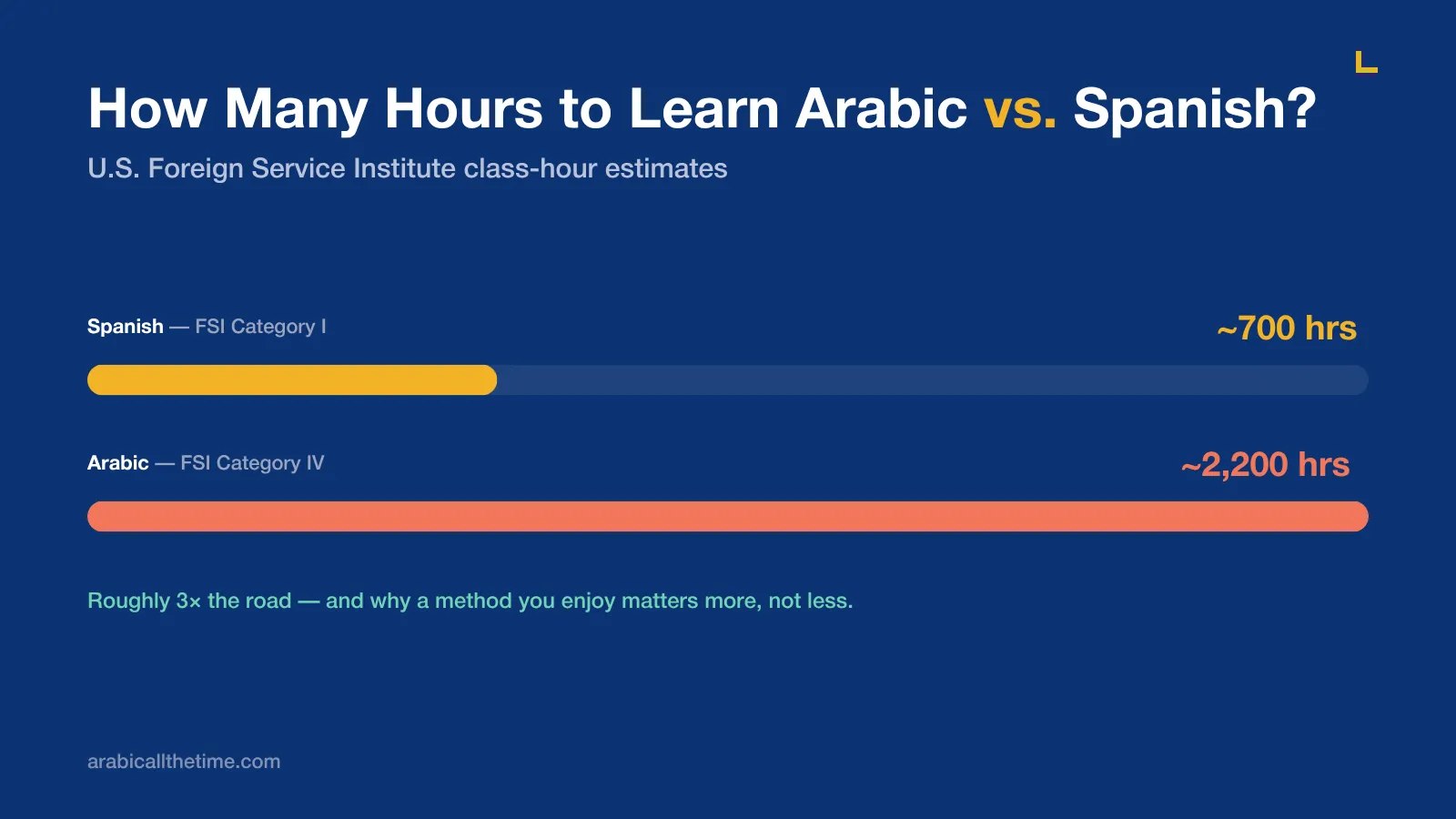
First, economics. The U.S. Foreign Service Institute classifies Arabic as Category IV, estimating around 2,200 class hours to professional proficiency, versus roughly 600 to 750 for Spanish. A longer journey means a smaller pool of learners who stick around, which means fewer creators willing to build a massive leveled library for them. Spanish got dozens of input channels. Arabic got scraps.
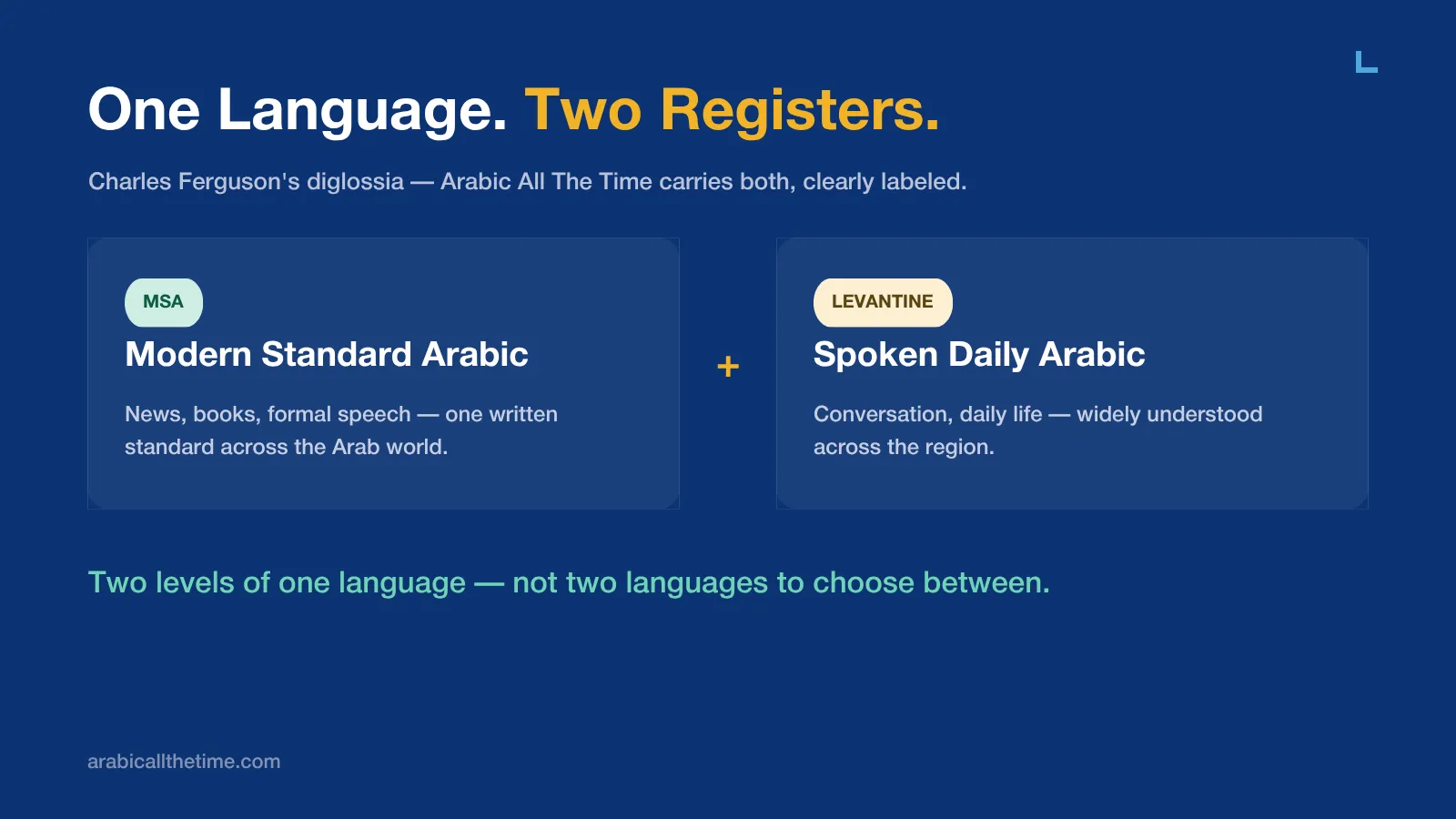
Second, diglossia. Charles Ferguson at Stanford University described it in his foundational 1959 paper: Arabic operates on two registers, the spoken varieties of daily life and Modern Standard Arabic for news, books, and formal speech. A Spanish input library needs one Spanish. An Arabic input library has to handle both registers honestly or it fails learners at the door. Most creators picked one lane, and learners were left confused about which Arabic to even start with.
So people who finished their Dreaming Spanish journey and typed "Dreaming Spanish for Arabic" into Google found Reddit threads, scattered YouTube channels, and no platform. I know because I was one of them.
The Research Says Video Input Works for Arabic Too
Nothing about Arabic exempts it from input research. Stuart Webb's research at Western University analyzed the vocabulary demands of television and showed how sustained viewing delivers the repeated encounters vocabulary acquisition requires. Elke Peters at KU Leuven, working with Webb, then demonstrated measurable incidental vocabulary acquisition from watching level-appropriate television in a second language. Video is not a fun supplement to real study. Video is the delivery mechanism.
For Arabic specifically, listening-first carries an extra payoff. James Flege's Speech Learning Model shows that the sound categories you build early determine your pronunciation ceiling, and Arabic has sounds English ears have never had to distinguish. Hundreds of hours of listening before speaking protects you from cementing wrong versions of them, which is why your ears come before your mouth here.
And the volume question is just arithmetic, not mystery. Arabic needs more hours than Spanish, so the approach that made hours pleasant and countable for Spanish is even more necessary for Arabic, not less. Paul Nation's research at Victoria University of Wellington on vocabulary growth through input makes the same point from the other side: acquisition tracks meaningful encounters, and encounters track hours.
What an Arabic Version Has to Solve That Spanish Didn't
Both registers in one library. That's non-negotiable. Arabic is one language with regional varieties, and a serious platform carries Modern Standard Arabic and a spoken variety side by side, labeled clearly, so you can build the Arabic you need and see how the two relate. We chose Levantine as the spoken track because it's widely understood across the region.
No alphabet gate. Dreaming Spanish never had a script problem, but Arabic resources traditionally lock the language behind letters first. Input-first flips that: you listen from minute one, and reading enters later, once your acquired vocabulary can carry it. I mapped that transition in Krashen's 1,500-word threshold.
A more patient ramp. Super Beginner Arabic has to work harder than Super Beginner Spanish, because English gives you free cognates in Spanish and almost none in Arabic. That means more visuals, slower speech, more repetition, and content designed for genuinely zero prior knowledge.
What Arabic All The Time Is (and Honestly Isn't Yet)
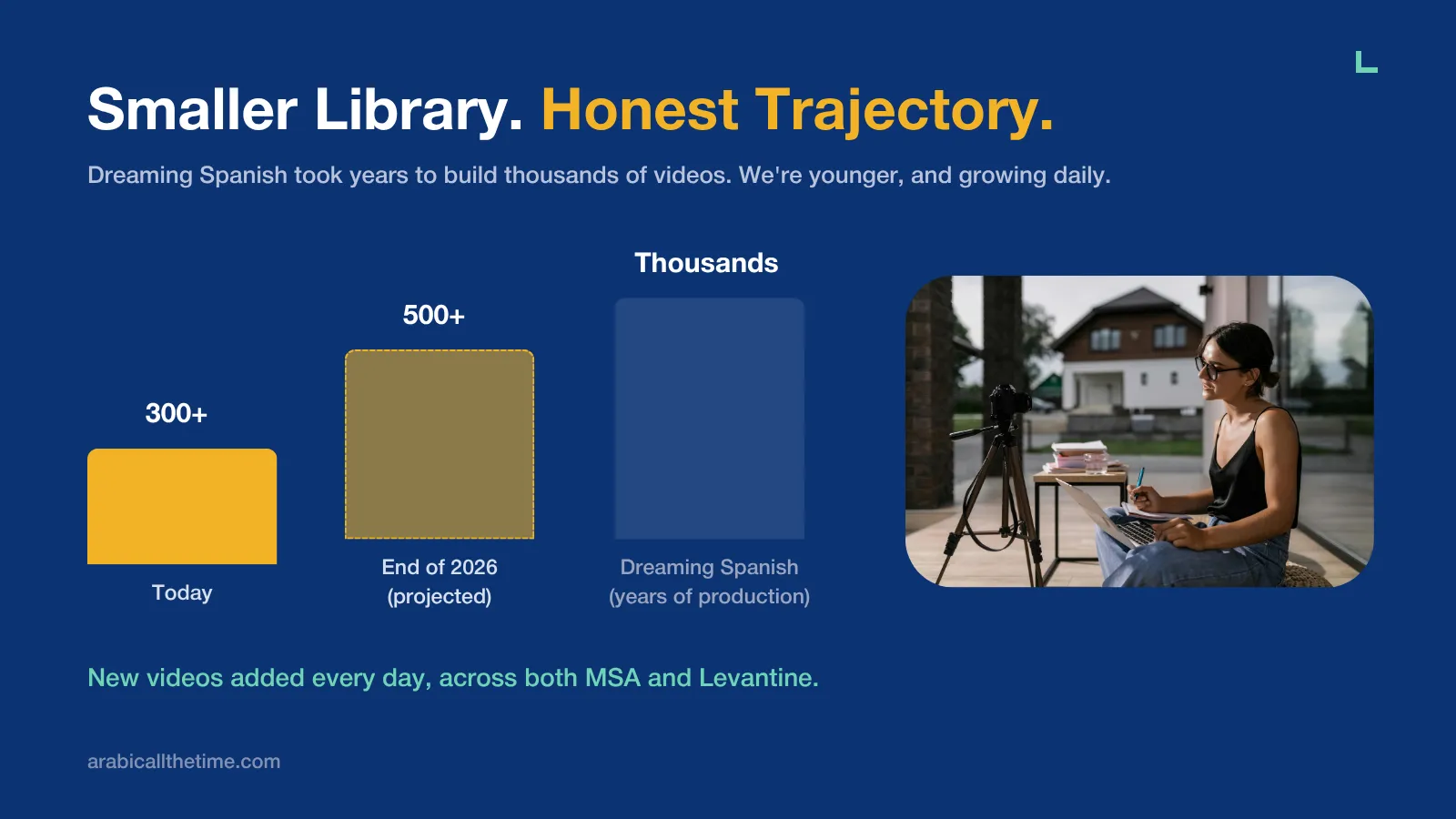
Arabic All The Time is the closest thing Arabic has to Dreaming Spanish, and it's built openly on the same lineage: Krashen's research, Brown's ALG, and my own years as a Dreaming Spanish learner. The library has hundreds of videos from Super Beginner through Advanced, in both MSA and Levantine, with a new video added every day. There are free videos at every level, not as a trial but as a trust builder, so you can verify the approach with your own ears before paying anything. I made the full case for the platform in What is Arabic All The Time.
Now the honest part. Dreaming Spanish has a library measured in thousands of videos, built over years by many presenters. We are younger and smaller, and I won't pretend otherwise. What I can tell you is the trajectory: a new video every day, with the library compounding the same way theirs did. Levantine and MSA are the focus today. Egyptian is on the long-term roadmap, and I'd rather tell you that plainly than dangle it.
One thing we have that Dreaming Spanish learners always wished for: crosstalk with a native speaker. Brown considered live two-way comprehensible conversation core to ALG, and it remains the most efficient input format I know, because the Arabic is calibrated to you in real time.
How to Use It Like You Used Dreaming Spanish
Same playbook, adjusted for the longer road. Pick your level by comfort, not ambition: if you follow 80 to 90 percent through visuals and context, you're placed right. Count hours, not lessons. Watch daily, don't rush into speaking, skip the grammar apps. If you did Dreaming Spanish, your habits transfer one to one, and I wrote a day-by-day plan for the first 30 days if you want the exact on-ramp.
Set your expectations with FSI's numbers, not with app-store promises. Arabic is a longer journey than Spanish, roughly three times longer by the government's own estimates, and I've laid out honest timelines here. The learners who make it are the ones who knew that going in and chose an approach they could enjoy for that long.
Try a Free Crosstalk Session
If crosstalk is the piece you always wished Dreaming Spanish had, try it. Your first session is free, a 30-minute one, in either Levantine Arabic or Modern Standard Arabic. You speak English. I speak Arabic. We talk about pictures, your daily life, topics you're curious about, and I adjust the Arabic in real time so the input stays comprehensible.
It's live comprehensible input, calibrated to your exact level, which is the thing no video library can fully replicate. Book a free session here.
Frequently Asked Questions
Is there a Dreaming Spanish for Arabic?
Yes in approach, not yet in scale. What Dreaming Spanish does, leveled video comprehensible input built on Stephen Krashen's research and Marvin Brown's Automatic Language Growth program, exists for Arabic at Arabic All The Time: hundreds of videos from Super Beginner through Advanced in both MSA and Levantine, growing daily. What no Arabic platform has yet is a catalog the size Dreaming Spanish built for Spanish over years. The honest answer is that the Arabic version exists and is compounding, and the approach transfers completely.
What is the closest equivalent to Dreaming Spanish for Arabic?
Arabic All The Time is the closest equivalent: a video platform built entirely around comprehensible input, with leveled content from Super Beginner up, hours as the unit of progress, free videos at every level, and daily releases. It was built by a Dreaming Spanish learner, me, after acquiring Spanish that way, purely by listening, specifically because no Arabic equivalent existed. It also adds two things Arabic requires that Spanish didn't: both registers, MSA and Levantine, in one library, and a listening-first design with no alphabet gate.
Does the Dreaming Spanish approach work for Arabic?
Yes. The engine is comprehensible input, and the evidence for it spans four decades and many languages, as Krashen's research at USC established. Stuart Webb's viewing research at Western University and Elke Peters's studies at KU Leuven show measurable vocabulary acquisition from level-appropriate video specifically. Arabic changes the arithmetic, not the mechanism: FSI's Category IV classification means more hours are required than for Spanish, which makes an enjoyable, sustainable way of getting input more important for Arabic, not less.
How many hours of Arabic input do I need compared to Spanish?
Plan for roughly three times the road. The U.S. Foreign Service Institute estimates around 600 to 750 class hours for Spanish and around 2,200 for Arabic, its Category IV tier. Those are classroom figures, not input figures, but the ratio is the honest planning number. I won't promise fluency at any hour count, because honest resources don't. What I can say is that the milestones arrive in the same order they did in Spanish, spaced further apart, and reaching them through input you actually enjoy is a transformative experience. The roadmap has the full ladder.
Do I need to learn the Arabic alphabet before starting input?
No. This is the biggest false gate in Arabic learning. Krashen's research shows acquisition runs on understood messages, and understanding comes through your ears and eyes long before it comes through script. James Flege's Speech Learning Model adds the pronunciation argument: early listening builds accurate sound categories for Arabic's unfamiliar sounds before reading habits can distort them. Start listening on day one. Add reading later, around the vocabulary threshold Krashen and Paul Nation describe, when the language underneath the letters is already alive.
Should I watch MSA or Levantine videos first?
It depends on your goal, and the good news is you don't have to choose forever. If your target is conversation with people, lead with Levantine. If it's media, books, and formal understanding, lead with MSA. Charles Ferguson's diglossia framework explains why both registers matter: they're two levels of one language, not two languages. Most serious learners end up running both tracks in parallel, which is exactly why Arabic All The Time keeps them in one library with clear labels.
Does Arabic All The Time have free videos?
Yes, at every level, permanently. They exist as trust builders, not as a trial, because we offer no trial period and no refunds and I want you fully convinced before you pay. Premium unlocks the full library, hundreds of videos across MSA and Levantine with a new one every day, at $24.99 a month or $179.88 a year, which works out to $14.99 a month. My standing advice is to spend your first week entirely on free videos and let your own comprehension make the decision.
What levels does Arabic All The Time have?
Super Beginner through Advanced, aligned with the CEFR range from A1 to C1. Super Beginner assumes zero Arabic and carries meaning through visuals, gestures, and slow, clear speech, the same design philosophy that makes Dreaming Spanish's lowest level work. Each level up reduces the scaffolding and raises the natural speed. The placement rule is comfort: watch at the level where you follow 80 to 90 percent of the meaning, and move up when that starts feeling easy.
What is crosstalk?
Crosstalk is a conversation where each person speaks their own language: you speak English, I speak Arabic, no switching and no translation. It comes from Marvin Brown's Automatic Language Growth work in Bangkok and it's the purest input format there is, because the Arabic adjusts to your comprehension in real time. It also removes all speaking pressure, which keeps Krashen's affective filter low. The first session is free (30 minutes), in Levantine or MSA, and follow-up sessions run $45 per 50 minutes, or $400 for ten.
Will Arabic All The Time add Egyptian Arabic?
It's on the long-term roadmap, and I want to be straight with you: it is not imminent. Building a leveled input library for a variety takes years of daily work, and our focus today is deepening MSA and Levantine. If Egyptian is your family's variety, the MSA track serves you fully now, and Levantine will feel far more familiar than you might expect, since the spoken varieties share a large common core. When Egyptian production actually begins, I'll say so plainly rather than dangle it.
The Bottom Line
The question behind "is there a Dreaming Spanish for Arabic" is really "can I acquire Arabic the way I acquired Spanish, by watching things I understand." The research answer is yes. Krashen's input framework, Brown's ALG results, and the viewing studies from Webb and Peters all point the same direction, and nothing about Arabic breaks the mechanism. Arabic only raises the required volume.
What Arabic lacked until recently was the delivery system: a leveled video library patient enough for a true beginner, honest enough to carry both registers, and disciplined enough to skip the drills. That's the gap I built Arabic All The Time to fill, after my own time as a Dreaming Spanish learner taught me exactly what the experience should feel like.
I'll keep being honest about scale. We are not thousands of videos deep yet. We are hundreds of videos in and growing every single day, with the same compounding curve Dreaming Spanish rode years ago. If you need a finished cathedral, wait. If you want the approach now, with free videos to prove it to yourself and a founder you can actually book a session with, it's here.
Either way, this is no longer Spanish-only. That era is over.
Start watching free Arabic comprehensible input videos · Book a free crosstalk session · Read: What is Arabic All The Time?
References
Brown, J. M. (n.d.). From the outside in. AUA Language Center.
Ferguson, C. A. (1959). Diglossia. Word, 15(2), 325 to 340.
Flege, J. E. (1995). Second language speech learning: Theory, findings, and problems. In W. Strange (Ed.), Speech perception and linguistic experience: Issues in cross-language research (pp. 233 to 277). York Press.
Krashen, S. D. (1982). Principles and practice in second language acquisition. Pergamon Press.
Nation, I. S. P. (2013). Learning vocabulary in another language (2nd ed.). Cambridge University Press.
Peters, E., & Webb, S. (2018). Incidental vocabulary acquisition through viewing L2 television and factors that affect learning. Studies in Second Language Acquisition, 40(3), 551 to 577.
U.S. Department of State, Foreign Service Institute. (n.d.). Foreign language training: Language difficulty rankings.
Webb, S., & Rodgers, M. P. H. (2009). Vocabulary demands of television programs. Language Learning, 59(2), 335 to 366.