How to Use Arabic All The Time: Your First 30 Days (Week-by-Week Plan)
By Hasan Alhamwi

This is exactly how to use Arabic All The Time in your first 30 days. Not a feature tour. A realistic week-by-week plan for what to watch, how long to watch it, and what progress should actually feel like, because the first month is where most language learners quit. Phillippa Lally's research at University College London found that new habits take 66 days on average to become automatic, which means your first 30 days have one real job: building the daily habit that carries everything else. The approach itself is simple. You watch Arabic you can understand, every day, at the right level, and acquisition happens as a byproduct of comprehension. That is Stephen Krashen's Input Hypothesis in one sentence, and four decades of research back it. The hard part is trusting the process during the weeks when it feels like nothing is happening. So this guide covers both the plan and the psychology: the doubt week, the honest day-30 milestones, and the four mistakes that stall almost every beginner. I built Arabic All The Time around this after acquiring Spanish the same way. Here is how I would use it if I were starting Arabic today.
Before Day 1: Pick Your Starting Level Honestly
Everything here depends on one thing: you must understand what you're watching. Krashen calls the target i+1, input slightly above your current level. Not far above. Slightly.
So before day one, run a two-minute test. Open a Super Beginner video. If you comfortably follow 80 to 90 percent of the meaning through the visuals, gestures, and context, move up a level and test again. If you're lost, that is your level, and there is zero shame in it. Super Beginner exists because every Arabic learner on earth starts there.
Complete beginners: start at Super Beginner, full stop. If you grew up hearing Arabic at home, you're not a beginner and shouldn't start like one. I wrote a separate guide for heritage speakers, because your path is genuinely different. And if you have classroom Arabic from years ago, test honestly. Most people with old classroom Arabic overestimate their listening level, because classrooms build reading and rules, not ears.
Then pick your track. MSA, Levantine, or both together. If you're unsure, I made the full case here, but don't let this decision delay day one. You can adjust anytime.

Week 1 (Days 1 to 7): Build the Anchor
Twenty to thirty minutes a day. That's it. Not two hours. The goal this week is not progress. It's the anchor.
BJ Fogg's habit research at Stanford University shows new behaviors stick when they attach to something you already do daily. Watch with your morning coffee. Watch on the commute. Watch right after you put the kids down. Wendy Wood's research at the University of Southern California adds the second half: habits live in context, so same time, same place, every day. Your brain should start expecting Arabic the way it expects the coffee.
While watching, your only job is to follow the meaning. Don't pause to translate. Don't take notes. Don't repeat words out loud. Understanding through pictures, gestures, and story is not a workaround for beginners. It is the mechanism itself. Every moment you understand a message, acquisition is happening, whether it feels like it or not.
By day three or four you'll notice you can follow full videos without understanding every word. Good. That's the system working.

Week 2 (Days 8 to 14): The Doubt Week
I'm warning you now because it happens to almost everyone. Around week two, your brain demands evidence. You can't list the words you've "learned." You can't produce a sentence. So it feels like you're failing.
You're not, and the neuroscience explains why. Michael Ullman's research at Georgetown University shows that real language competence builds largely in procedural memory, the same implicit system that learns to ride a bike. Procedural learning is invisible to introspection. You cannot feel it forming, the same way you can't feel your legs getting stronger during a single run. I went deep on this in Your Brain on Arabic, and it's the single most useful thing to understand in week two.
There's also simple math. Paul Nation's vocabulary research at Victoria University of Wellington shows a word needs roughly 8 to 12 meaningful encounters before it's truly yours. In week two, most of your words are sitting at encounter three. The feeling of "nothing is sticking" is just a word that's three meetings into a twelve-meeting process. Keep showing up to the meetings.
Whatever you do, don't add flashcards to fix the feeling. Here's why that backfires.

Week 3 (Days 15 to 21): Raise the Volume
If 20 to 30 minutes feels comfortable, push toward 45 or 60 on the days you can. Volume drives everything here. More comprehensible input means more encounters per word, more sentences heard, more of the language settling into place.
Rewatching counts. A video you've seen before delivers input at even higher comprehension, which is exactly what Nation's encounter research says you want. Rewatch freely and without guilt.
And protect your sleep. Matthew Walker's research at UC Berkeley and Robert Stickgold's work at Harvard Medical School show that memory consolidation happens during sleep, especially for procedural learning. This is one more reason daily beats binging: thirty minutes followed by a night of sleep, repeated thirty times, consolidates far better than one heroic Sunday.
Week 4 (Days 22 to 30): The First Click Moments
Here's what honestly happens by day 30 if you've watched daily. You'll have 10 to 15 hours of input. Super Beginner videos that felt fast on day one will feel slow. You'll catch the shape of sentences before you catch every word. A handful of words will simply be yours, no translation step, no effort. And Arabic will have stopped sounding like a wall of sound.
Here's what does not happen by day 30: conversations, reading the news, impressing your in-laws. Anyone promising that in a month is selling something. Arabic is one of the longest journeys an English speaker can take, and I'd rather you know that on day one than discover it on day 40. For the full honest map, see how many hours Arabic actually takes.
One more thing you should not do yet: speak. Not because speaking is bad for you, but because at 10 hours of input you have nothing to practice with. Speaking is a real skill that needs its own practice, and that practice is worth far more once you understand enough to build a sentence. Your first 30 days are for your ears. Here is why not to speak too early.

The Four Mistakes That Stall Beginners
Starting too high. Ego picks Intermediate, comprehension collapses, and the approach stops working because the approach is comprehension. Drop your level until it feels almost easy.
Translating in your head. If you pause every sentence to convert it to English, you're studying, not acquiring. Let meaning arrive through the visuals. Fuzzy understanding that flows beats perfect understanding that stalls.
Adding grammar study "to be safe." Beniko Mason's research at Shitennoji University, much of it with Krashen, found input-based approaches consistently outperform form-focused study per hour spent. Splitting your 30 minutes with a grammar app just moves time into the low-yield channel.
Skipping days, then binging. Lally's habit research has good news here: missing a single day doesn't derail habit formation. But irregular patterns never form one. Miss a day, shrug, watch tomorrow. Never double up to compensate.
Free Videos, Premium, and What I Recommend
Arabic All The Time has free videos at every level. They're not a teaser and they're not a trial. They exist so you can verify, with your own ears, that this works for you before paying anything. We offer no trial period and no refunds, so I genuinely want you to use the free videos until you're sure.
Premium unlocks the full library, hundreds of videos from Super Beginner through Advanced across MSA and Levantine, with new videos added daily. It's $24.99 a month, or $179.88 a year, which works out to $14.99 a month.
My honest recommendation: do your first week entirely on free videos. If you finish a video wanting the next one, you have your answer.
Try a Free Crosstalk Session
The other thing I'd do in your first 30 days is book one crosstalk session, because it's comprehensible input calibrated to you personally, in real time. Your first session is free, a 30-minute one, in either Levantine Arabic or Modern Standard Arabic. You speak English. I speak Arabic. We talk about pictures, your daily life, topics you're curious about, and I adjust the Arabic in real time so the input stays comprehensible.
It's also the fastest way to confirm your level placement, because I'll hear exactly where your comprehension sits. Book a free session here.
Frequently Asked Questions
How do I start with Arabic All The Time?
Run the level test first: open a Super Beginner video and check whether you comfortably follow 80 to 90 percent through the visuals and context. Move up until that comfort disappears, then settle one level below. Pick MSA, Levantine, or both. Then anchor a daily 20 to 30 minute watching slot to something you already do, following BJ Fogg's habit research at Stanford. Start on the free videos. That's the entire setup. The whole thing is watching Arabic you understand, every day.
How many minutes a day should I watch?
Start with 20 to 30 minutes daily and grow toward 45 to 60 by week three if it feels comfortable. Consistency beats volume in the first month. Phillippa Lally's research at University College London shows habits form through daily repetition over roughly two months, and Matthew Walker's sleep research at UC Berkeley shows each night of sleep consolidates what you took in. Thirty minutes daily with thirty nights of sleep outperforms a single four-hour weekend session every time.
What level should I start at?
The level where you comfortably understand 80 to 90 percent of the meaning. That comfort is not a nice-to-have. It is the mechanism, because Stephen Krashen's Input Hypothesis shows acquisition happens through understood messages slightly above your level. Complete beginners start at Super Beginner. Heritage speakers usually start at Intermediate for their home variety. People with old classroom Arabic should test their listening honestly, since classrooms build rules and reading rather than ears. When in doubt, go lower.
Should I take notes while watching?
No. Notes convert acquisition into study, and study runs on the wrong memory system. Michael Ullman's research at Georgetown University shows lasting language ability builds in procedural memory through exposure and use, not in the declarative system where notes and lists live. Your job while watching is to follow the meaning, nothing else. If a word matters, the videos will hand it to you again and again until it sticks, which is exactly how Paul Nation's encounter research says vocabulary is actually acquired.
Is Arabic All The Time free?
There are free videos at every level, permanently. They exist as trust builders so you can confirm this works for you before paying, because we offer no trial period and no refunds. Premium unlocks the full library, hundreds of videos across MSA and Levantine with new videos daily, for $24.99 a month or $179.88 a year, which comes to $14.99 a month. My recommendation is to spend your first week on the free videos and let your own experience decide.
Why does it feel like I'm not learning anything?
Because the learning is happening in a system you cannot inspect. Michael Ullman's research at Georgetown shows language competence builds largely in procedural memory, which is implicit by nature. You can't list what it contains, the same way you can't explain how you balance a bike. Add Paul Nation's finding that words need 8 to 12 meaningful encounters, and week-two doubt makes sense: most of your vocabulary is mid-process. The feeling of nothing happening is the normal texture of acquisition.
Should I study grammar or use flashcards alongside the videos?
No, and this is the mistake I see most. Beniko Mason's research at Shitennoji University, with Stephen Krashen, found input-based approaches deliver more acquisition per hour than form-focused study. Flashcards create recognition without ownership, which is why memorized words vanish in real conversation. Grammar comes from thousands of understood sentences, in the right order, without a single drill. If you have extra time and energy, the highest-yield move is always the same: watch another video at your level.
When should I start speaking Arabic?
Not in your first 30 days, and not because speaking will hurt you. It's that speaking practice is expensive and you want to spend it well. Put your hours into listening first, until you understand enough to have something to say. Then give speaking its own short block of practice. That's what turns comprehension into speech, and it won't happen by itself. Crosstalk is the gentlest place to start.
What if I miss a day?
Miss it and move on. Phillippa Lally's habit formation study at University College London found that missing a single day has almost no effect on long-term habit formation. What kills the habit is the spiral after the miss: guilt, then doubling up, then avoidance. So never compensate with a marathon session. Watch your normal 20 to 30 minutes the next day at your normal anchor time. The streak that matters is the loose one measured in weeks, not the perfect one measured in days.
What happens after the first 30 days?
You raise the volume and keep going. Retest your level around day 30, since many people are ready to mix in the next level up. Push toward an hour a day if life allows, because from here progress tracks accumulated hours of comprehensible input. Somewhere in the following months you'll hit the milestones I mapped in the hours guide: following familiar topics with ease, then new topics, then the point where a short block of speaking practice starts paying off. Day 30 isn't a finish line. It's the day the habit starts carrying you.
The Bottom Line
Your first 30 days on Arabic All The Time have one job, and it isn't fluency. It's building a daily input habit at a level you genuinely understand. Lally's research says the habit takes about two months to become automatic, so month one is the foundation pour. Twenty to thirty minutes, anchored to something you already do, at a level that feels almost easy.
The doubt will come around week two, and it will lie to you. Ullman's neuroscience and Nation's encounter math both say the same thing: acquisition is invisible while it's happening. The learners who make it are not the ones who feel constant progress. They're the ones who keep watching through the stretch where they feel nothing.
Resist the urge to add things. No flashcards, no grammar app, no speaking drills yet. Every one of those splits your time into a lower-yield channel and, worse, replaces the pleasant act of watching stories with work. The whole thing survives on being sustainable.
By day 30 you'll have 10 to 15 hours behind you, a habit that mostly runs itself, and the first quiet proof that Arabic is learnable this way: videos that felt fast now feel slow. That's not a small thing. That's the whole engine, already turning.
Start watching free Arabic comprehensible input videos · Book a free crosstalk session · Read: How to Start Learning Arabic as a Complete Beginner
References
Fogg, B. J. (2020). Tiny habits: The small changes that change everything. Houghton Mifflin Harcourt.
Krashen, S. D. (1982). Principles and practice in second language acquisition. Pergamon Press.
Lally, P., van Jaarsveld, C. H. M., Potts, H. W. W., & Wardle, J. (2010). How are habits formed: Modelling habit formation in the real world. European Journal of Social Psychology, 40(6), 998-1009.
Mason, B., & Krashen, S. (2004). Is form-focused vocabulary instruction worthwhile? RELC Journal, 35(2), 179-185.
Nation, I. S. P. (2013). Learning vocabulary in another language (2nd ed.). Cambridge University Press.
Stickgold, R. (2005). Sleep-dependent memory consolidation. Nature, 437(7063), 1272-1278.
Ullman, M. T. (2004). Contributions of memory circuits to language: The declarative/procedural model. Cognition, 92(1-2), 231-270.
Walker, M. (2017). Why we sleep: Unlocking the power of sleep and dreams. Scribner.
Wood, W. (2019). Good habits, bad habits: The science of making positive changes that stick. Farrar, Straus and Giroux.
Related posts
How to Get 2,500 Hours of Arabic Input
The Arabic roadmap runs to 2,500 hours. No library holds them all. Here is where every hour comes from, and how to count them.
Arabic for Heritage Speakers: A Reactivation Plan Backed by Research
If you understand Arabic but freeze when it's your turn to speak, you're not a beginner. The research on heritage speakers, why your Arabic is dormant rather than gone, the two-registers problem you inherited, and the exact plan to reactivate it through input, then give speaking its own short block of practice.
Is There a Dreaming Spanish for Arabic? An Honest Answer (From Someone Who Did Both)
Is there a Dreaming Spanish for Arabic? Yes in method, not yet in scale. Why Dreaming Spanish works, why Arabic never got its version, what the research says about video input for Arabic, and what Arabic All The Time is and honestly isn't yet.

How to Maintain Arabic Fluency (and Get It Back If It Slipped)
Arabic fades without use, and it fades in a predictable order. What the research says about losing a language, what goes first in Arabic, the daily routine that keeps it, and how heritage speakers wake theirs back up.

Krashen's 1,500-Word Threshold: When You're Ready to Read Arabic (Research-Backed)
Krashen's 1,500-word threshold for reading explained — when you're actually ready to read Arabic, why it matters, and how to reach it through comprehensible input.
How Many Hours to Learn Arabic? The Honest Roadmap (FSI + Comprehensible Input)
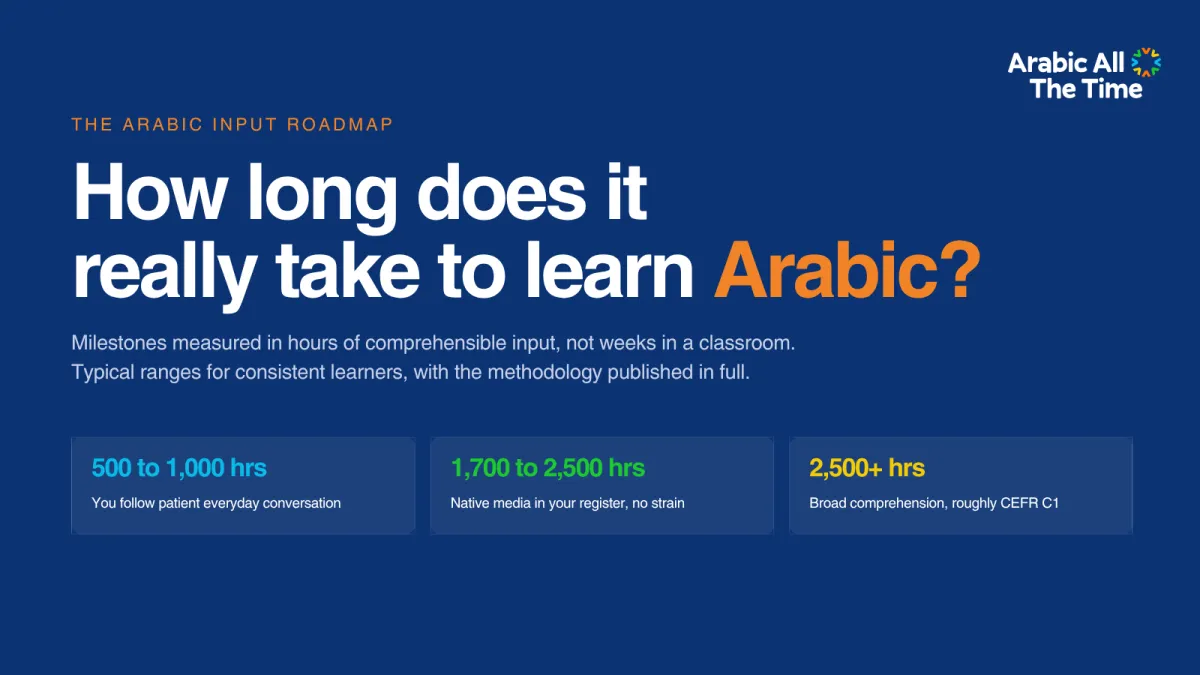
The U.S. Foreign Service Institute estimates 2,200 hours to reach professional Arabic proficiency. Here are the realistic CEFR milestones at each stage of the journey, from 50 hours to 2,200 hours, based on FSI data and comprehensible input research.