Discover how to learn Arabic naturally through comprehensible input.

A realistic week-by-week plan for your first 30 days on Arabic All The Time: how to pick your level, how long to watch, what the doubt week feels like, what honestly happens by day 30, and the four mistakes that stall almost every beginner.

Crosstalk is a conversation where you speak English and your partner speaks Arabic, the whole session, with no translation and no pressure to produce. What it is, where it comes from, why it beats language exchange, what a session actually sounds like, and how to try one free.

Arabs don't think of Arabic as separate dialects — they're accents of one language. Here's an Arab's honest take on where to start and why it matters less than you think.
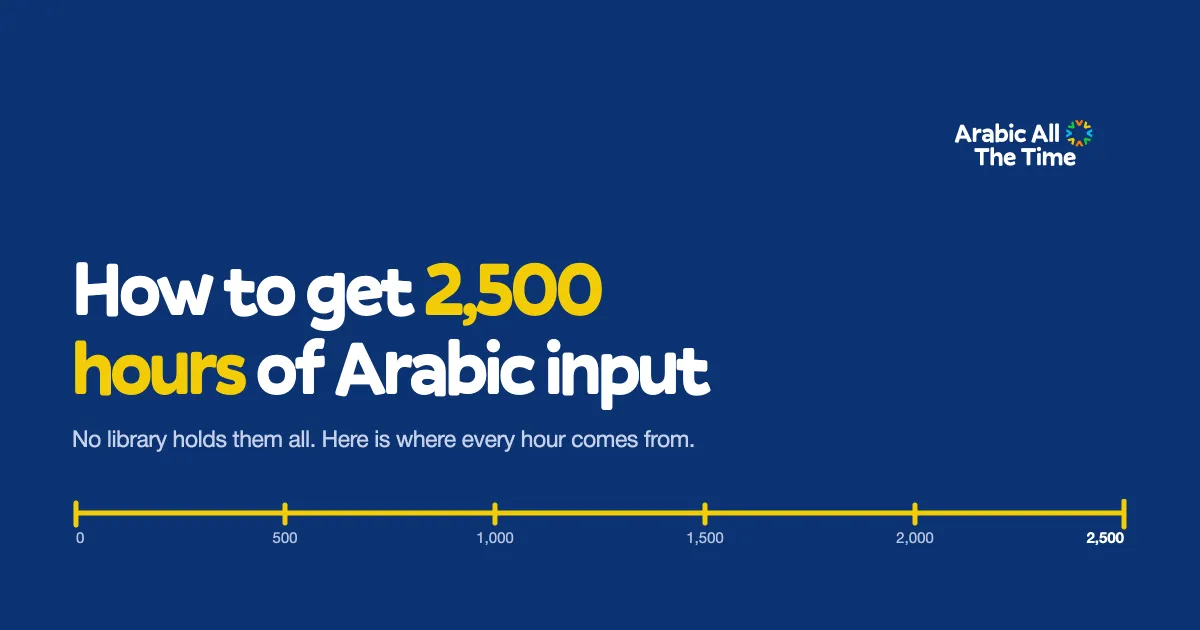
The Arabic roadmap runs to 2,500 hours. No library holds them all. Here is where every hour comes from, and how to count them.
If you understand Arabic but freeze when it's your turn to speak, you're not a beginner. The research on heritage speakers, why your Arabic is dormant rather than gone, the two-registers problem you inherited, and the exact plan to reactivate it through input, then give speaking its own short block of practice.
Is there a Dreaming Spanish for Arabic? Yes in method, not yet in scale. Why Dreaming Spanish works, why Arabic never got its version, what the research says about video input for Arabic, and what Arabic All The Time is and honestly isn't yet.

Arabic fades without use, and it fades in a predictable order. What the research says about losing a language, what goes first in Arabic, the daily routine that keeps it, and how heritage speakers wake theirs back up.

Krashen's 1,500-word threshold for reading explained — when you're actually ready to read Arabic, why it matters, and how to reach it through comprehensible input.
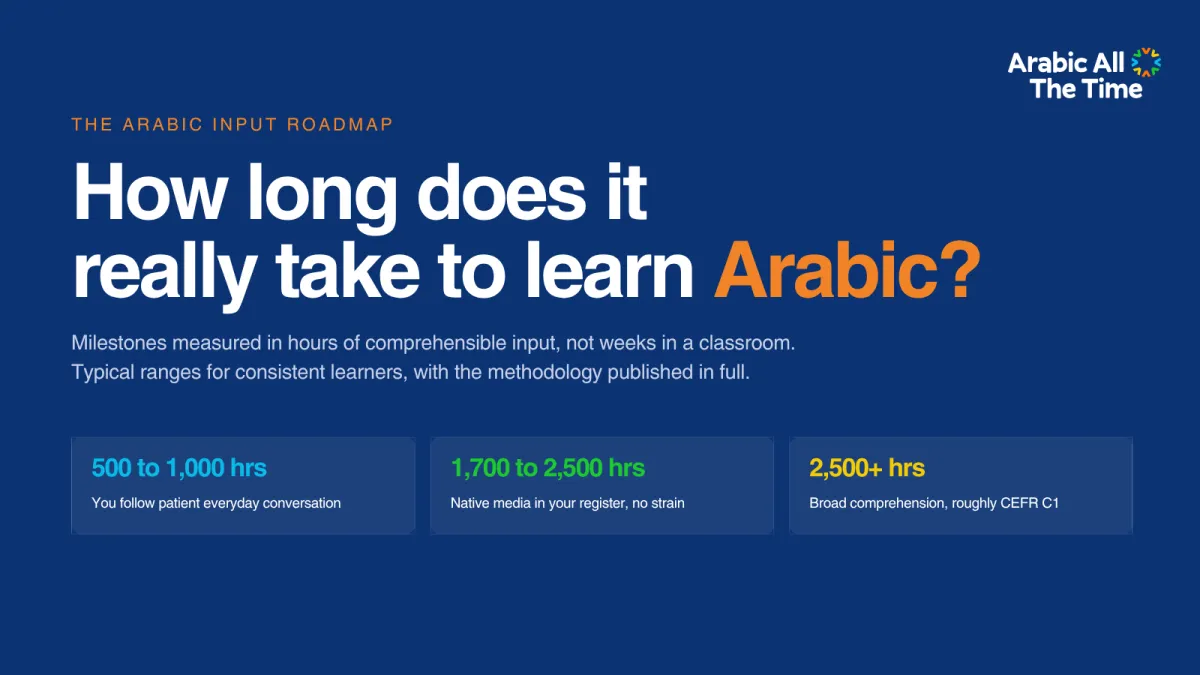
The U.S. Foreign Service Institute estimates 2,200 hours to reach professional Arabic proficiency. Here are the realistic CEFR milestones at each stage of the journey, from 50 hours to 2,200 hours, based on FSI data and comprehensible input research.

Why Arabic All The Time is built entirely around comprehensible input, what that changes for a learner, and who it was made for. Leveled videos in Levantine and Modern Standard Arabic by native speakers, a new one every day, and live crosstalk with the founder.

Krashen's Input Hypothesis is 40 years old. What does the research actually say — what holds up, what's been refined, and what it means for learning Arabic.
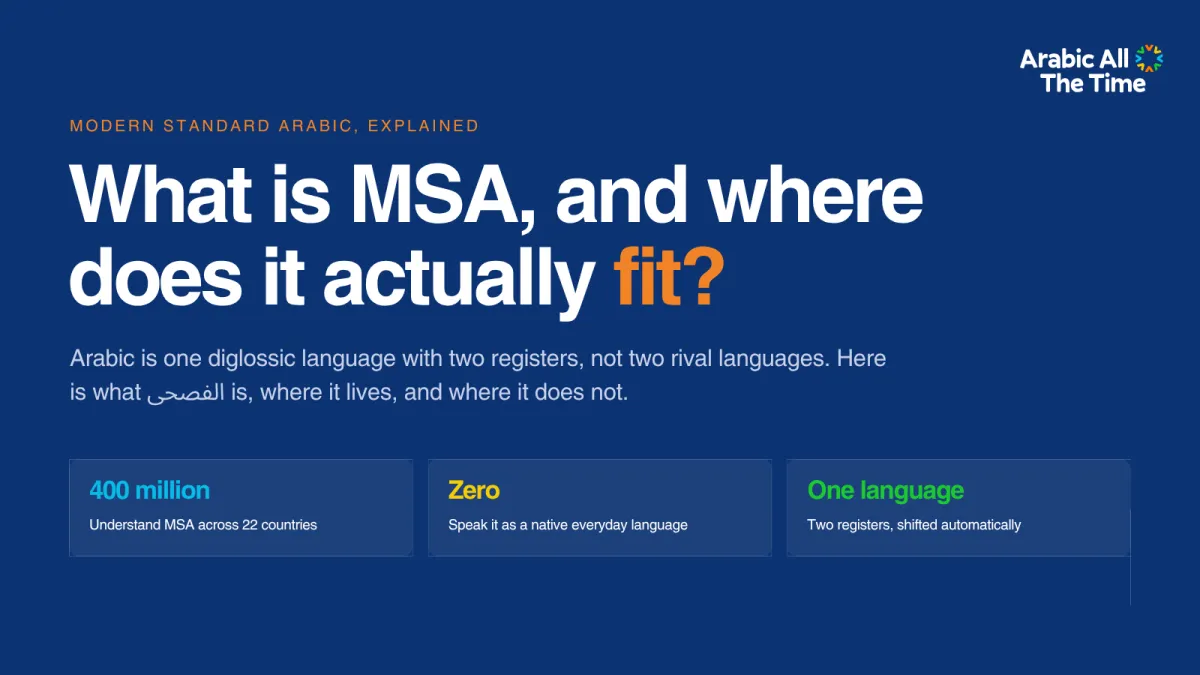
Modern Standard Arabic (MSA) is the formal Arabic of news, literature, and education across the Arab world. A Syrian founder explains MSA plainly — what it is, where it sits in the language, and whether to learn it.

Never heard a word of Arabic? Start here. A practical research-backed guide to your first 20 hours on Arabic All The Time — exactly what to watch, what to skip, what to expect.

Listening is how your brain actually acquires Arabic. Research by Krashen, Ullman, and Nation explains why ears must come before mouth — and how to do it right.
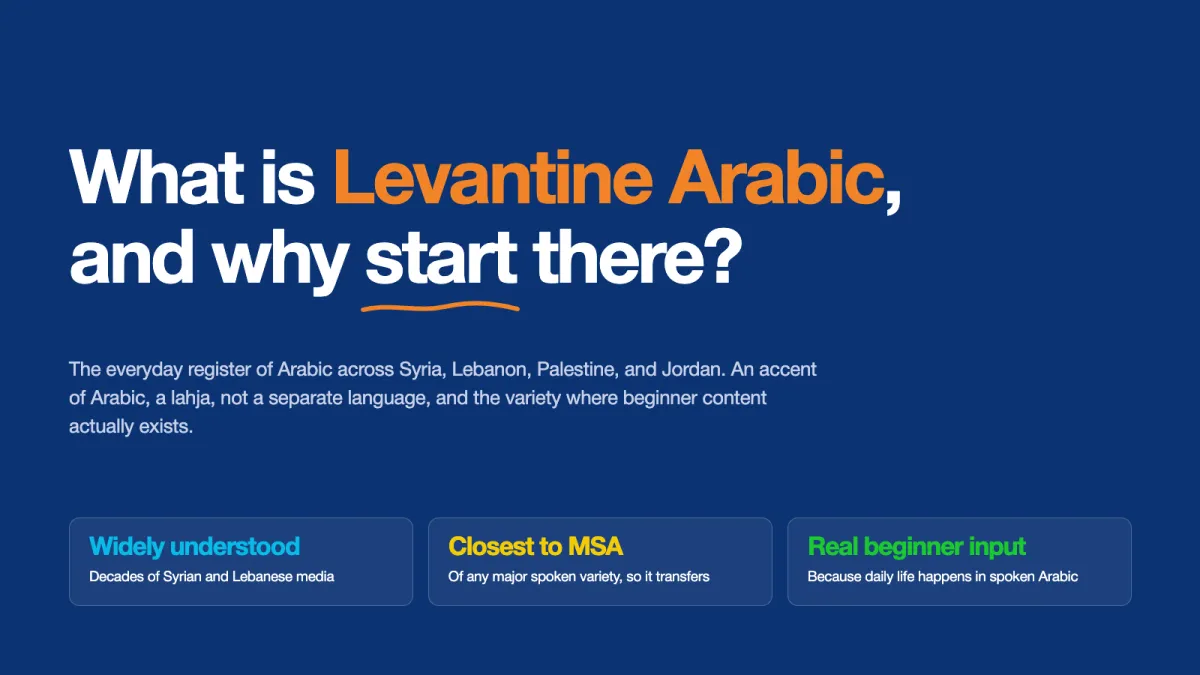
Shami is the Arabic of Syria, Lebanon, Palestine, and Jordan. A native speaker explains what it is, where it fits in the language, and how to acquire it naturally.

Traditional language exchange delivers 15–25% useful input. Crosstalk doubles it and removes production anxiety. Here's what the research shows.

Arabic All The Time is a comprehensible input video library for Levantine and Modern Standard Arabic: hundreds of videos you can actually understand, leveled from absolute beginner to advanced, with a new one every day. What it is, who built it, how it works, and what it costs.

Comprehensible input is language you understand through context, not translation. Here's what it means, how it works, and why it's the fastest path to Arabic fluency.

Everyone wants a number. Here is the honest breakdown of what fluent in Arabic actually means and how long it really takes, in hours and in years.

Flashcards and vocabulary lists don't produce Arabic fluency. Research by Paul Nation and Michael Ullman shows why — and what actually builds acquired vocabulary.

You know the words but freeze when someone speaks Arabic to you. The problem isn't your ability — it's a psychological mechanism called the affective filter. Here's how to lower it.

Early speaking locks in a foreign accent, and the research has shown it since 1974. Why to wait, when to start, and why waiting alone won't make you speak.

Does comprehensible input actually work? Yes — and the evidence is among the strongest in applied linguistics. Here's what 40 years of research shows.

fMRI research by Michael Ullman at Georgetown shows why you can pass Arabic tests but can't speak. Traditional study builds declarative memory. Fluency requires procedural memory. Here's the neuroscience.