How Many Hours to Learn Arabic? The Honest Roadmap (FSI + Comprehensible Input)
By Hasan Alhamwi
Updated July 2026: the milestone bands in this post have been revised upward and the full methodology behind them is now published. See "What changed in this update" below. We think honest numbers matter more than encouraging ones.
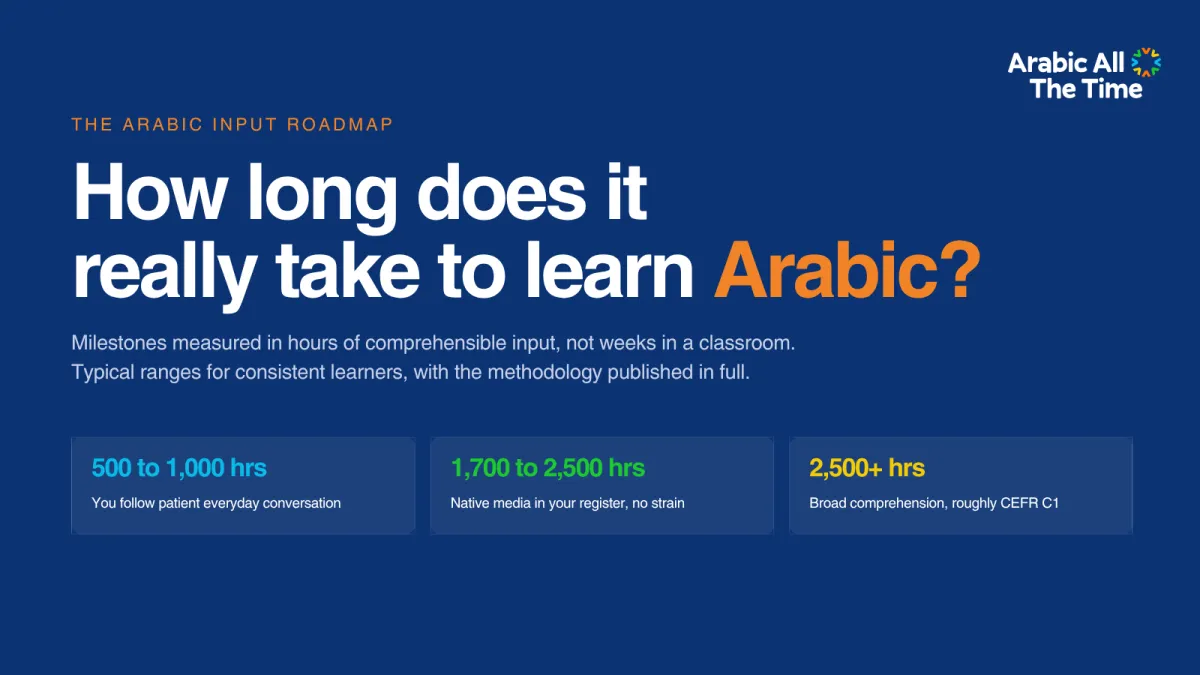
The U.S. Foreign Service Institute classifies Arabic in Category IV, its most demanding tier, and estimates 88 weeks (approximately 2,200 class hours) of intensive full-time training to reach professional working proficiency. But that figure measures something most learners are not aiming for. For learners acquiring Arabic through comprehensible input, the milestones that actually matter arrive in stages: following everyday conversation typically lands between 500 and 1,000 hours of input, enjoying native media in your chosen register typically lands between 1,700 and 2,500 hours, and broad C1-level comprehension of one register typically arrives beyond 2,500 hours. These are typical ranges, not promises, and this post shows exactly where they come from.
If you've searched for how long it takes to learn Arabic, you've probably met three kinds of answers: confident marketing promising fluency in six months, traditional schools selling four-year programs, and the intimidating FSI figure quoted without context. None of them answer the question you're actually asking, which is: at what point in the journey will I be able to do specific things, follow a conversation, watch a show, understand a podcast? This post answers that question, and unlike most timelines on the internet, it shows its math.
 The Arabic Input Roadmap
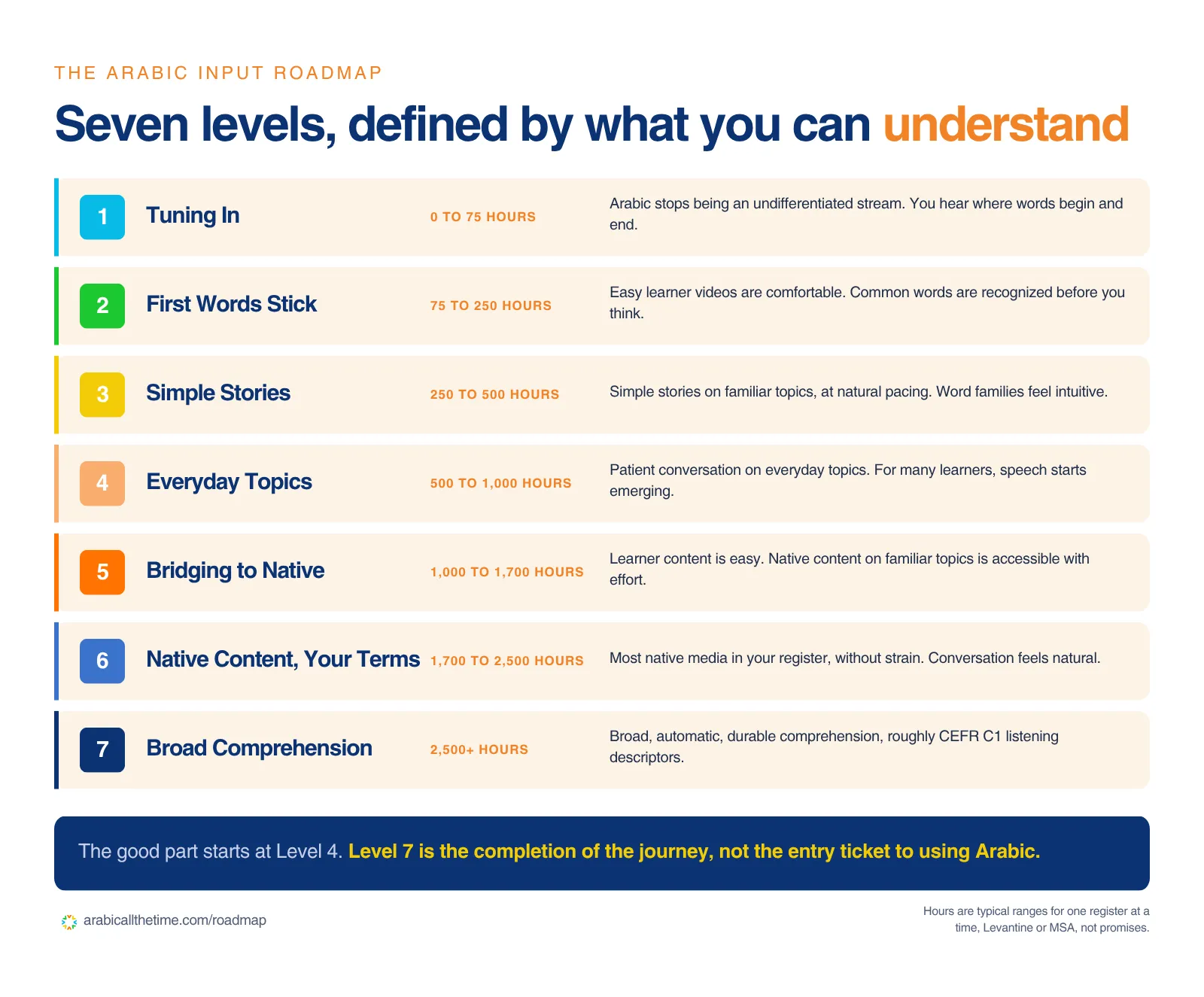
The roadmap below describes progress in one register of Arabic at a time: either a spoken variety like Levantine, or Modern Standard Arabic. (Why that matters is explained further down.) Levels are defined by what you can understand and do, because abilities are observable and hour counts alone are not. The hour bands are typical ranges for consistent learners, with real individual variation in both directions.
| Level | Name | Typical range | What you can do |
|---|---|---|---|
| 1 | Tuning In | 0 to 75 hours | Arabic stops being an undifferentiated stream. You follow the easiest A1 videos fully through visuals and slow speech, and you hear where words begin and end. |
| 2 | First Words Stick | 75 to 250 hours | Easy learner videos are comfortable. High-frequency words are recognized automatically, across different videos and speakers, without trying. |
| 3 | Simple Stories | 250 to 500 hours | You follow simple stories and descriptions on familiar topics made for learners, at more natural pacing. Word-family patterns start feeling intuitive. |
| 4 | Everyday Topics | 500 to 1,000 hours | You follow patient conversation and advanced learner content on everyday topics. This is where speaking practice becomes worth starting, because you have enough Arabic to build sentences out of. |
| 5 | Bridging to Native | 1,000 to 1,700 hours | All learner content is easy. Native content on familiar topics becomes accessible with effort: you follow the thread and most of the detail. |
| 6 | Native Content, Your Terms | 1,700 to 2,500 hours | You follow most native media in your register on general topics without strain. Conversation feels natural on familiar ground: imperfect and real. |
| 7 | Broad Comprehension | 2,500+ hours | Comprehension in your register is broad, automatic, and durable, including unfamiliar topics, at roughly the C1 level of the CEFR listening descriptors. |
Two things about this table before the detail.
First, notice what the destination is. Level 7 corresponds to approximately C1-level comprehension of your chosen register. It is deliberately not "four-skill professional mastery of MSA plus a spoken variety," which is what the FSI figure prices in, and it is deliberately not "speaks like a native," which no hour count delivers. Comprehension is what input builds directly; speaking emerges from it and gets polished through use.
Second, notice where the good part starts. The things most learners actually want, real conversations on familiar ground and native media you can enjoy, arrive across Levels 4 to 6. Level 7 is the completion of the journey, not the entry ticket to using Arabic. By 500 to 1,000 hours you are already living parts of the language.
Level 1: Tuning In (0 to 75 hours)
Your brain is building the phonological foundation: learning to segment the speech stream into words and to distinguish sounds that don't exist in English, like the pharyngeal ح and ع or the emphatic consonants. This is non-conscious work, and it takes dozens of hours before Arabic stops sounding like a single undifferentiated stream. Your only real job here is the habit: watch the easiest A1 content daily, follow through the visuals, and don't try to force understanding.
Level 2: First Words Stick (75 to 250 hours)
Easy learner videos become comfortable, and something strange starts happening: common words are just recognized, before you think about them. This is acquired vocabulary, not studied vocabulary, and it behaves differently. High-frequency words account for a disproportionate share of everything you'll ever hear, which is why comprehension expands faster than raw word counts would suggest.
Level 3: Simple Stories (250 to 500 hours)
Simple stories and descriptions on familiar topics become followable at more natural pacing. Arabic's root-and-pattern morphology starts working for you instead of against you: families like kitab (book), katib (writer), and maktab (office) begin feeling related rather than memorized separately. Nobody sits you down and explains this pattern. Exposure builds it.
Level 4: Everyday Topics (500 to 1,000 hours)
You follow patient conversation and advanced learner content on everyday topics, aand words start surfacing on their own. That isn’t speech yet. It’s the raw material for it, and this is the point where speaking practice converts fastest (more on when to start speaking). Crosstalk sessions get noticeably richer here, because the comprehensible band has widened so much.
Level 5: Bridging to Native (1,000 to 1,700 hours)
Everything made for learners is now easy, and the interesting frontier is native content on familiar topics: you follow the thread and most of the detail, with effort. This is the range where the language starts feeling like part of your life rather than a project, and where Krashen's affective filter, the anxiety that blocks acquisition, tends to drop for good.
Level 6: Native Content, Your Terms (1,700 to 2,500 hours)
Most native media in your register, on general topics, without strain. Shows, podcasts, conversations among patient speakers. If you've been speaking, conversation feels natural on familiar ground: you communicate comfortably, you make mistakes, and neither fact cancels the other.
Level 7: Broad Comprehension (2,500+ hours)
Topic no longer decides whether you understand. Comprehension in your register is broad, automatic, and durable, at roughly the C1 level of the CEFR listening descriptors. Refinement continues from here for years, but it's no longer hours-bounded. You just live the language.
 Where These Numbers Come From
This is the section most timeline posts skip, and it's the section that matters most. Our full methodology is published on a dedicated page (read it here); this is the summary.
The anchor. The largest body of observational milestone data for input-based acquisition comes from Dreaming Spanish, whose published roadmap for Spanish places its levels at 50, 150, 300, 600, 1,000, and 1,500 hours, based on outcomes tracked across thousands of learners. No comparable dataset exists yet for Arabic. Any Arabic hour estimate on the internet is therefore an extrapolation, including ours. The honest question is which extrapolation is best reasoned.
The difficulty gap. The FSI's category system is the best available measure of relative linguistic distance from English: Category I Spanish at roughly 600 to 750 class hours, Category IV Arabic at roughly 2,200. The raw ratio between them is about 3x.
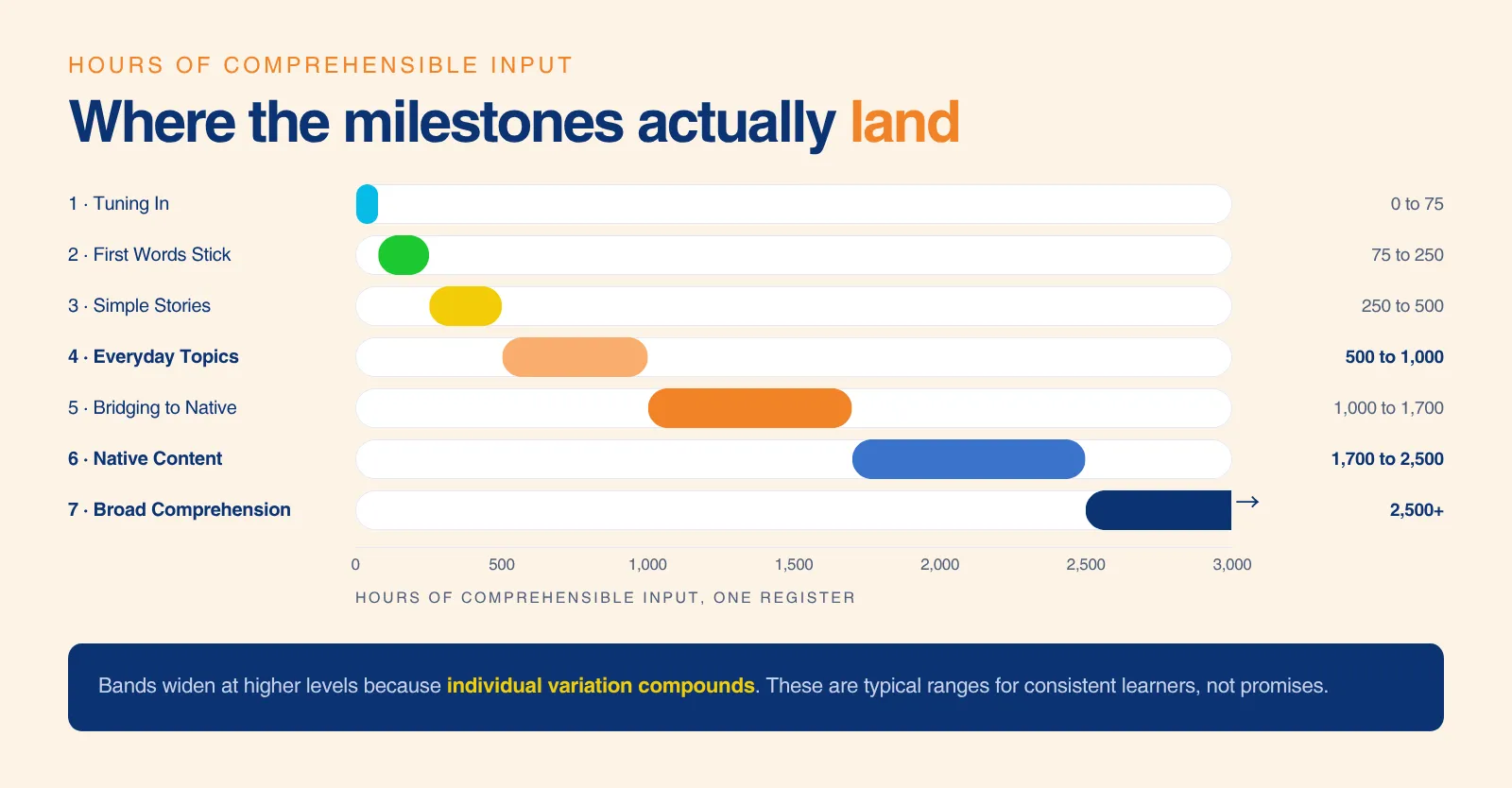
Why we don't scale by 3x. The FSI Arabic figure prices in things this roadmap does not promise: professional four-skill proficiency, strong formal literacy, and historically command of MSA plus a spoken variety at once. Our roadmap targets comprehension-first progress in a single chosen register. Removing the costs we don't charge for, and keeping the genuine ones that remain (zero cognate transfer from English, unfamiliar phonology, root-and-pattern morphology, and the timing of the script), we scale the Spanish milestone bands by roughly 1.6 to 1.8x, with ranges that widen at higher levels because individual variation compounds. That's how 50 becomes 75, 600 becomes 1,000, and 1,500 becomes 2,500.
What we know we don't know. This scaling is a reasoned estimate, not a measured constant, and we say so plainly. Prior language experience, input intensity, content fit, and consistency all move the bands. Our progress tracker measures real comprehensible input minutes, and we're adding optional level self-assessments so we can publish the first actual calibration of Arabic CI milestones against learner data, and revise these bands with evidence. When the data disagrees with the estimate, the data wins.
What the FSI 2,200 Hours Actually Measures
The U.S. Foreign Service Institute has trained American diplomats in foreign languages since 1947, and its difficulty rankings are the most cited timeline benchmark in language learning. They're also routinely misquoted, including, previously, by us. Three clarifications matter.
The 2,200 figure is class hours. The official FSI estimate for Category IV languages is 88 weeks of full-time training, approximately 2,200 classroom hours. Students also complete substantial directed study outside class, so total time on task is meaningfully higher than 2,200 hours. Treating 2,200 as a total-hours figure, on any method's scale, understates what FSI training actually involves.
The target is professional proficiency across all four skills. The estimate targets Interagency Language Roundtable Level 3, General Professional Proficiency: negotiating, presenting technical material, and operating professionally in the language, in speaking, listening, reading, and writing. That maps approximately to CEFR C1. It is far beyond "comfortable conversations and native media," which arrives much earlier on any path.
FSI Arabic historically means MSA plus a spoken variety. Diplomats need formal Arabic and street Arabic. That dual-register load is part of what makes the Arabic figure so large, and it's a load a learner focused on one register doesn't carry at first.
The FSI categories remain genuinely useful for one thing: measuring how far Arabic is from English relative to other languages. That relative distance is exactly what we use them for, and nothing more.
For context, the four categories: Category I (Spanish, French, Italian, Portuguese, Dutch, and others) at roughly 600 to 750 class hours; Category II (German) at roughly 900; Category III (Russian, Hindi, Hebrew, Turkish, Vietnamese, and others) at roughly 1,100; Category IV (Arabic, Mandarin, Japanese, Korean, Cantonese) at roughly 2,200.
 Why Arabic Takes Longer Than Spanish
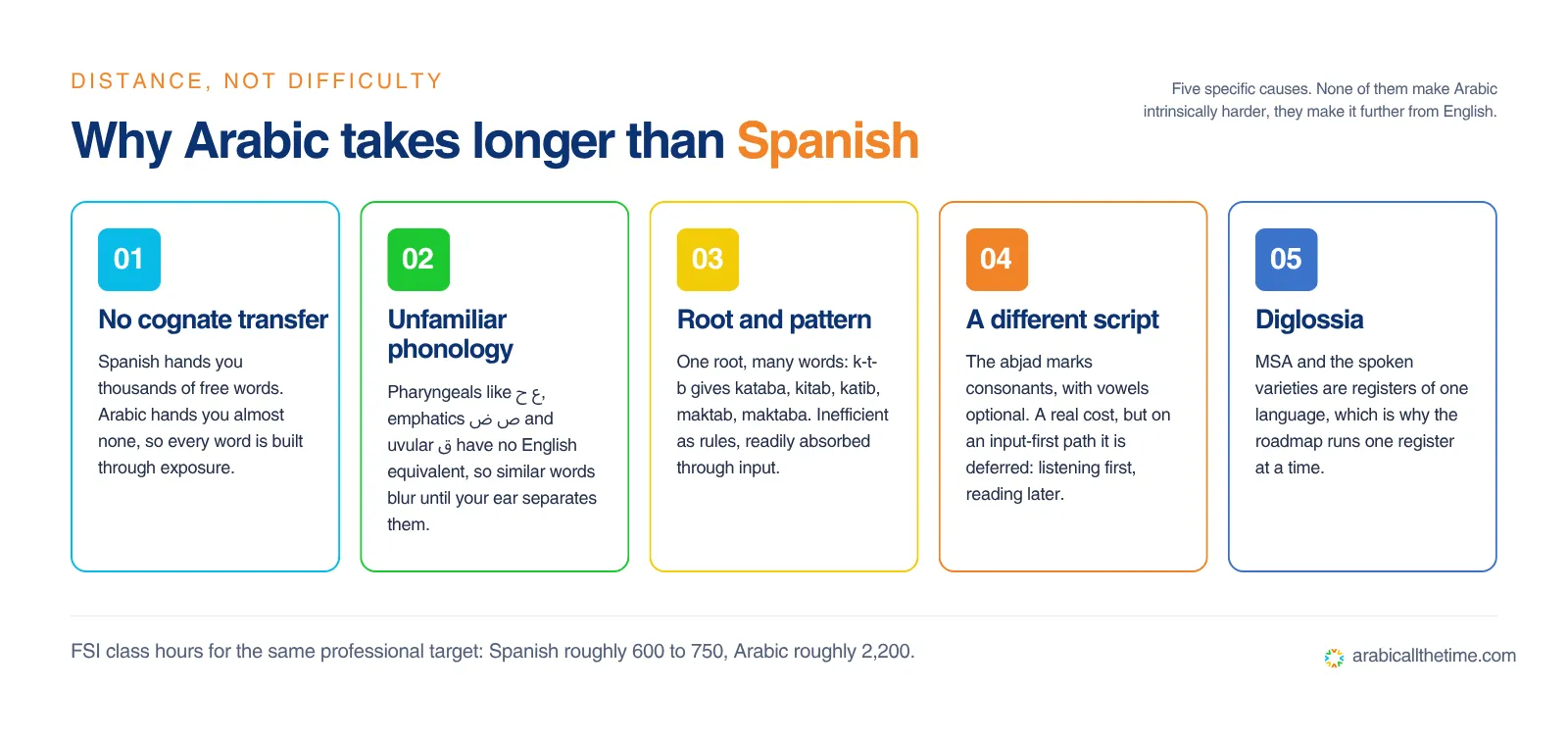
The gap is real, and it has specific causes rather than mystical ones.
No cognate transfer. Spanish hands an English speaker thousands of free words: importante, familia, educación. Arabic hands you almost none. Every word is built from scratch through exposure, which is also why context-based acquisition suits Arabic better than memorization does.
Unfamiliar phonology. Pharyngeal consonants like ع, emphatics like ص and ض, and the uvular ق don't exist in English, and until your ear can distinguish them reliably, vocabulary acquisition runs slower because similar-sounding words blur together.
Root-and-pattern morphology. Arabic generates word families from three-consonant roots through templates: k-t-b gives kataba, kitab, katib, maktub, maktab, maktaba. Dramatically unlike English, impossible to learn efficiently as rules, and readily absorbed through input.
A different script. The Arabic abjad marks consonants with optional vowel diacritics. It imposes a real cost, though on an input-first path the cost is deferred: you build listening first and read later, with better pronunciation as a side effect.
Diglossia. As Charles Ferguson described in his foundational 1959 paper, Modern Standard Arabic and the spoken varieties function as different registers of one language. This is why our roadmap runs per register, and why "learn Arabic" is really a choice about which Arabic first.
None of this makes Arabic intrinsically harder than other languages. It makes Arabic more distant from English, which is what the hours are measuring.
One Register at a Time
The roadmap describes one track: the Levantine track or the MSA track. If you split your hours across both, each track advances according to the hours it receives, with meaningful but partial transfer between them. Shared core vocabulary and structure carry over; sounds, function words, and register habits carry over less.
Adding a strong second register after finishing the first is substantially faster than starting over, but it isn't free. As a working estimate, expect roughly a third to a half of the original track's hours, concentrated at the lower levels. We flag this estimate as provisional, like everything else on this page, and it will be calibrated against learner data along with the rest of the roadmap.
A Note on the Word "Fluency"
You'll notice this post never promises fluency at any hour count. That's deliberate. The word has no technical definition, so every argument about it is two people using one word for two things.
Here's the honest version instead. I built my own Spanish through roughly 700 hours of listening input. I understand Spanish media comfortably, I hold real conversations naturally and without effort, and I make mistakes, regularly, including things I can't yet express as precisely as I'd like. Both halves of that sentence are true at once, and they don't cancel each other. That is what real language ability looks like at every level short of native: comfortable, imperfect, real. Some learners would call my Spanish fluent. Others, with double my hours, wouldn't call their own fluent. The disagreement is about the word, not the ability, which is exactly why this roadmap describes abilities.
How to Make the Hours Count
The bands above assume hours of genuine comprehensible input, not hours of activity that feels productive. Five principles keep the hours honest.
Daily beats intensive. Memory consolidation research by Robert Stickgold at Harvard has shown that procedural memory, the system fluent language use runs on, strengthens through sleep after frequent activation. Thirty minutes every day outperforms one long weekly session.
Comprehensible beats hard. An hour of content you don't understand produces almost nothing. An hour at your level, where you follow the message and stretch slightly, is where acquisition happens (what comprehensible input actually means).
Variety prevents narrow Arabic. Only news gives you political vocabulary and no dinner table. Only kids' content gives you colors and no adult conversation. Range across topics is what builds range in you.
Let production wait for its level. Let speaking wait for its level. Because you can’t practice expressing what you haven’t acquired yet. Around Level 4 you have enough to work with, and that’s when a short block of speaking practice pays for itself (the silent period, explained).
Track hours roughly, not obsessively. Tracking calibrates your expectations. Obsessing turns a relaxing habit into a stressful audit, which is itself a tax on acquisition.
 How Arabic All The Time Maps to the Roadmap
The AATT library is built to keep comprehensible input available at every level of this roadmap, in both Levantine and MSA tracks: A1 content with maximum visual support for Tuning In, beginner content through First Words Stick and Simple Stories, intermediate content across Everyday Topics and Bridging to Native, and advanced content carrying learners into native material. New videos are released daily, because the practical bottleneck at every level is the same: running out of fresh content you can actually understand.
The progress tracker measures real comprehensible input minutes, and it celebrates what deserves celebrating along the way: your first hour, your first 10, 25, 50, your streaks, your first video followed without pausing. The levels above are the honest map. The daily wins are yours to stack.
Try a Free Crosstalk Session
The densest input hours you can get, especially early, come from one-on-one conversation calibrated to exactly your level. I offer free 30-minute crosstalk sessions for new learners in both Levantine Arabic and MSA. You speak English. I speak Arabic. We talk about pictures, your life, whatever you're curious about, and the Arabic stays comprehensible the entire time. Book a free session here.
Frequently Asked Questions
How many hours does it take to learn Arabic?
It depends on the target. Following patient conversation on everyday topics typically arrives between 500 and 1,000 hours of comprehensible input. Enjoying native media in your chosen register typically arrives between 1,700 and 2,500 hours. Broad, automatic comprehension at roughly the C1 level typically arrives beyond 2,500 hours in one register. These are typical ranges extrapolated from the best available input-based milestone data and the FSI difficulty classifications; the full methodology is published on our roadmap.
How long does it take to be fluent in Arabic?
"Fluent" has no technical definition, which is why answers to this question vary so wildly. Defined as comfortable conversation on familiar topics with real but non-blocking mistakes, most consistent learners reach it somewhere between Levels 4 and 6 of the roadmap, roughly 1,000 to 2,500 hours of input in one register. Defined as near-native across all contexts, no hour count honestly delivers it. We describe abilities instead of using the word.
What is the FSI estimate for learning Arabic?
The Foreign Service Institute places Arabic in Category IV and estimates 88 weeks, approximately 2,200 class hours, of intensive full-time training to reach ILR Level 3, General Professional Proficiency, across all four skills. Students also complete substantial study outside class, so total time on task exceeds 2,200 hours. The estimate is rigorous for what it measures: professional four-skill proficiency in diplomatic training, historically covering both MSA and a spoken variety. It is not a milestone on a comprehensible input roadmap, and we use it only as a measure of Arabic's relative distance from English.
Where did the roadmap numbers come from?
We anchor to the Dreaming Spanish roadmap, the largest observational milestone dataset for input-based acquisition, and scale its bands by roughly 1.6 to 1.8x for Arabic. The raw FSI class-hour ratio between Arabic and Spanish is about 3x, but that ratio prices in four-skill professional proficiency and dual-register command, which our comprehension-first, single-register roadmap doesn't target. The scaling is a reasoned estimate, stated as such, and will be recalibrated against AATT learner data as our tracker and level self-assessments accumulate it. The full methodology is on our roadmap.
Can I learn Arabic in one year?
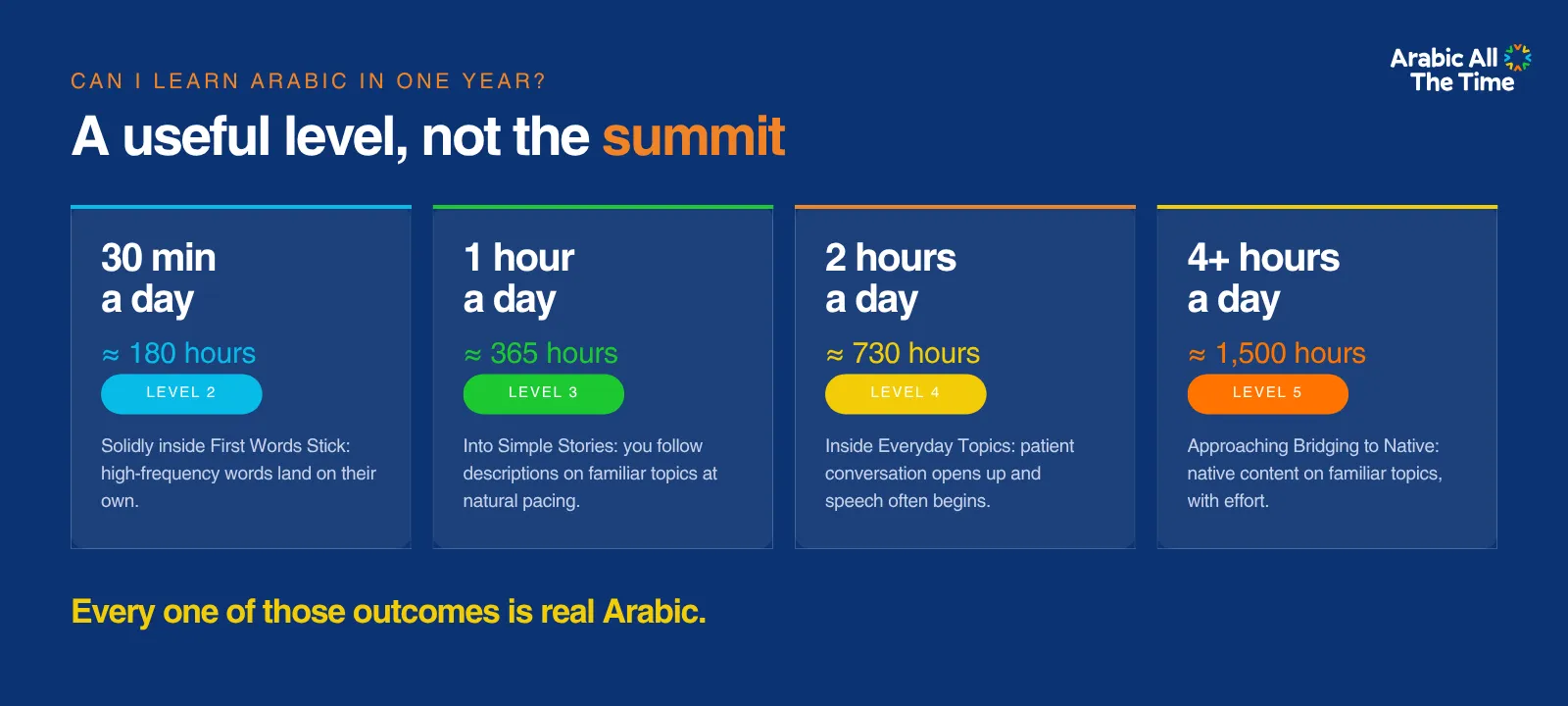
You can reach a genuinely useful level, not the summit. At 30 minutes daily, a year is roughly 180 hours: solidly inside First Words Stick. At one hour daily, roughly 365 hours: into Simple Stories. At two hours daily, roughly 730 hours: inside Everyday Topics, where patient conversation opens up and speaking practice becomes worth adding. At an intensive 4+ hours daily, roughly 1,500 hours: approaching Bridging to Native. Every one of those outcomes is real Arabic.
When will I be able to watch Arabic shows and follow native media?
Native content on familiar topics becomes accessible with effort during Bridging to Native, typically 1,000 to 1,700 hours in your register. Most native media on general topics, followed without strain, is Level 6 territory, typically 1,700 to 2,500 hours. Learner-made content carries you the whole way there, which is what the leveled library is for.
Do these hours cover both MSA and a spoken variety?
No, and that's deliberate. The roadmap describes one register track at a time, Levantine or MSA, because that's the honest unit of progress. Hours split across both advance each track separately, with partial transfer between them. Adding a strong second register after the first typically costs roughly a third to a half of the original track, concentrated at the lower levels: a provisional estimate we flag as such.
How does Arabic compare to Spanish in hours?
The FSI places Spanish at roughly 600 to 750 class hours and Arabic at roughly 2,200, about 3x, for the same professional four-skill target. On our comprehension-first, single-register roadmap, the honest multiplier is smaller, roughly 1.6 to 1.8x the Spanish input milestones, because the dual-register and formal-literacy costs that inflate the FSI Arabic figure aren't part of the target. The gap comes from zero cognate transfer, unfamiliar phonology, root-and-pattern morphology, and the script.
Does daily practice or intensive study work better?
Daily. Procedural memory consolidates through sleep after activation, so frequent shorter sessions capture a nightly multiplier that occasional marathons don't. Intensive immersion accumulates hours faster when it's sustainable, but for most adults with real lives, 30 to 60 minutes every single day is the highest-quality path through the roadmap.
What Changed in This Update
An earlier version of this post presented milestone bands that closely followed the Dreaming Spanish numbers while describing them as scaled for Arabic's difficulty, and treated the FSI's 2,200 class hours as a total-hours endpoint. A sharp-eyed member of our community pointed out the inconsistency, and they were right. This version publishes the scaling logic in full, revises the bands upward to match it, reframes the FSI figure as exactly what it is, and commits the roadmap to calibration against real learner data. We'd rather revise in public than defend numbers we can't stand behind.
The Bottom Line
The FSI's 2,200 class hours is real, rigorous, and measures something most learners aren't aiming for. The milestones that make Arabic worth it arrive in stages along the way: everyday conversation opening up between 500 and 1,000 hours of comprehensible input, native media on your terms between 1,700 and 2,500, and broad C1-level comprehension of your register beyond 2,500. Wide ranges, honestly stated, with the methodology public and a commitment to replace estimates with data.
The hours compound. Every hour of input makes more content comprehensible, which turns more of the world into input, which builds more comprehension. The first 100 hours feel slow. The hundredth 100 hours feel fast.
However you slice it, the path is the same: comprehensible input, daily, accumulated patiently. The hours add up, and they're the most enjoyable hours any method has to offer. When you're ready, start with a free video at your level, book a free crosstalk session, or read the full methodology.
References
Council of Europe. (2001). Common European Framework of Reference for Languages: Learning, Teaching, Assessment. Cambridge University Press.
Dreaming Spanish. Language Learning Roadmap. dreamingspanish.com.
Ferguson, C. A. (1959). Diglossia. Word, 15(2), 325 to 340.
Interagency Language Roundtable. ILR Skill Level Descriptions. U.S. Government.
Krashen, S. D. (1982). Principles and Practice in Second Language Acquisition. Pergamon Press.
Nation, I. S. P. (2013). Learning Vocabulary in Another Language (2nd ed.). Cambridge University Press.
Stickgold, R., & Walker, M. P. (2013). Sleep-dependent memory triage: Evolving generalization through selective processing. Nature Neuroscience, 16(2), 139 to 145.
Ullman, M. T. (2015). The declarative/procedural model: A neurobiological model of language learning, knowledge, and use. In G. Hickok & S. L. Small (Eds.), Neurobiology of Language (pp. 953 to 968). Academic Press.
U.S. Foreign Service Institute. Foreign Language Training. U.S. Department of State.
Related posts
How to Get 2,500 Hours of Arabic Input
The Arabic roadmap runs to 2,500 hours. No library holds them all. Here is where every hour comes from, and how to count them.
Arabic for Heritage Speakers: A Reactivation Plan Backed by Research
If you understand Arabic but freeze when it's your turn to speak, you're not a beginner. The research on heritage speakers, why your Arabic is dormant rather than gone, the two-registers problem you inherited, and the exact plan to reactivate it through input, then give speaking its own short block of practice.
Is There a Dreaming Spanish for Arabic? An Honest Answer (From Someone Who Did Both)
Is there a Dreaming Spanish for Arabic? Yes in method, not yet in scale. Why Dreaming Spanish works, why Arabic never got its version, what the research says about video input for Arabic, and what Arabic All The Time is and honestly isn't yet.

How to Use Arabic All The Time: Your First 30 Days (Week-by-Week Plan)
A realistic week-by-week plan for your first 30 days on Arabic All The Time: how to pick your level, how long to watch, what the doubt week feels like, what honestly happens by day 30, and the four mistakes that stall almost every beginner.

How to Maintain Arabic Fluency (and Get It Back If It Slipped)
Arabic fades without use, and it fades in a predictable order. What the research says about losing a language, what goes first in Arabic, the daily routine that keeps it, and how heritage speakers wake theirs back up.

Krashen's 1,500-Word Threshold: When You're Ready to Read Arabic (Research-Backed)
Krashen's 1,500-word threshold for reading explained — when you're actually ready to read Arabic, why it matters, and how to reach it through comprehensible input.