Arabic for Heritage Speakers: A Reactivation Plan Backed by Research
By Hasan Alhamwi
Arabic for heritage speakers is a different problem than Arabic for complete beginners, and almost every resource ignores that. If you grew up hearing Arabic at home, understand your parents perfectly, but freeze the moment it is your turn to speak, this guide is for you. Maria Polinsky's research at Harvard University has shown that heritage speakers are not beginners and not native speakers. They are a third category with their own strengths, their own gaps, and their own reactivation path. The research here is genuinely hopeful. Your Arabic is not gone. Decades of work on dormant languages shows that childhood exposure leaves durable traces in memory and perception, and that the fastest way to wake those traces up is massive comprehensible input, not grammar drills and not an alphabet course. In this post I will explain what the research says about why you understand but cannot speak, why the Arabic you grew up with is a real asset even though formal Arabic feels foreign, and exactly how to reactivate your Arabic through input. I am Hasan, the founder of Arabic All The Time, and I am Syrian. I have watched this exact story play out in my own extended family across three countries. This is the plan I wish every heritage speaker had.
What "Heritage Speaker" Actually Means
Guadalupe Valdés at Stanford University gave the field its working definition: a heritage speaker is someone raised in a home where a language other than the community's dominant language was spoken, who understands that language and is to some degree bilingual in it. Notice what the definition does not require. It does not require that you speak it well. It does not require that you read it at all.
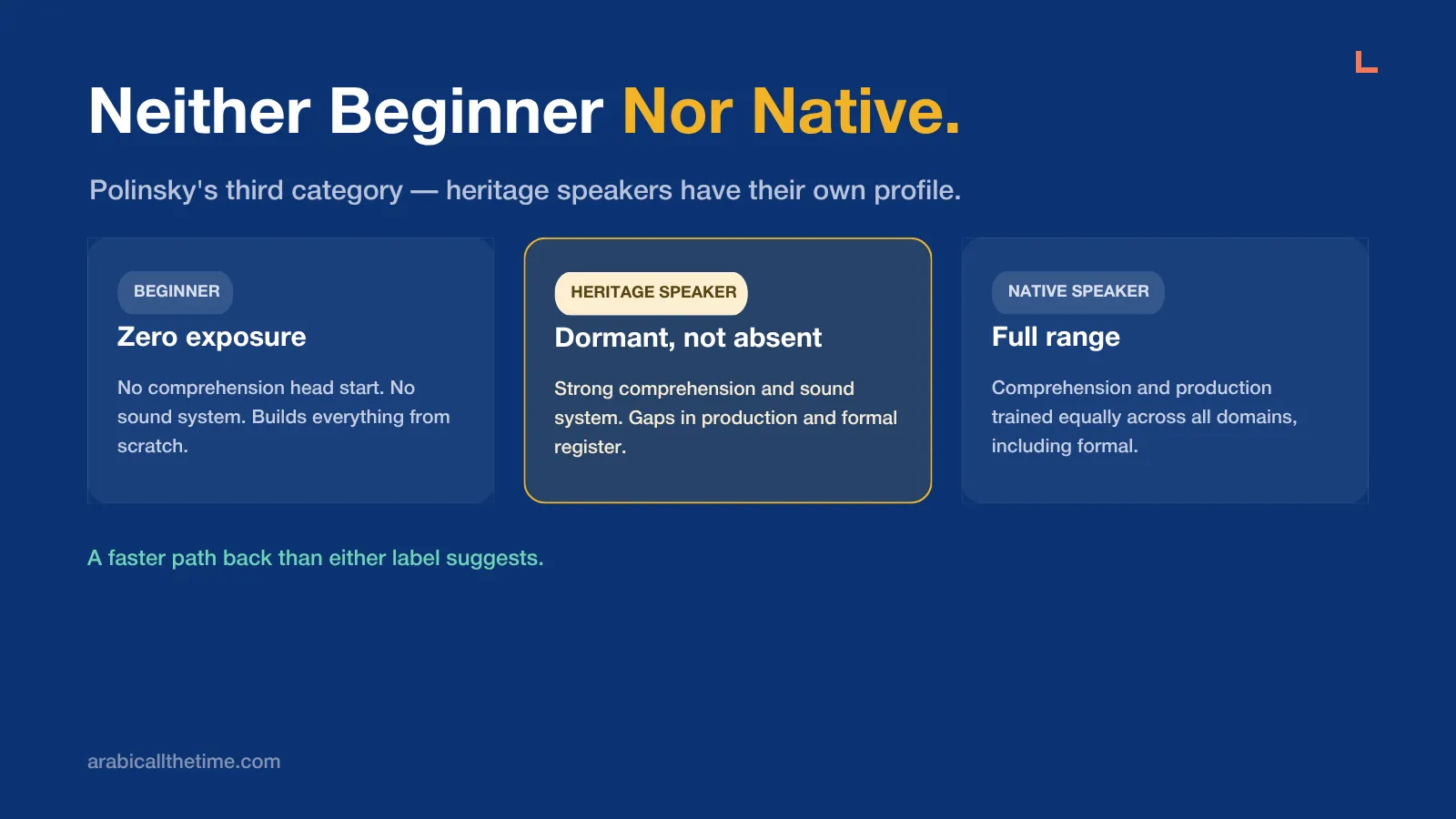
Polinsky's book Heritage Languages and Their Speakers (2018) maps the typical profile with precision. Comprehension runs far ahead of production. The sound system is strong because it was built in childhood. Vocabulary is deep in home domains, food, family, feelings, arguments, and thin everywhere else. Grammar was acquired naturally but under reduced input, so it has real gaps.
Sound familiar? You can follow a full-speed family argument. You can hear instantly when someone's Arabic is off. But you answer in English, your Arabic caps out at kitchen topics, and the news might as well be a different language.
Olga Kagan's research at UCLA argued that this profile demands a different starting point than the one foreign-language programs offer. Standard beginner courses waste your strengths and never touch your actual gaps. That mismatch, not any failure of yours, is why the Arabic class you tried felt insulting and useless at the same time.
Your Arabic Isn't Gone. It's Dormant.
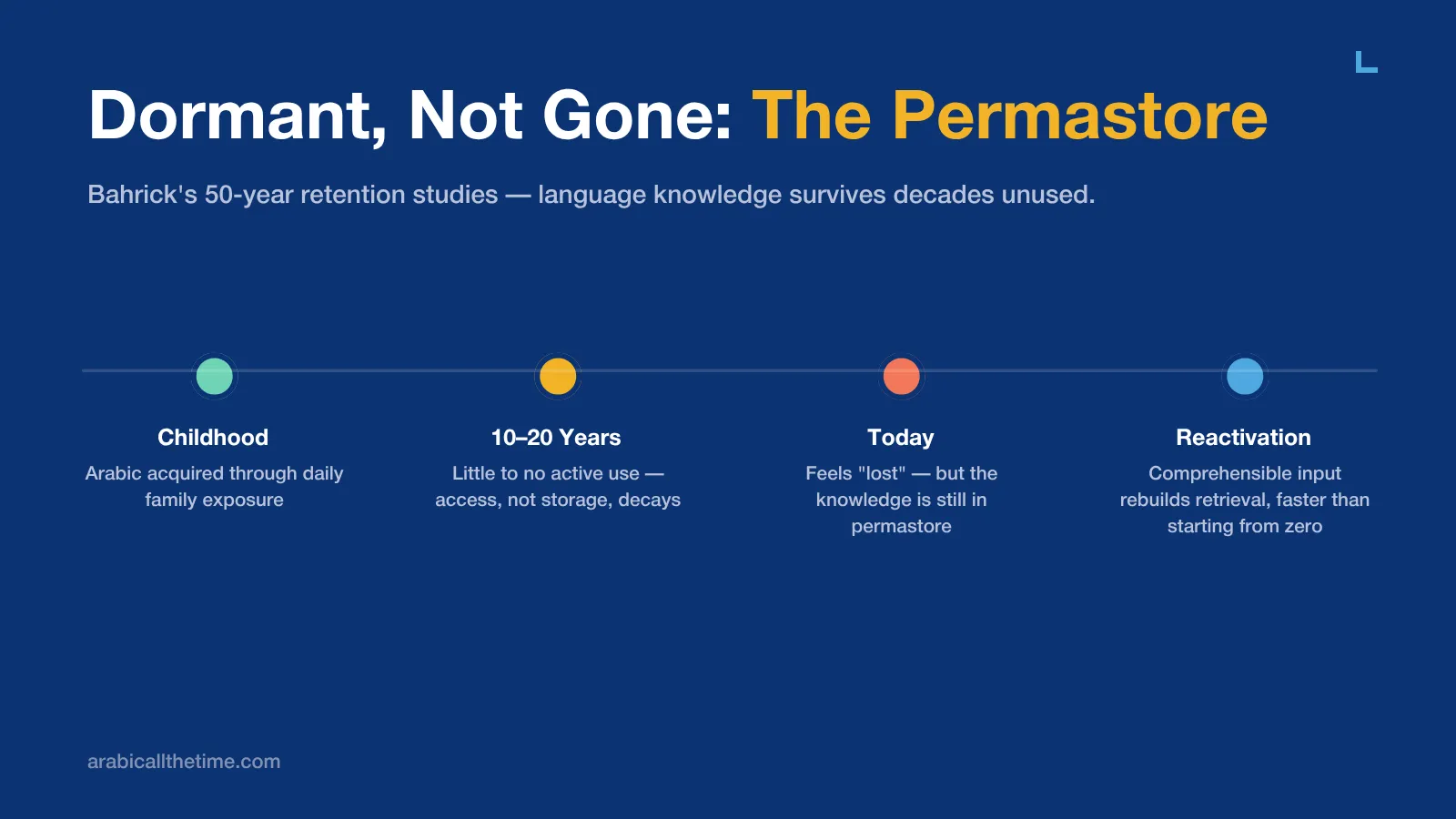
This is the finding I want you to sit with, because most heritage speakers carry a quiet grief about having "lost" the language. The research says you did not lose it.
Harry Bahrick at Ohio Wesleyan University ran 50-year longitudinal studies on language retention and found what he called the permastore: language knowledge that stabilizes and survives for decades without any use at all. Monika Schmid's work at the University of York on language attrition points the same direction. What decays is not the knowledge itself but your access to it. The files are there. The retrieval pathways are rusty.
The most striking evidence comes from Terry Kit-fong Au's research at UCLA, published in Psychological Science in 2002. Her team studied adults who had merely overheard Spanish as children, never speaking it themselves. When those adults later returned to the language, they acquired measurably more native-like pronunciation than typical late learners. Childhood ears leave an advantage that survives into adulthood, even without childhood speech.
You did far more than overhear. Which means your job is not acquisition from zero. It is reactivation, and reactivation is faster. This is also why maintaining Arabic once you have it back takes far less effort than people fear.
Why You Understand Everything but Freeze When You Speak
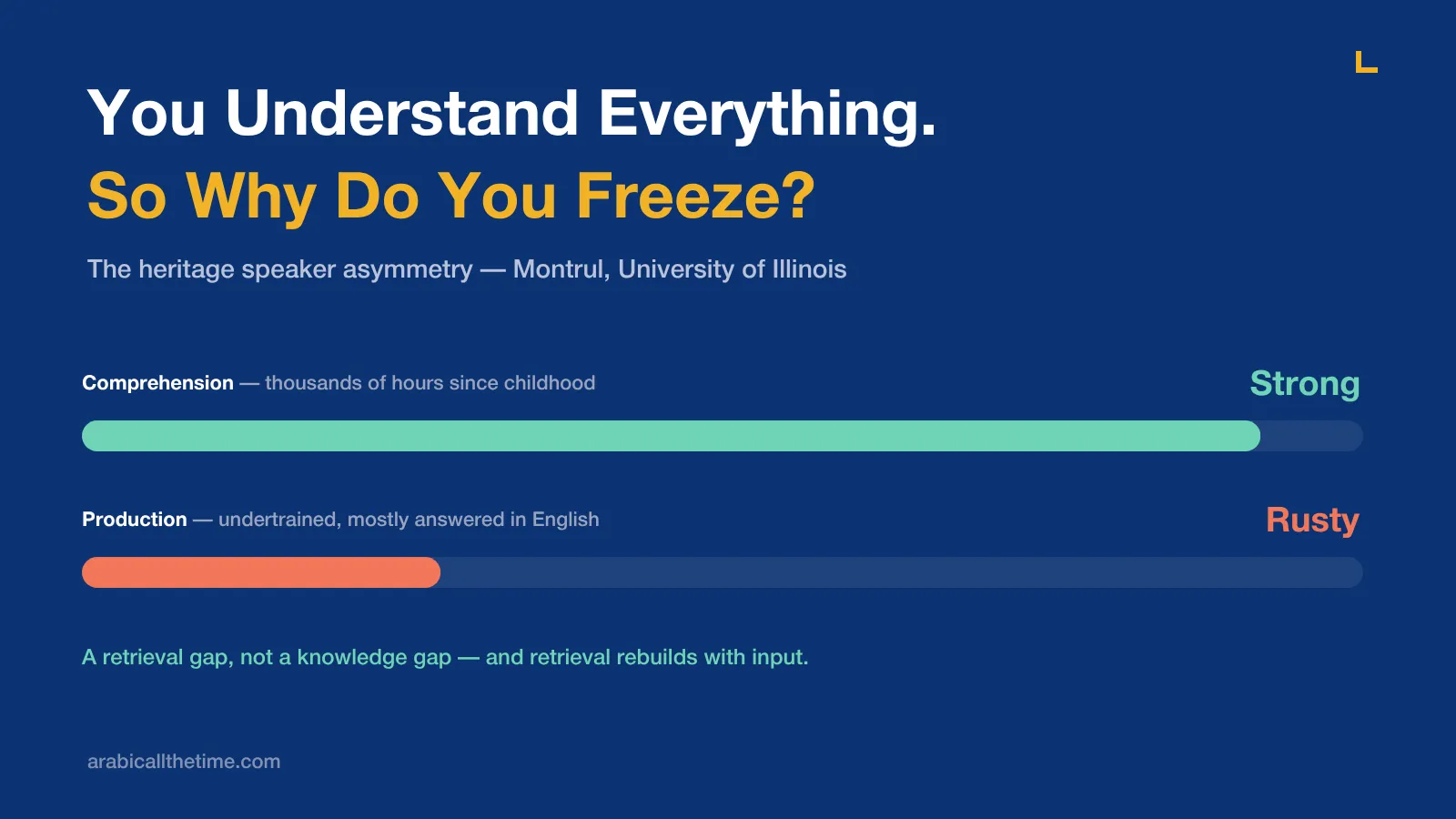
Silvina Montrul's research at the University of Illinois documents the core asymmetry of heritage speakers: receptive ability far outruns productive ability. The reason is simple input history. As a child you heard Arabic constantly and, in most diaspora households, answered in English. Your comprehension system got thousands of hours of training. Your production system got scraps.
Then there is the shame loop. Stephen Krashen at the University of Southern California showed that anxiety raises what he called the affective filter, a psychological wall that blocks the language system exactly when you need it. And no environment raises the filter like a relative asking why you don't speak Arabic. The pressure of "you should already know this" is the highest-anxiety condition a learner can face. I wrote about how that stress mechanically blocks acquisition, and heritage speakers live at the extreme end of it.
So the freeze is not evidence that your Arabic is weak. It is evidence that your filter is high and your retrieval is out of practice. Both are fixable, and neither is fixed by being put on the spot at a family dinner. Rebuild the listening first, in private, with no audience. Speaking gets its own turn, and its own practice, later. Here is why not to speak too early.
The Two-Arabics Problem You Inherited
Here is the piece nobody explained to you as a kid. Charles Ferguson at Stanford University described Arabic in his foundational 1959 paper as a diglossic language: one language operating on two levels. The spoken varieties carry daily life. Modern Standard Arabic carries news, books, and formal speech.
What you absorbed at home was almost certainly a spoken variety, Levantine if your family is from Syria, Lebanon, Palestine, or Jordan. What schools and apps offer is usually MSA. So heritage speakers get labeled "beginners" because they cannot read a news article, while they can follow a family argument at full speed. Both facts are true, and the label is still wrong.
Research by Abdulkafi Albirini at Utah State University and Elabbas Benmamoun at Duke University, published in Studies in Second Language Acquisition (2011), examined Arabic heritage speakers' oral production directly. The picture is precise: a solid everyday spoken foundation, with systematic gaps in root-and-pattern morphology and in the formal register. In other words, you own a real piece of the language and you are missing specific, identifiable pieces. That is a far better starting position than zero.
Arabic is one language with regional varieties, and the smart path uses both registers together. I made the full case in MSA or Dialect: Which Arabic Should You Learn First?, and for heritage speakers the answer is even clearer: reactivate the variety you already carry, then add MSA on top to fill the gap you actually have.
Why Comprehensible Input Is the Right Tool for Reactivation
Krashen's Input Hypothesis says acquisition happens when you understand messages in the language, slightly above your current level. For a complete beginner, finding understandable Arabic is the hard part. For you it is not. Your comprehension head start means far more input is already comprehensible to you than to any true beginner. You get to skip levels on day one.
Input also solves the filter problem. Watching and listening asks nothing of you. No one is waiting for your answer, no one is grading your accent, no aunt is sighing. You flood the dormant pathways with thousands of comprehensible sentences, and retrieval quietly rebuilds underneath. This is why listening comes first here, and why it works even better for heritage speakers than for anyone else.
One more liberation: you do not need the alphabet to start. Reactivation is a listening and speaking project first. Reading is a later stage with its own vocabulary threshold, which I covered in Krashen's 1,500-word threshold. Do not let a script course gatekeep you from the language you already partly own.
And the wrong tools deserve naming. Flashcard decks and grammar-first courses treat you like a blank slate. Paul Nation's vocabulary research at Victoria University of Wellington shows words consolidate through repeated meaningful encounters, which is exactly what input delivers and exactly what memorization fails to deliver.
Your Reactivation Plan
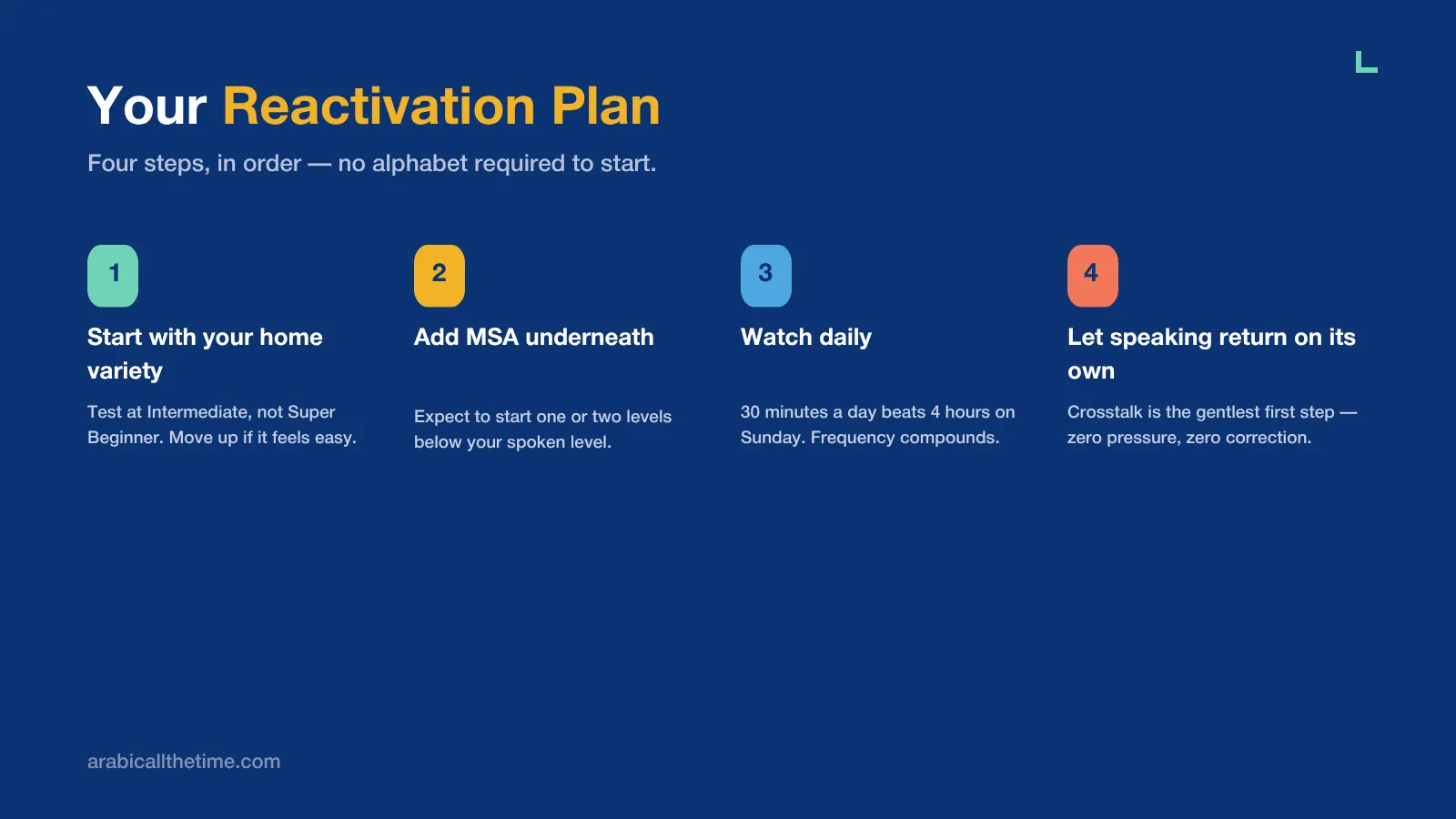
Start with your home variety. If your family speaks Levantine, open the Levantine track on Arabic All The Time and test yourself at Intermediate, not Super Beginner. The rule is comfort at roughly 90 percent understanding. If a level feels easy, move up until it stops feeling easy. Kagan's placement research supports this: heritage learners belong at a different entry point, and starting too low is as damaging as starting too high because boredom kills consistency.
If your family variety is Egyptian, Gulf, or Maghrebi, an honest note: our spoken track is Levantine, which is widely understood across the region and will still feel far more familiar to you than MSA, but it will not be identical to your home sound. The MSA track serves every heritage speaker equally, because MSA is the register almost none of us got at home.
Then add MSA underneath. This is usually the real gap, the thing that separates following a family story from following the news. Expect to start MSA one or two levels below your spoken level. That is normal and it is exactly what Albirini and Benmamoun's data predicts.
Watch daily. Thirty minutes every day beats four hours on Sunday, because acquisition compounds through frequency. Then give speaking its own block. For heritage speakers this is usually short, because the understanding is already there, so a short block of low-pressure conversation is often all it takes. Crosstalk is the gentlest place to start it.
Try a Free Crosstalk Session
If speaking with family feels loaded, crosstalk removes the pressure completely. Your first session is free, a 30-minute one, in either Levantine Arabic or Modern Standard Arabic. You speak English. I speak Arabic. We talk about pictures, your daily life, topics you're curious about, and I adjust the Arabic in real time so the input stays comprehensible.
For heritage speakers this is often the first Arabic conversation in years where nobody corrects you and nobody asks why you don't speak. Just comprehensible Arabic, calibrated to the level you actually have. Book a free session here.
Frequently Asked Questions
What is a heritage Arabic speaker?
Following Guadalupe Valdés's definition from Stanford University, a heritage Arabic speaker is someone raised in a home where Arabic was spoken, who understands it and is to some degree bilingual in Arabic and the community language. Maria Polinsky's research at Harvard shows the typical profile: strong comprehension, strong sound system, limited production, vocabulary concentrated in home topics. You are not a beginner and not a native speaker. You are a third category with a faster path back than either label suggests.
Why do I understand Arabic but can't speak it?
Because your two systems got completely different childhoods. Silvina Montrul's research at the University of Illinois documents this asymmetry in heritage speakers: comprehension trained by thousands of hours of hearing family speech, production undertrained because you answered in English. Add Stephen Krashen's affective filter, the anxiety block that peaks under family judgment, and you get the classic freeze. It is a retrieval and pressure problem, not a knowledge problem. Input rebuilds the understanding, and a short block of real speaking practice afterward is what turns it into speech.
Is my Arabic gone after 10 or 20 years of not using it?
No. Harry Bahrick's 50-year studies at Ohio Wesleyan University found language knowledge enters a permastore that survives decades without use. Monika Schmid's attrition research at the University of York shows the loss is in access, not storage. And Terry Kit-fong Au's UCLA study found that even adults who only overheard a language as children kept a measurable pronunciation advantage. Your Arabic is dormant. Dormant things wake up.
Should heritage speakers start with MSA or their family's variety?
Start with the variety, because that is where your dormant knowledge lives and where reactivation is fastest. Then add MSA, because Charles Ferguson's diglossia framework explains the gap you actually feel: home Arabic and formal Arabic are two registers of one language, and you only received one. Research on Arabic heritage speakers by Abdulkafi Albirini and Elabbas Benmamoun confirms the formal register is the systematic gap. Arabic All The Time carries both tracks in one library so you can run them in parallel.
Do heritage speakers learn Arabic faster than complete beginners?
Typically yes, especially early. Au's overhearer research at UCLA showed childhood exposure preserves a pronunciation advantage into adulthood. Polinsky's work shows the comprehension head start lets heritage speakers start at higher input levels immediately. Montrul's research adds the honest caveat: the size of the advantage tracks how much exposure you got as a child, so it varies from person to person. There is no fixed timeline, but the direction is consistent. Reactivation outpaces acquisition from zero.
What level should I start at on Arabic All The Time?
Test downward from confidence, not upward from humility. Open an Intermediate video in your home variety. If you comfortably follow around 90 percent, try the level above. If you are lost, step down without shame. Olga Kagan's research at UCLA established that heritage learners need different placement than foreign-language learners, and most Levantine heritage speakers land at Intermediate for Levantine and one or two levels lower for MSA. Comfort with light stretch is the target.
Do I need to learn the Arabic alphabet first?
No. Reactivation is a listening-first project, and Krashen's research shows acquisition runs on understood messages, not on decoding text. Your childhood advantage lives entirely in your ears, so that is where to invest first. Reading has its own entry point later, once your acquired vocabulary crosses the threshold Krashen and Paul Nation describe, roughly 1,500 words for comfortable early reading. Letters are a two-week project when the language underneath them is alive. Done in reverse, they become a gate that stops you before you start.
How long until I can speak comfortably with my family again?
I will not give you a promised date, because honest resources don't. What the research supports: heritage reactivation moves substantially faster than from-zero acquisition (Polinsky, Au), and the early gains come quickest because your comprehension system is already built. In practice, consistent daily input brings the understanding back within weeks, and a short block of speaking practice on top of it brings comfortable Arabic answers forward in months, not years. The shift from following family conversations to joining them is a genuinely transformative experience. Your childhood exposure sets your pace more than any schedule can.
Why do I freeze when speaking Arabic with relatives?
Krashen's affective filter research at USC explains it: anxiety and fear of judgment block the language system precisely when you reach for it. Family settings are the maximum-filter environment, because the stakes are identity, not grammar. "You're Arab and you don't speak Arabic?" raises the wall higher than any exam. The fix is counterintuitive: stop performing, flood yourself with pressure-free input, and rebuild speaking in private, with practice that nobody is grading. The freeze dissolves when the filter drops and retrieval gets rehearsal, in that order.
Can I really reactivate Arabic just by watching videos?
Input is the mechanism, and the evidence base is large. I reviewed it in 40 years of comprehensible input research: acquisition happens through understood messages. For heritage speakers the effect is amplified, because far more content is comprehensible to you from day one. Video adds visual context that keeps comprehension high. The gaps Albirini and Benmamoun identified, morphology and formal register, close through sustained MSA input volume. Speaking then needs its own practice on top of that, which is where crosstalk and conversation take over.
One More Thing About Speaking
Input is the engine. Nothing replaces the hours.
But full speech doesn't arrive on its own. Words and short phrases do. Holding a conversation doesn't. You can understand Arabic well and still not be able to say much, because understanding and speaking are two different skills built two different ways. Input builds the understanding. Speaking practice gives you access to it.
The proof is everywhere in the Arab world. Almost every educated Arab has thousands of hours of Modern Standard Arabic behind them, from school, news, books, cartoons, Friday sermons. They understand it completely. Most of them still can't speak it comfortably, because they were never made to. Put those same people somewhere only MSA is allowed for a week or two and they're fine. The understanding was already there. It had just never been used.
And it won't start by itself, because your brain always takes the path of least resistance. If there is an easier way to be understood, it takes it. That is why heritage speakers understand their parents and answer in English. At some point you have to remove the easier option.
So spend your hours listening. Then give speaking its own short block of real practice. It's a fraction of the listening, but it isn't free, and nobody should tell you it is.
The Bottom Line
You are not a beginner, and you never were. The research is unambiguous on this: heritage speakers form their own category, with a durable childhood advantage in comprehension and pronunciation that survives decades of disuse. The grief so many of us carry about having "lost" the family language is built on a false premise. Bahrick's permastore and Schmid's attrition research show the language is stored. It is waiting on access.
The reason school Arabic failed you is structural, not personal. Ferguson named it in 1959: Arabic runs on two registers, you inherited the spoken one, and the classroom sold you the formal one from page one of a blank-slate curriculum. A curriculum built for tourists cannot serve someone who can follow a full-speed family argument.
Comprehensible input is the tool that fits your actual shape. It meets your comprehension where it already is, fills the specific gaps the research identifies, and asks for zero performance while your retrieval rebuilds. Start with your home variety at the highest level you comfortably understand, add MSA underneath, show up daily, and then put real hours into speaking once the listening feels solid.
It does come back. I have watched it happen in my own family, and it is one of the best things I get to see in this work: the moment someone stops translating their heritage and starts living in it again.
Start watching free Arabic comprehensible input videos · Book a free crosstalk session · Read: How to Maintain Arabic Fluency
References
Albirini, A., Benmamoun, E., & Saadah, E. (2011). Grammatical features of Egyptian and Palestinian Arabic heritage speakers' oral narratives. Studies in Second Language Acquisition, 33(2), 273-303.
Au, T. K., Knightly, L. M., Jun, S.-A., & Oh, J. S. (2002). Overhearing a language during childhood. Psychological Science, 13(3), 238-243.
Bahrick, H. P. (1984). Semantic memory content in permastore: Fifty years of memory for Spanish learned in school. Journal of Experimental Psychology: General, 113(1), 1-29.
Benmamoun, E., Montrul, S., & Polinsky, M. (2013). Heritage languages and their speakers: Opportunities and challenges for linguistics. Theoretical Linguistics, 39(3-4), 129-181.
Ferguson, C. A. (1959). Diglossia. Word, 15(2), 325-340.
Kagan, O. (2005). In support of a proficiency-based definition of heritage language learners: The case of Russian. International Journal of Bilingual Education and Bilingualism, 8(2-3), 213-221.
Krashen, S. D. (1982). Principles and practice in second language acquisition. Pergamon Press.
Montrul, S. (2016). The acquisition of heritage languages. Cambridge University Press.
Nation, I. S. P. (2013). Learning vocabulary in another language (2nd ed.). Cambridge University Press.
Polinsky, M. (2018). Heritage languages and their speakers. Cambridge University Press.
Schmid, M. S. (2011). Language attrition. Cambridge University Press.
Valdés, G. (2005). Bilingualism, heritage language learners, and SLA research: Opportunities lost or seized? The Modern Language Journal, 89(3), 410-426.
Related posts
How to Get 2,500 Hours of Arabic Input
The Arabic roadmap runs to 2,500 hours. No library holds them all. Here is where every hour comes from, and how to count them.
Is There a Dreaming Spanish for Arabic? An Honest Answer (From Someone Who Did Both)
Is there a Dreaming Spanish for Arabic? Yes in method, not yet in scale. Why Dreaming Spanish works, why Arabic never got its version, what the research says about video input for Arabic, and what Arabic All The Time is and honestly isn't yet.

How to Use Arabic All The Time: Your First 30 Days (Week-by-Week Plan)
A realistic week-by-week plan for your first 30 days on Arabic All The Time: how to pick your level, how long to watch, what the doubt week feels like, what honestly happens by day 30, and the four mistakes that stall almost every beginner.

How to Maintain Arabic Fluency (and Get It Back If It Slipped)
Arabic fades without use, and it fades in a predictable order. What the research says about losing a language, what goes first in Arabic, the daily routine that keeps it, and how heritage speakers wake theirs back up.

Krashen's 1,500-Word Threshold: When You're Ready to Read Arabic (Research-Backed)
Krashen's 1,500-word threshold for reading explained — when you're actually ready to read Arabic, why it matters, and how to reach it through comprehensible input.
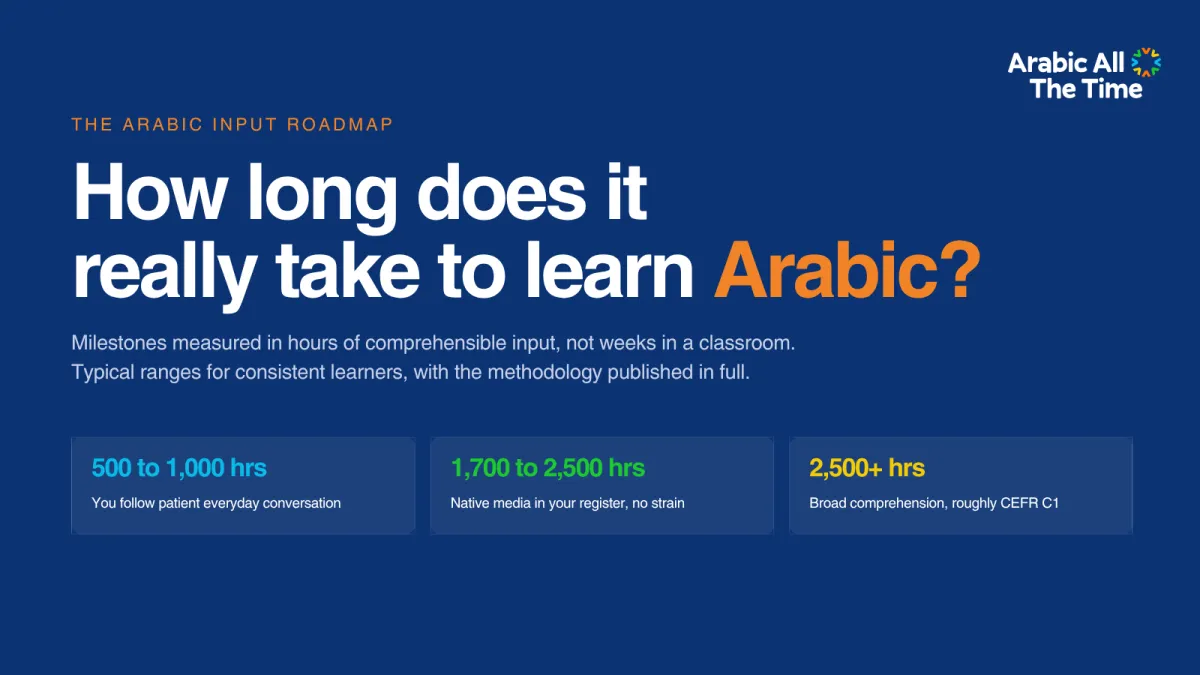
How Many Hours to Learn Arabic? The Honest Roadmap (FSI + Comprehensible Input)
The U.S. Foreign Service Institute estimates 2,200 hours to reach professional Arabic proficiency. Here are the realistic CEFR milestones at each stage of the journey, from 50 hours to 2,200 hours, based on FSI data and comprehensible input research.