How to Get 2,500 Hours of Arabic Input
By Hasan Alhamwi
Our roadmap has seven levels. Each one comes with a typical range of hours, and the last level sits around 2,500 hours of understood Arabic.
People read that number, look at the library, and ask a fair question: where is the rest supposed to come from?
This is the answer.
No library holds the whole road
The roadmap is the road. It is not the size of any website, including ours.
Dreaming Spanish, the largest library of this kind in any language, took more than nine years and a team to reach the 1,500 hours on their own roadmap. Comprehensible input cannot be scraped or generated. It has to be made, one video at a time, by people who know how to be understood.
So the question is not which library has 2,500 hours. None does. The question is where your hours come from at each stage of the road.
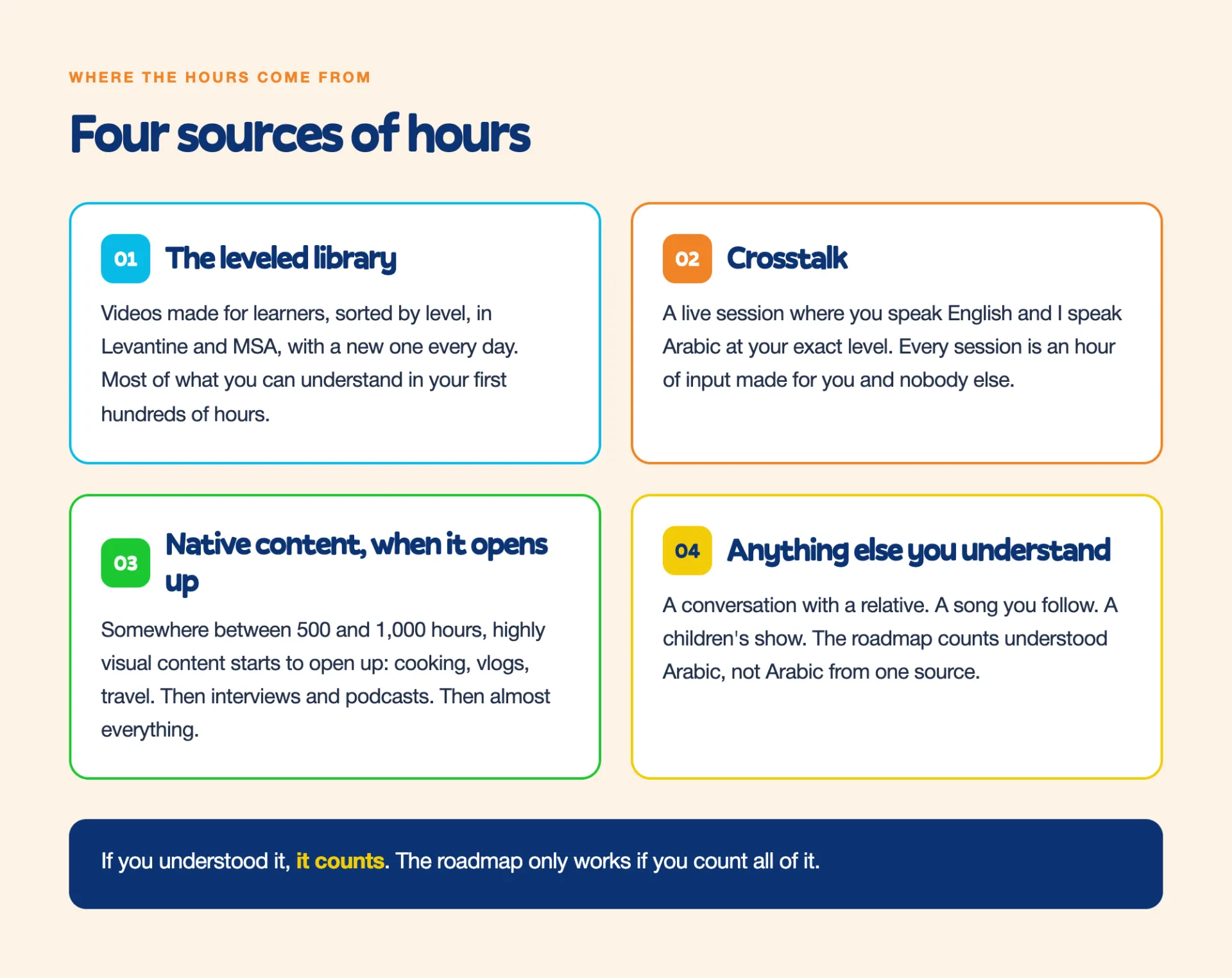 Four sources of hours
1. The leveled library
Videos made for learners, sorted by level, in Levantine and MSA, with a new one every day. In your first hundreds of hours this is most of what you can understand, so it is where we put our work.
You can see exactly what exists. Open the library, filter by level, or level and dialect, and the total videos and hours are shown at the top. We would rather you check than guess.
2. Crosstalk
A live session where you speak English and I speak Arabic at your exact level, adjusting as we go. If you look lost, the Arabic slows down, gets rephrased, gets drawn. Every session is an hour of input made for you and nobody else. No library can do that.
It works at any level, and it is the fastest way to add hours that fit you exactly. The first 30 minutes are free.
3. Native content, when it opens up
Content made for Arabic speakers is not understandable at first. That changes gradually. Somewhere between 500 and 1,000 hours, highly visual and well-edited content starts to open up: cooking videos, vlogs, travel shows, anything where the picture carries part of the meaning. After that, interviews and podcasts. After that, almost everything.
From this point on, most of your hours come from the real world, and the problem is choosing what to watch, not finding something you can.
4. Anything else you understand
A conversation with a relative. A song you follow. A children's show. If you understood it, it counts. The roadmap counts understood Arabic, not Arabic from one source.
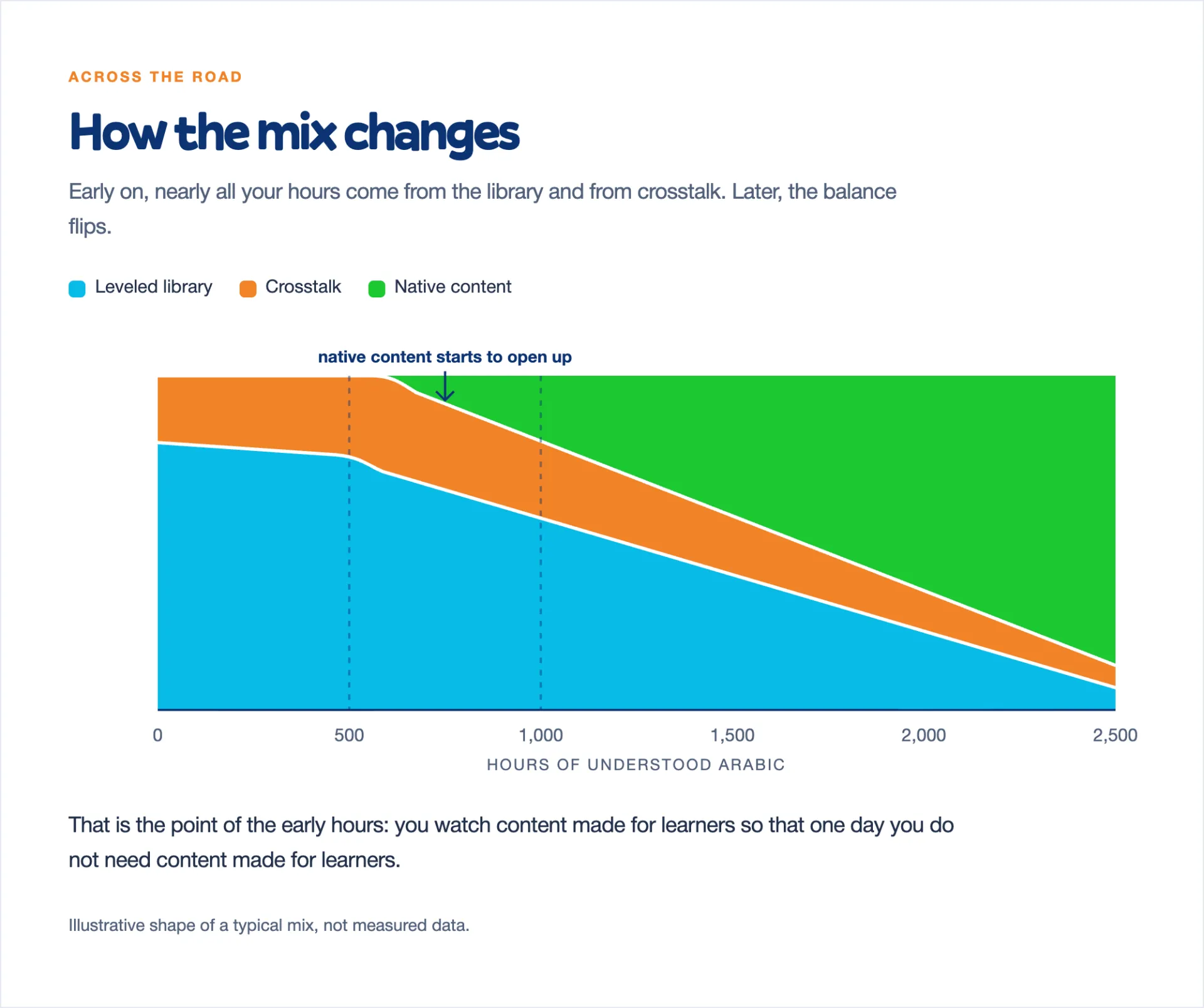 How the mix changes
Early on, nearly all your hours come from the library and from crosstalk, because nearly nothing else is understandable. This is the stage where most people quit, because it feels like there is nothing to listen to. There is. It is just made for you rather than for natives.
Later, the balance flips. Native content takes over, and the library becomes one source among many. That is the point of the early hours: you watch content made for learners so that one day you do not need content made for learners.
Count every hour
Your progress page tracks the hours you watch here automatically. For everything else, a crosstalk session, a show, a conversation, use the outside-input button and add it. The roadmap only works if you count all of it.
We are building the library the same way
A library of comprehensible input grows the way a language does: a little every day, for years, with the results showing up later than you would like. We publish every day. We are moving production back to the beginner levels next. And every premium member is funding the next video, which is why the library you see today is the smallest it will ever be.
Check the hours at your level. Start there. Add crosstalk when you want input made for you. Log everything. The road is long, and it is real, and you do not walk it alone.
Related posts

Arabic for Heritage Speakers: A Reactivation Plan Backed by Research
You understand your parents but freeze when you try to speak. Your Arabic isn't gone. It's dormant. Here's the research-backed plan to bring it back.
Is There a Dreaming Spanish for Arabic? An Honest Answer (From Someone Who Did Both)
Yes and no. I acquired Spanish through Dreaming Spanish, then built Arabic All The Time because the equivalent didn't exist. Here's the honest comparison, from someone who used both.

How to Use Arabic All The Time: Your First 30 Days (Week-by-Week Plan)
A realistic week-by-week plan for what to watch, how long to watch it, and what progress should actually feel like in your first 30 days on the platform.

How to Maintain Arabic Fluency: A Research-Backed Guide for Advanced Learners
Arabic fluency erodes without use. Research-backed framework for advanced learners and heritage speakers — what specifically decays first, how much daily exposure is enough, and how to reactivate dormant Arabic.

Krashen's 1,500-Word Threshold: When You're Ready to Read Arabic (Research-Backed)
Krashen's 1,500-word threshold for reading explained — when you're actually ready to read Arabic, why it matters, and how to reach it through comprehensible input.
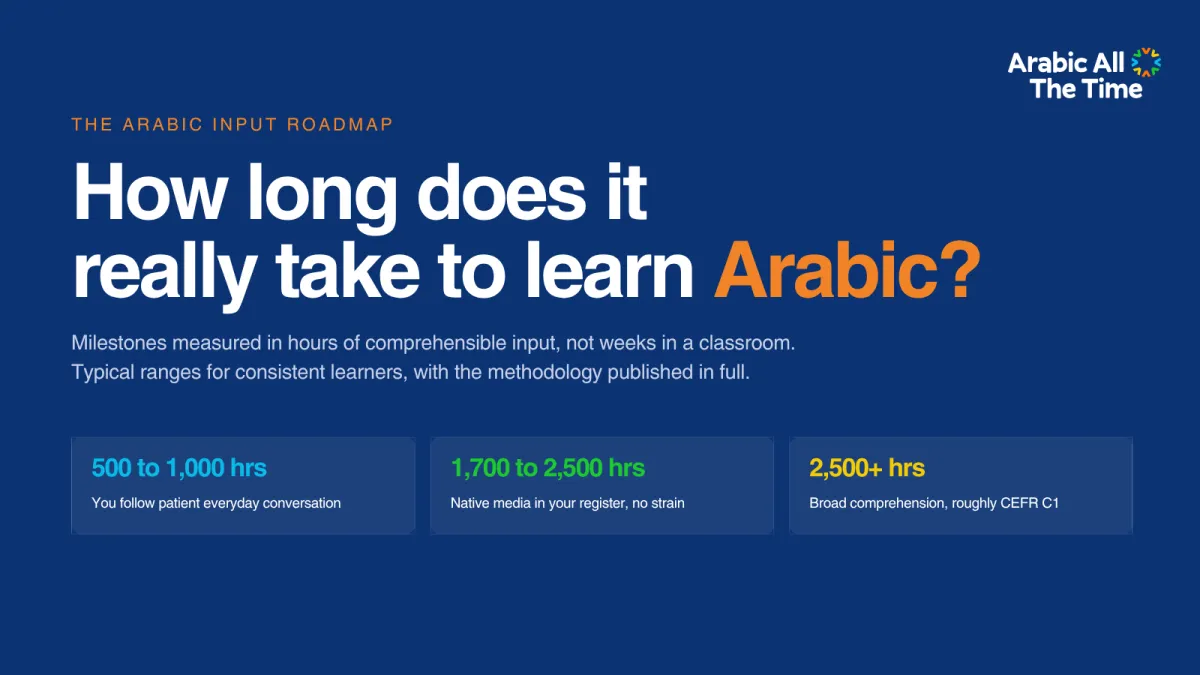
How Many Hours to Learn Arabic? The Honest Roadmap (FSI + Comprehensible Input)
The U.S. Foreign Service Institute estimates 2,200 hours to reach professional Arabic proficiency. Here are the realistic CEFR milestones at each stage of the journey, from 50 hours to 2,200 hours, based on FSI data and comprehensible input research.