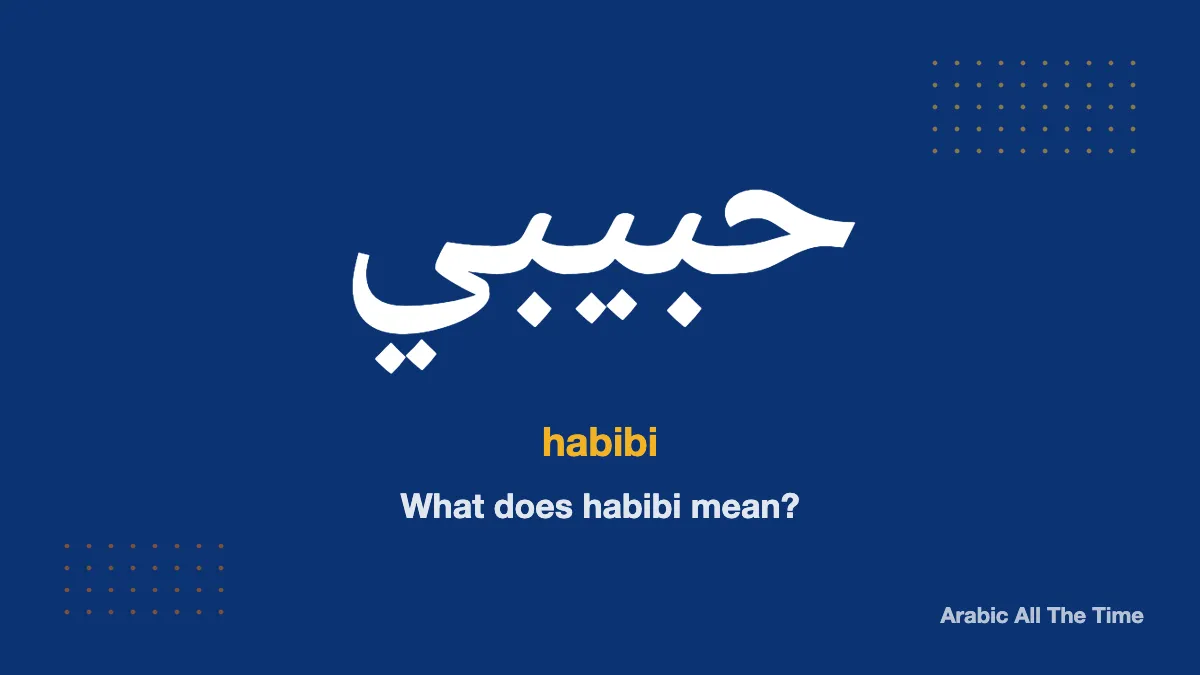
Habibi (حبيبي) means "my love" or "my dear." That's the dictionary answer. But if you translate it that way every time you hear it, you'll misunderstand most of the conversations it shows up in.
I grew up in Syria, where I heard habibi every day. My mother said it to me, and so did the man at the bakery when he handed me my bread. Neither of them meant it romantically. The word is warm, and Arabs spread that warmth around a lot more freely than English speakers spread "my love."
What habibi means, word by word
Habibi is two pieces. Habib (حبيب) means beloved, someone you love. The ending -i (ـي) means "my." Put them together and you get "my beloved."
Habib comes from the Arabic root ḥ-b-b (ح ب ب), which carries the idea of love. The same three letters give you hubb (حب), love, and bhebbak (بحبك), "I love you" in Levantine Arabic. Once your ears know the root, you start hearing it everywhere. Habib is also a common first name.
Habibi or habibti?
Arabic changes words for gender, and habibi is the masculine form. You say habibi to a man and habibti (حبيبتي) to a woman.
There's a small difference between spoken and formal Arabic here. In Modern Standard Arabic, the formal Arabic of books and the news, the feminine form is habibati. In everyday speech, in Syria, Lebanon, Egypt and almost everywhere else, people drop the middle vowel and say habibti. That's the one you'll actually hear.
In Lebanon and Syria you'll also hear habibi said to women, especially in quick, friendly speech. "Merci habibi" to a friend, man or woman, is completely normal in Beirut. When you're talking to a group, the plural is habaybi (حبايبي), "my dear ones."
Who Arabs call habibi
The relationship and the tone decide what habibi means. These are the situations you'll hear it in most.
- A partner. Here it really is "my love," the same as in songs.
- Children. Parents and grandparents say it constantly. "Ta'a la hon habibi" (تعا لهون حبيبي) is "come here, sweetheart."
- Friends. Men call each other habibi all the time, and it isn't romantic at all. It's closer to "buddy" or "my friend."
- Strangers. A taxi driver, a waiter or a shopkeeper might say "tfaddal habibi" (تفضل حبيبي), "here you go, my friend." It's politeness with some warmth in it.
- Annoyance. Said slowly with a certain look, "habibi, I told you three times" is not affectionate at all.
Is habibi romantic?
It can be, but usually it isn't. Between people of the same gender who know each other, it's ordinary friendliness. Between a man and a woman who aren't close, habibti can sound too familiar, and in more conservative settings it's better not to use it. If you're not sure, listen to how the people around you use it first.
Tone matters as much as the word. "Ya habibi!" said with a big smile can also mean "wow," the way someone might react to good news or a beautiful view.
Habibi in songs
Arabic pop music is full of habibi, and that's how many people outside the Arab world first hear it. Amr Diab's "Habibi Ya Nour El Ain," released in 1996, made the word famous far beyond Egypt. Fairuz, the Lebanese singer whose songs play in cafés across the Levant every morning, sang "Habaytak Bel Sayf," "I loved you in the summer," built on the same root.
More recently, "Habibi, come to Dubai" became a meme, and the word picked up a playful life of its own online.
Other words of affection
Other words do the same job. You'll hear these from parents, partners and close friends, mostly in Levantine Arabic.
- Habib albi (حبيب قلبي): "love of my heart."
- Ya albi (يا قلبي): "my heart."
- Ya rouhi (يا روحي): "my soul."
- Hayati (حياتي): "my life."
- Ya 'omri (يا عمري): also "my life."
You might notice albi starts with a little catch in the throat where the written word has a q. In the cities of Syria and Lebanon, the letter qaf (ق) is usually pronounced as a glottal stop, so qalbi becomes albi.
How to say it like a native
The first sound is the Arabic ḥ (ح). It's an h pushed from deeper in the throat, like breathing on glasses to clean them. The stress falls on the middle syllable, ha-BEE-bee. For a woman, ha-BEEB-tee.
You'll also hear it with ya in front, "ya habibi." Ya is the word Arabic uses to call someone, so "ya habibi" is "oh, my dear."
Hear it in real conversations
Reading about habibi gets you the meaning. Hearing it in real conversations, again and again, is how you get the feel for it. That's how every Arab learned it.
In one of my videos, I ask my twin sisters which of them loves me more, and Lutas answers "ana ktir bhebbak ya Hasan," "I love you a lot, Hasan," with the same root as habibi (8:53). In an episode where we follow the Turkish drama Nour, Maysoun calls her husband "ya rouhi" in the middle of an argument, and she doesn't mean it sweetly (10:22).
Every video on Arabic All The Time is made to be understood from the first minute, with free videos at every level. If you want the Arabic people actually speak in Syria, Lebanon, Jordan and Palestine, start with Levantine Arabic.
Frequently Asked Questions
What does habibi mean in English?
Habibi means "my love" or "my dear." Between friends it's closer to "buddy" or "my friend," and from a shopkeeper or taxi driver it's simply a warm way to be polite.
What is the difference between habibi and habibti?
Habibi is said to a man and habibti to a woman. In Lebanon and Syria, people also say habibi to women in casual speech. In formal Arabic the feminine form is habibati, but in daily life everyone says habibti.
Can I call my friend habibi?
Yes. Friends call each other habibi all the time, especially men, and it isn't romantic. With someone of the opposite gender you don't know well, it can sound too familiar, so wait until you hear how they talk.
Is habibi a religious word?
No. Habibi is an ordinary Arabic word with no religious meaning. Arabs of every religion use it.
How do you reply when someone calls you habibi?
You don't need to reply to the word itself. It's part of the sentence, like "my friend" in English. Among friends you can say habibi back.
Is habibi Levantine or Egyptian?
Both. Habibi is used in every Arabic dialect, from Morocco to the Gulf, and in Modern Standard Arabic. What changes is how freely people use it, and in the Levant and Egypt that's very freely.