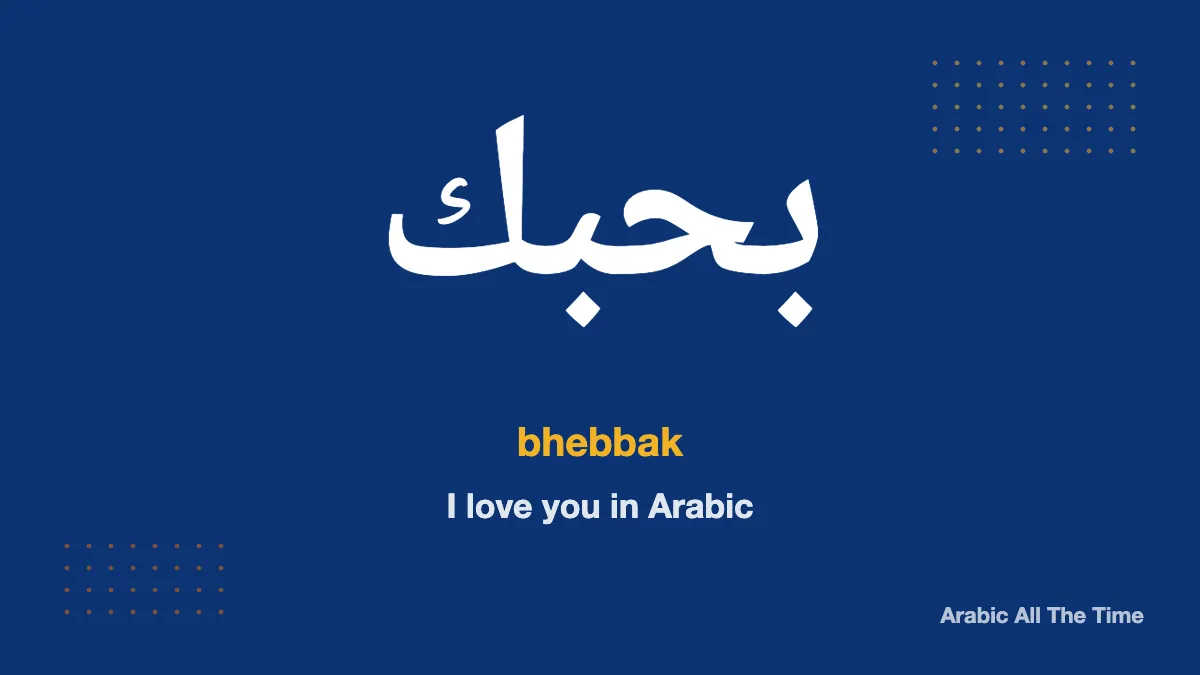
In everyday spoken Arabic in Syria, Lebanon, Jordan and Palestine, "I love you" is bhebbak (بحبك) to a man and bhebbik to a woman. You can add ana, "I," in front, ana bhebbak, and it sounds a little more deliberate.
Arabic changes the word depending on who you're talking to, so there's no single "I love you" to memorize. It also changes from country to country, and the formal Arabic of books has its own version.
I love you to a man, a woman or a group
- To a man: bhebbak (بحبك)
- To a woman: bhebbik (بحبك)
- To a group: bhebbkon (بحبكن), which you'll hear a lot from singers on stage and from parents to their kids
The masculine and feminine forms are written the same way in Arabic, and only the vowel tells them apart. That's one reason it's so much easier to learn these words by hearing them than by reading them.
The formal version: uhibbuk
In Modern Standard Arabic, the formal Arabic of books, poetry and the news, it's uhibbuka (أحبكَ) to a man and uhibbuki (أحبكِ) to a woman. In song lyrics and poems you'll often see ana uhibbuk.
It's correct, and every Arab understands it, but people rarely say it to their partner over dinner. If you say uhibbuki in a café in Beirut, it will sound like a line from a poem. That can be romantic, or it can make people smile. For daily life, the spoken form is the one you want. I wrote more about how the two kinds of Arabic fit together in MSA or a dialect, which first?
I love you in other dialects
- Egyptian: bahebbak to a man, bahebbek to a woman. The extra "a" at the start is very Egyptian.
- Gulf and Iraqi: ahibbak to a man, and to a woman you'll often hear ahibbich, with a "ch" sound.
- Moroccan: kanbghik, the same for a man or a woman, from a completely different verb.
Saying it with more feeling
- Ana ktir bhebbak (أنا كتير بحبك): "I love you so much." Ktir means "a lot."
- Bmout fik (بموت فيك): literally "I die in you," meaning "I'm crazy about you." To a woman, bmout fiki.
- Ya habibi or ya habibti: "my love." You can read everything about that one in What does habibi mean?
How to say "I love you too"
The simplest answer is w ana kaman (وأنا كمان), "me too." If you want to say the whole thing, it's w ana kaman bhebbak to a man or bhebbik to a woman. In Egypt, w ana kaman is the same.
It isn't only romantic
Arabs say bhebbak to family and close friends much more easily than English speakers say "I love you." Parents say it to their kids all day. Two friends might end a phone call with "bhebbak ya zalameh," "love you, man." And the same verb works for things. Bhebb el-ahweh is "I love coffee," and bhebbo is "I love it."
Hear it in real conversations
In a video with my twin sisters, I ask which of them loves me more. Lutas answers "ana ktir bhebbak ya Hasan," "I love you so much, Hasan" (8:53), and a few seconds later the other twin jumps in with "w ana bhebbak ya Hasan kaman," "and I love you too, Hasan" (9:00). When I cook shawarma at home, you'll hear the same verb for things, "ana ktir bhebb rihet el-hel," "I really love the smell of cardamom" (4:48). And in a walk around my city, I say simply "ana bhebb Montreal" (5:12).
Every video on Arabic All The Time is made to be understood from the first minute, with free videos at every level. For the Arabic people actually speak in Syria, Lebanon, Jordan and Palestine, start with Levantine Arabic.
Frequently Asked Questions
How do you say I love you in Arabic?
In spoken Levantine Arabic, bhebbak to a man and bhebbik to a woman. In formal Arabic, uhibbuka to a man and uhibbuki to a woman.
How do you say I love you to a woman in Arabic?
Bhebbik in Levantine Arabic, bahebbek in Egyptian and uhibbuki in formal Arabic.
How do you say I love you to a man in Arabic?
Bhebbak in Levantine Arabic, bahebbak in Egyptian and uhibbuka in formal Arabic.
How do you say I love you too in Arabic?
W ana kaman, "me too," or w ana kaman bhebbak to a man and bhebbik to a woman.
What does ana bhebbak mean?
It means "I love you," said to a man, in Levantine Arabic. Ana is "I," and bhebbak is "I love you."
Is ana uhibbuk used in everyday Arabic?
Not much. It's the formal version from books, poetry and songs. People understand it, but in daily life they use their own dialect's form, like bhebbak in the Levant.