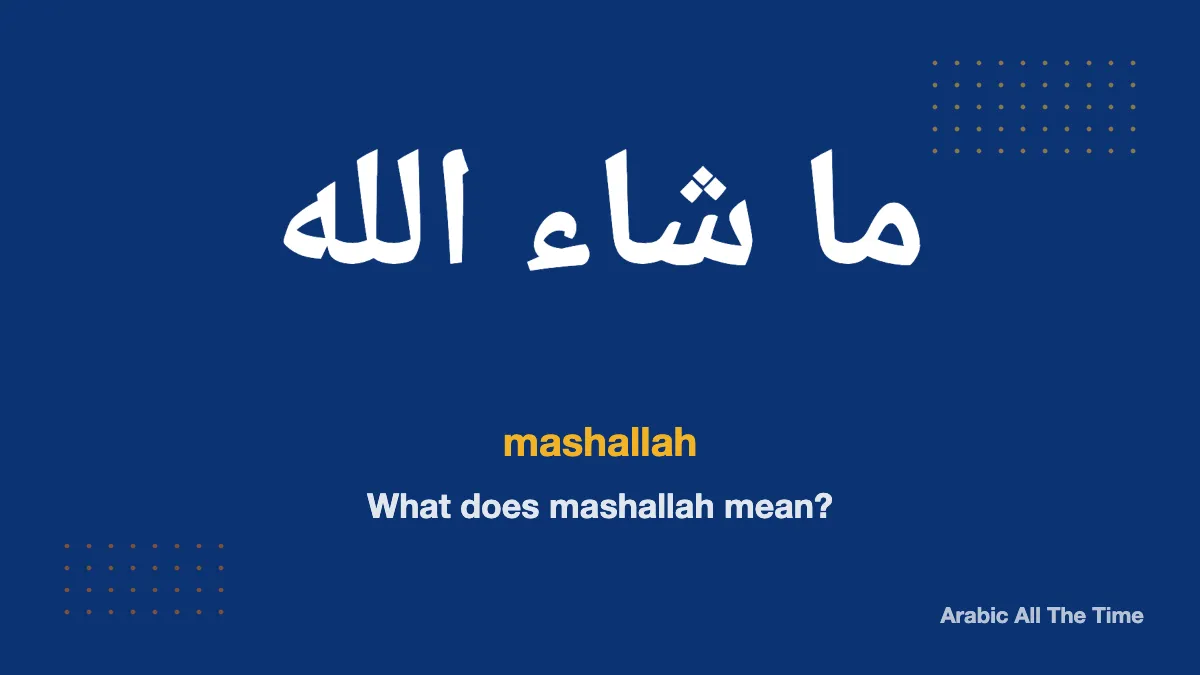
Mashallah (ما شاء الله) means "what God has willed." Arabs say it when they see or hear something good, like a new baby, a friend's new job, a beautiful house or a plate of food that came out perfect.
It's praise and a kind wish at the same time. When someone says mashallah about your child or your work, they're telling you it's wonderful and that they wish it well.
What mashallah means, word by word
Like inshallah, it's three words. Ma (ما) means "what." Sha'a (شاء) means "willed" or "wished." Allah (الله) means God. Together they mean "what God has willed," or more naturally, "look at what God has given."
In speech it becomes one word, mashallah. In Syria and Lebanon you'll often hear mashalla, without the h at the end.
When Arabs say mashallah
- Children. This is the classic one. Someone sees your son after a year and says "mashallah, kbir!" (ما شاء الله كبير), "mashallah, he's so grown!"
- Success. A new job, a graduation, a new home. "Mashallah 'alek" (ما شاء الله عليك) is "good for you," said to a man. To a woman it's 'aleki.
- Anything impressive. A great view, a beautiful car, a meal someone worked hard on. Here it works a lot like "wow."
- Your Arabic. Speak a few sentences of Arabic to an Arab and there's a good chance the first thing you'll hear back is "mashallah!"
Mashallah and the evil eye
In many Arab and Muslim communities, people believe that admiring something too openly, without wishing it well, can invite envy, known as al-'ayn (العين), the evil eye. Saying mashallah is a way of showing that your praise comes with no envy at all.
That's why you'll hear it so often around babies and good news, and why you'll see ما شاء الله written on car windows and shop walls. Not everyone takes the evil eye seriously, but the habit of saying mashallah is everywhere.
Mashallah or inshallah?
The two sound alike, and learners mix them up all the time. The difference is time. Mashallah is for something good that already happened or that you can see right now. Inshallah, "if God wills," is for something you hope will happen.
Your friend got the job? Mashallah. Your friend has the interview tomorrow? Inshallah.
Tabarak Allah and Allahumma barik
You'll often hear mashallah paired with a blessing. Tabarak Allah (تبارك الله), "blessed is God," is very common in the Gulf and in Morocco, where tbarkallah 'lik is an everyday "well done." Allahumma barik (اللهم بارك), "O God, bless it," is another favorite. "Mashallah tabarak Allah" together is a very warm compliment.
Is mashallah only for Muslims?
The phrase is Islamic in origin, and many Muslims say it with real religious meaning. In daily life, Arab Christians say it too, especially in the Levant, the same way they say inshallah. If you're not Muslim and you say it sincerely, people will take it as a warm, respectful compliment.
How to reply to mashallah
- Allah ybarek fik (الله يبارك فيك), "God bless you," is the most common reply. To a woman, fiki.
- Shukran is always fine too.
Hear it in real conversations
Mashallah comes up most when someone shows you a new baby or a new house, and that doesn't happen on camera very often. What you'll hear in my videos is the praise that sits right next to it. When my twin sisters say something sweet, I answer "Allah, Allah, dam'it 'eyni," "wow, I teared up" (4:50). When the shawarma meat is done, it's "ya salam" (13:34), and my sister Lutas adds "el-riha bitjannen," "the smell is amazing" (19:57). And when a learner who started Arabic seven months earlier shows how far he's come, I tell him his Arabic is excellent and say "bravo" (14:39), exactly the kind of moment where you'd also hear mashallah.
Every video on Arabic All The Time is made to be understood from the first minute, with free videos at every level. For the Arabic people actually speak in Syria, Lebanon, Jordan and Palestine, start with Levantine Arabic.
Frequently Asked Questions
What does mashallah mean in English?
Mashallah means "what God has willed." People use it to admire something good, a bit like "wow" or "good for you," with a blessing included.
What is the difference between mashallah and inshallah?
Mashallah is for good things that already happened or that you can see now. Inshallah, "if God wills," is for things you hope will happen in the future.
Why do Arabs say mashallah to babies?
Because praising a baby is the moment people most want to show they mean well. Many believe mashallah protects what's being praised from envy, the evil eye.
What does it mean when someone says mashallah to a girl?
It's a compliment with a blessing, usually about how she looks, what she did or how she's grown. On its own it isn't flirting. Who says it and how they say it tell you the rest.
How do you respond to mashallah?
Say Allah ybarek fik, "God bless you," or Allah ybarek fiki to a woman. Shukran works too.
Can non-Muslims say mashallah?
Yes. Arab Christians use it in daily life, and when anyone says it sincerely, it's received as a warm compliment.