What Is Modern Standard Arabic? An Arab's Plain-Language Guide to MSA (Fusha)
By Hasan Alhamwi
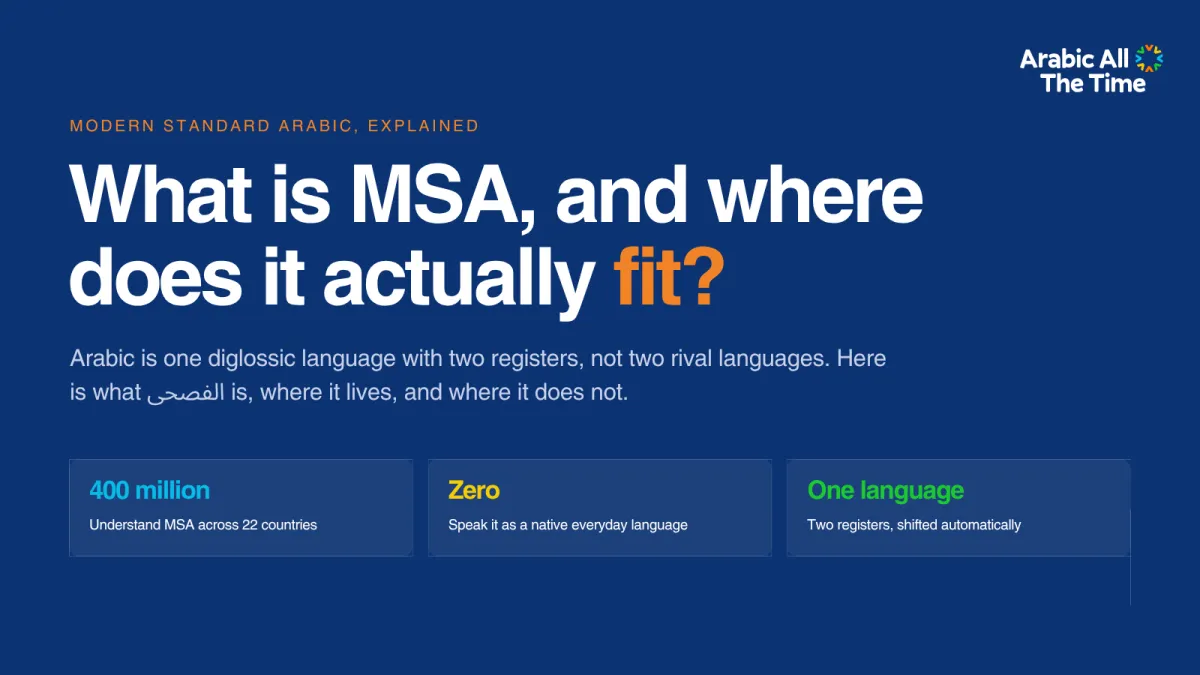
Modern Standard Arabic, known as MSA or الفصحى (al-Fusha), is the formal register of Arabic used in news broadcasts, official speeches, literature, education, and written communication across the entire Arab world. Linguists describe Arabic as a diglossic language, a concept formalized by Stanford linguist Charles Ferguson in his 1959 paper Diglossia: a single language existing in two forms, a "high" formal variety (MSA) and "low" everyday spoken varieties (Levantine, Egyptian, Gulf, Maghrebi, and others). MSA is understood by over 400 million people across 22 Arab countries, but no one speaks it as a native everyday language. It is the Arabic of Al Jazeera, of newspapers, of academic textbooks, of formal public life, and the Arabic that connects the Arab world linguistically across enormous geographic and cultural distances. For learners, understanding what MSA actually is, where it sits in the Arabic language as a whole, and where it doesn't, is foundational to deciding how to learn Arabic.
I'm a native Arab speaker. I grew up speaking Levantine at home, learning MSA at school, hearing both daily, and switching between them naturally without conscious thought. This post is the explanation I wish I could have given my younger self learning English about how my own language actually works.
Where MSA Comes From
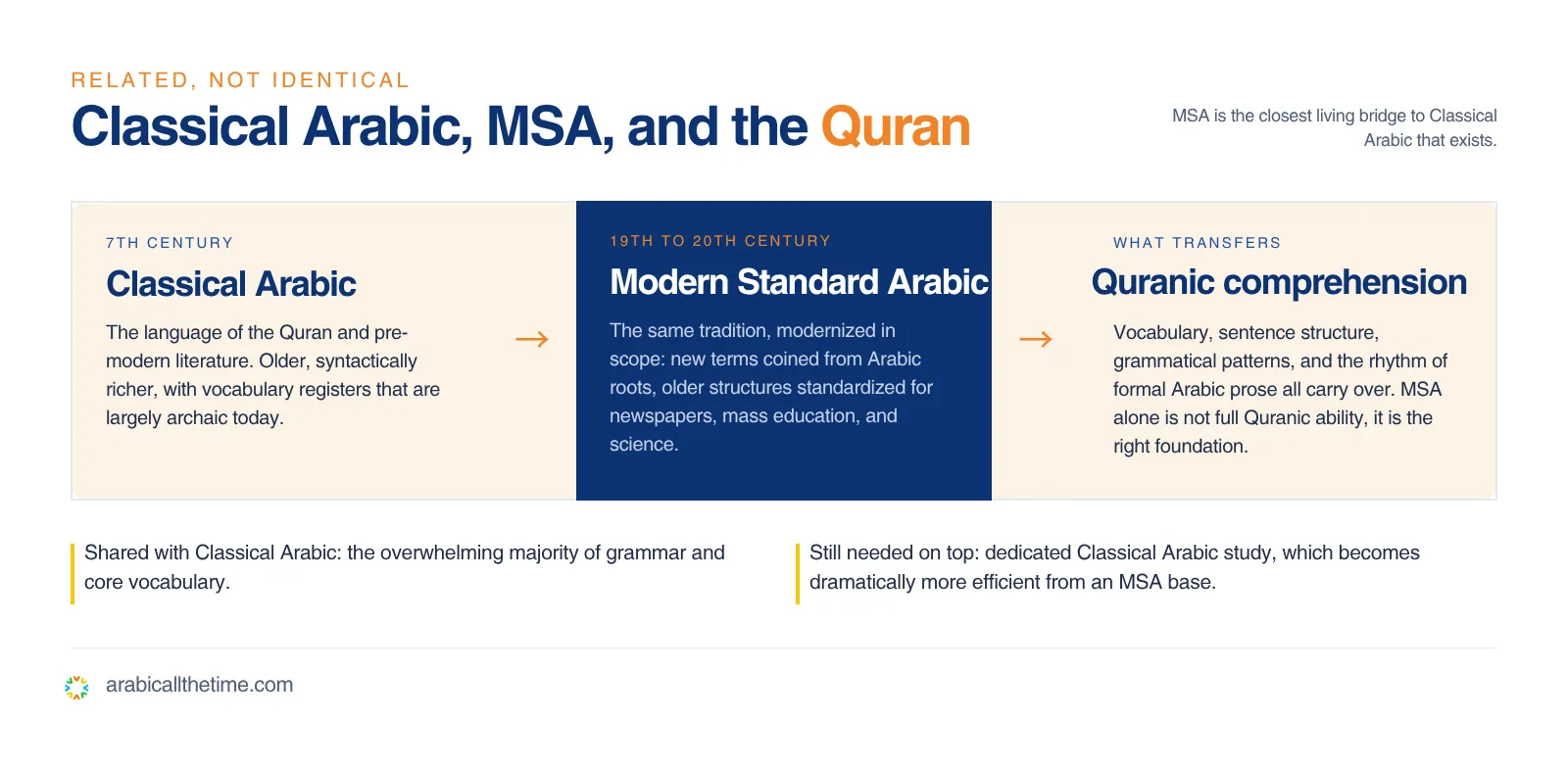
Modern Standard Arabic descends directly from Classical Arabic, the language of the Quran and pre-modern Arabic literature, dating to the 7th century. Classical Arabic was the prestige language of a vast medieval civilization stretching from Spain to Central Asia. It produced a literary tradition that includes some of the most influential poetry, philosophy, and scientific writing in human history.
As the Arab world entered the modern era in the 19th and 20th centuries, confronting newspapers, mass education, science, technology, and modern political life, Classical Arabic was carefully updated to handle the new vocabulary required. New terms were coined from Arabic roots. Older syntactic structures were standardized. The result was Modern Standard Arabic: fully continuous with Classical Arabic in grammar and core vocabulary, modernized in scope.
So MSA isn't a living mother tongue in the traditional sense. No child grows up speaking it at home. But it's deeply alive, in every newspaper, every formal broadcast, every official document, every school curriculum across the Arab world. Arabs learn it through education the way English speakers learn formal written English, except the gap between formal and informal Arabic is significantly larger than the gap between formal and informal English.
 MSA and Diglossia: The Real Structure of Arabic
This is where most explanations of Arabic get it wrong. The common framing is that Arabic is split into two competing things, formal Arabic on one side and everyday speech on the other, as though they're rival options. That framing imports a foreign concept onto the language. Arabs don't experience Arabic this way.
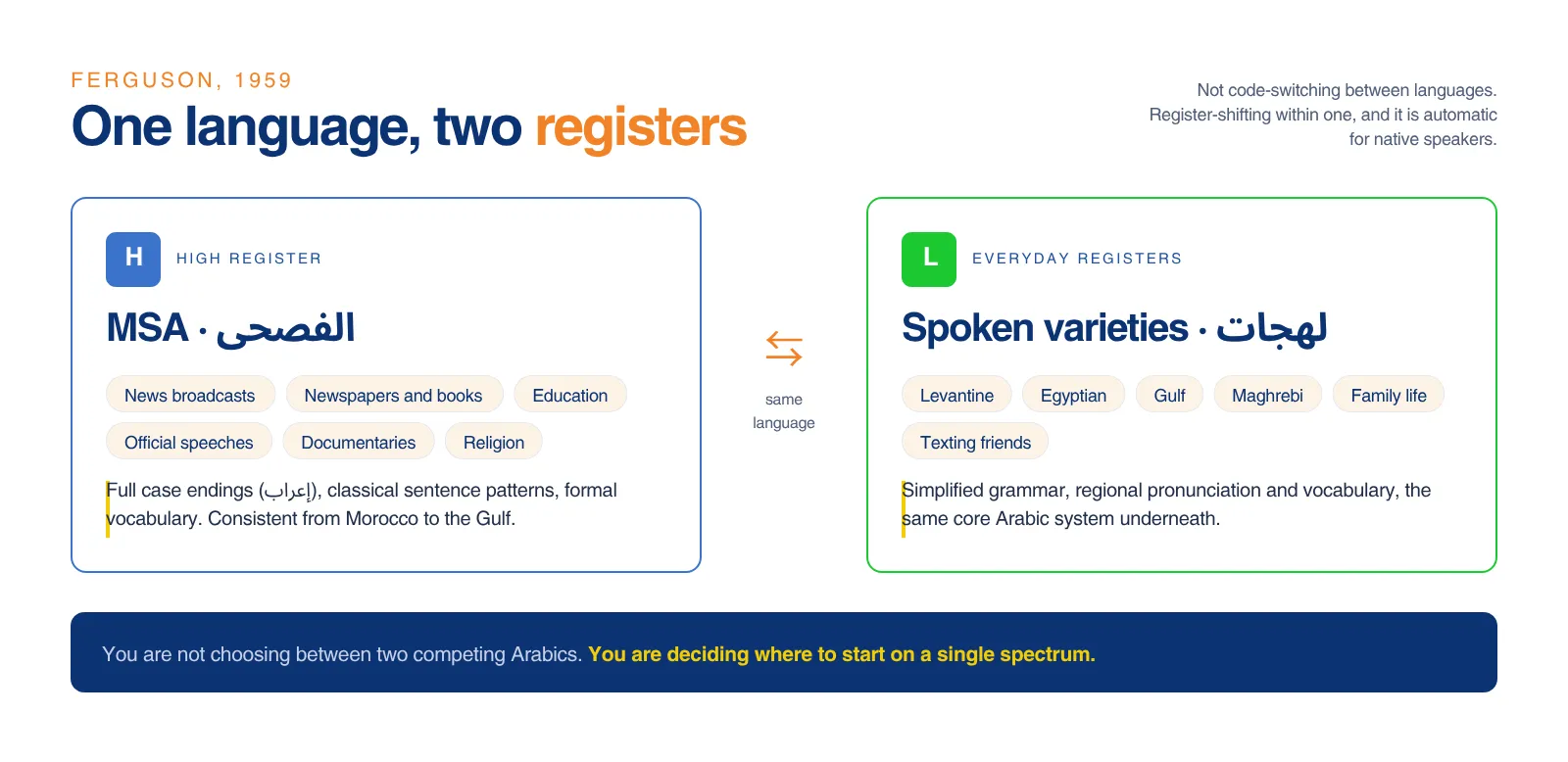
The accurate framework comes from Charles Ferguson, the Stanford linguist who coined the term diglossia in his 1959 paper of the same name. Ferguson described diglossia as a stable sociolinguistic situation in which two varieties of the same language coexist in a single speech community, each with its own social functions. The "high" variety (in Arabic, MSA) is used in formal writing, education, religion, journalism, and official speech. The "low" varieties (Levantine, Egyptian, Gulf, Maghrebi, and others) are used in everyday conversation, family life, popular culture, and informal communication.
Critically, Ferguson argued, and modern Arabic linguistics broadly agrees, that the two varieties function as one language operating in two registers, not as separate languages. Native speakers move between them constantly: writing a formal email in MSA, texting a friend in Levantine, watching the news in MSA, calling their mother in Egyptian. It's not code-switching between languages. It's register-shifting within one language. That shift is natural and automatic for Arabs.
What learners often call "dialects" are what Arabs call لهجات (lahjat), accents. Regional ways of speaking the same Arabic. Syrian, Egyptian, Gulf, Moroccan: these aren't separate languages. They're how Arabic sounds when it's spoken casually in different places, the same way American and British English are both English.
For learners, understanding this changes everything. You're not choosing between two competing Arabics. You're deciding where to start on a single spectrum. Our guide to starting with Levantine covers that choice in practice.
What MSA Sounds and Looks Like
If you've ever heard an Arabic news broadcast, you've heard MSA. It's formal, precise, and consistent: the same whether the speaker is Syrian, Egyptian, or Moroccan. That consistency is one of MSA's most important features, mutual intelligibility across the entire Arab world. A Moroccan and a Saudi who wouldn't easily follow each other's everyday spoken Arabic can communicate in MSA without difficulty.
MSA has full case endings (إعراب, i'rāb), grammatical suffixes that change depending on a word's role in a sentence, which are largely dropped in spoken varieties. Its vocabulary is more formal and classical. Its sentence structures follow Classical Arabic patterns that spoken Arabic naturally simplifies. To a native Arab speaker, MSA sounds the way formal written English sounds to a native English speaker: recognizable, respected, and clearly distinct from everyday conversation.
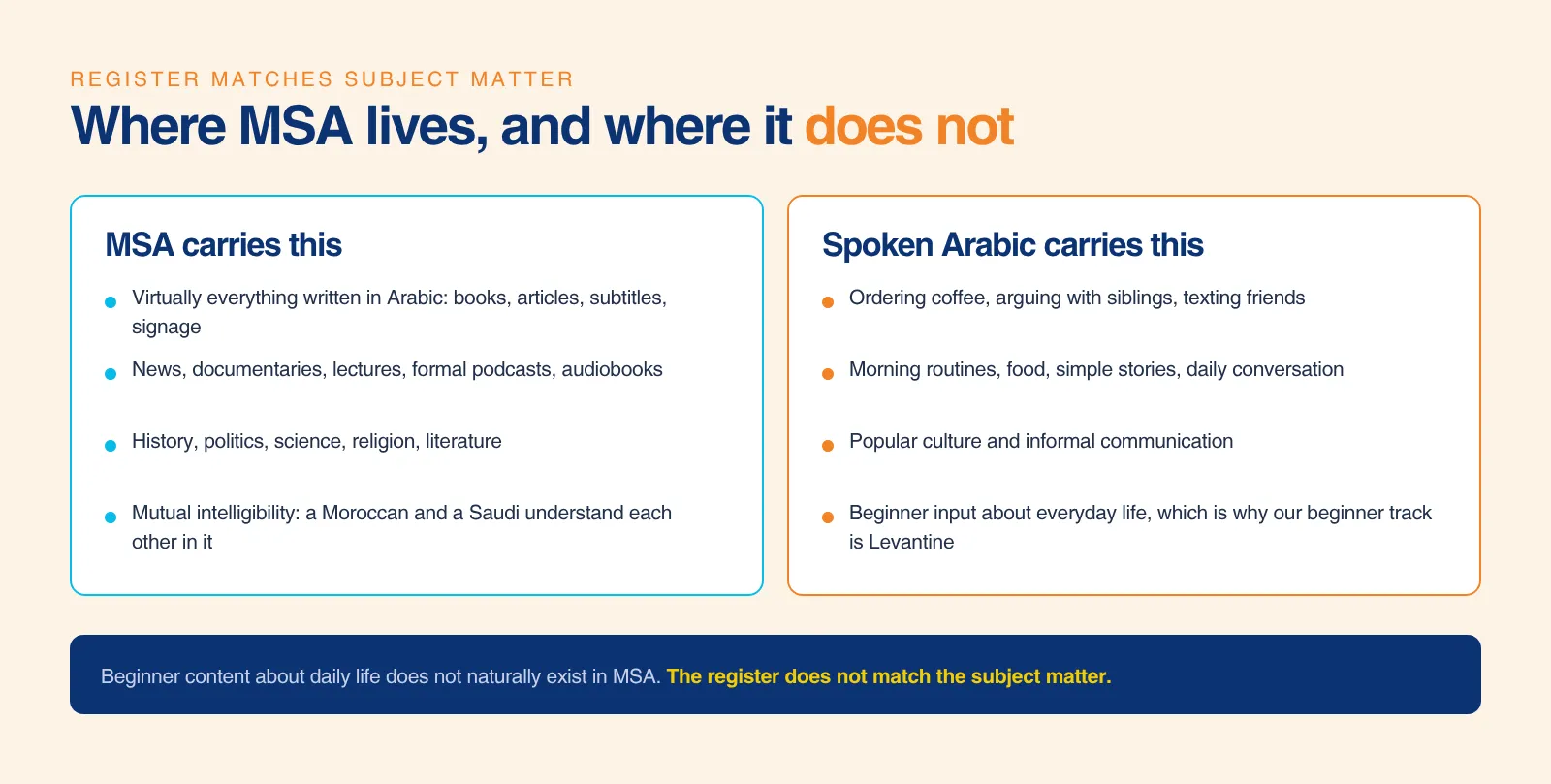
Written Arabic is almost always MSA. Books, articles, news sites, subtitles, signage: if it's written in Arabic, it's virtually always in MSA. This means reading ability and MSA comprehension are deeply connected. You can't become a literate reader of Arabic without acquiring MSA.
 Why MSA Matters for Learners
The practical case for MSA is strong. It's the Arabic of every serious written source. It's the Arabic of documentaries, lectures, formal podcasts, and educational videos. It's the Arabic of history, politics, science, religion, and literature. If you want to engage with Arabic media and culture beyond casual conversation, MSA is unavoidable.
It's also the Arabic with the most comprehensible input available at the intermediate and advanced level. Once you have a base in MSA, you unlock an enormous body of content: Al Jazeera, BBC Arabic, countless YouTube channels, audiobooks, full documentary libraries. The volume of accessible MSA content at intermediate and advanced levels is on a different scale than what's available for any single spoken variety.
And practically: MSA is understood everywhere. Whatever country you're visiting, whatever Arab speaker you're meeting, MSA works. It may sound formal for casual conversation, but it's never wrong. It's the closest thing Arabic has to a universal default.
Where MSA Has Limits
MSA isn't used for daily life. Nobody orders coffee in Fusha. Nobody argues with their siblings in MSA. Nobody texts their friends in Modern Standard Arabic. Everyday conversation across the Arab world happens in spoken varieties, Levantine, Egyptian, Gulf, Maghrebi, and attempting to use MSA in casual settings sounds stiff and unnatural.
This has a direct practical consequence for learners: beginner content about daily life doesn't naturally exist in MSA. If you're at the very beginning and looking for comprehensible input about everyday topics, morning routines, food, simple stories, daily conversations, MSA isn't where that content naturally lives. The register doesn't match the subject matter.
This is why at Arabic All The Time, we use Levantine Arabic for beginner content covering daily life and MSA for intermediate and advanced material covering formal subjects. Not because MSA and Levantine are separate languages, they aren't, but because the type of content that works for beginners is everyday content, and everyday content happens naturally in spoken Arabic. As learners advance into news, history, science, and formal topics, MSA takes over, and at that level the resources are vast.
 How Long Does It Take to Acquire MSA?
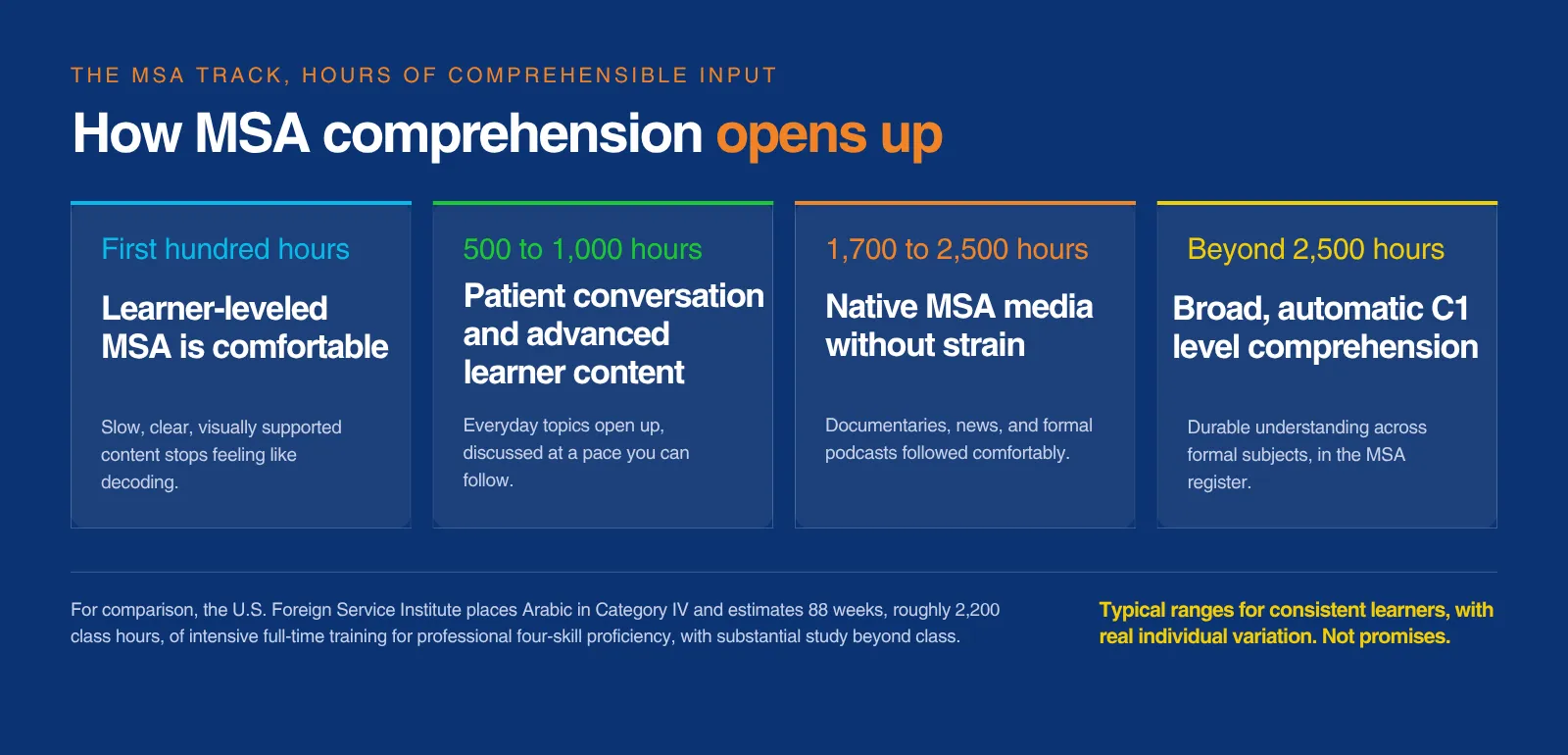
Arabic is classified by the U.S. Foreign Service Institute as a Category IV language, alongside Mandarin, Japanese, and Korean, its most demanding tier, with an estimate of 88 weeks, approximately 2,200 class hours, of intensive full-time training to reach professional working proficiency across all four skills. Students also study substantially outside class, so total time on task exceeds that figure. It measures something most learners aren't aiming for.
For input-based acquisition, the MSA track follows the same milestone roadmap as any register of Arabic. Learner-leveled MSA content becomes comfortable across the first few hundred hours of input. Patient conversation and advanced learner content on everyday topics opens between 500 and 1,000 hours. Native MSA media, documentaries, news, and formal podcasts followed without strain, typically arrives between 1,700 and 2,500 hours. Broad, automatic C1-level comprehension arrives beyond 2,500 hours. These are typical ranges with real individual variation, and the full reasoning behind every number is public: read the honest Arabic hours roadmap and the methodology behind it.
These timelines aren't longer than what traditional study demands for comparable ability. They're often shorter, and the comprehension they build is dramatically more durable.
 MSA and the Quran
A common question: if I'm learning Arabic to understand the Quran, should I focus on MSA?
Yes, with an important clarification. The Quran is written in Classical Arabic (often called Quranic Arabic), which predates MSA by more than a millennium. MSA is derived from Classical Arabic and shares the overwhelming majority of its grammar and core vocabulary, but Classical Arabic is older, syntactically richer, and uses vocabulary registers that are largely archaic in modern usage.
Think of MSA as the modern descendant of the same formal Arabic tradition. Every hour of MSA comprehensible input you build transfers directly toward Quranic comprehension: vocabulary, sentence structure, grammatical patterns, and the rhythm of formal Arabic prose. It's the closest living bridge to Classical Arabic that exists. MSA alone won't give you full Quranic fluency, which requires dedicated Classical Arabic study on top of an MSA foundation, but MSA is the right foundation to build on, and it makes subsequent Classical Arabic study dramatically more efficient.
How to Acquire MSA Through Comprehensible Input
The same way you acquire any Arabic: comprehensible input. Slow, clear, visually supported content in MSA that you can mostly understand. Not grammar drills. Not vocabulary memorization. Not translation exercises. Listening and watching content that's slightly above your current level, with enough context that meaning becomes clear without conscious translation.
Decades of research by Stephen Krashen at the University of Southern California have established that humans acquire language by understanding meaningful messages, not by studying language as an abstract system. His Input Hypothesis, formalized in his 1982 book Principles and Practice in Second Language Acquisition, has been supported across hundreds of studies in dozens of languages, and applies to MSA acquisition just as it does to Spanish, Mandarin, or any other language. Our approach page explains what comprehensible input actually means in practice.
At the beginner level, we recommend starting with Levantine content for daily life topics and letting MSA grow alongside it as you move into more formal subjects. The two reinforce each other because they're the same language at different registers, with substantial overlap in core vocabulary and structure. Our roadmap counts each register's hours on its own track, with real but partial transfer between them, so follow your interests: as they pull you toward news, history, and formal topics, your MSA track accumulates naturally. If you're brand new, here's exactly how to start.
At the intermediate level, MSA content is everywhere. News programs, documentaries, educational YouTube channels, formal podcasts, audiobooks: your comprehensible input library becomes enormous. Acquisition accelerates because the resources are abundant and high-quality.
Try a Free Crosstalk Session
If you want to hear what MSA sounds like at a beginner-accessible pace, and feel what comprehensible input in MSA actually looks like, I offer free 30-minute crosstalk sessions for new learners in both MSA and Levantine Arabic. You speak English. I speak Arabic. We talk about pictures, topics you're curious about, things from your daily life. No pressure to produce Arabic. Just real comprehensible input, calibrated to where you are right now.
Most people are surprised by how much MSA they understand by the end of their first session. Book a free session here.
Frequently Asked Questions
What is Modern Standard Arabic (MSA)?
Modern Standard Arabic (MSA), known in Arabic as الفصحى (al-Fusha), is the formal register of Arabic used in news, literature, education, official speeches, and written communication across all 22 Arab countries. It's derived from Classical Arabic, the language of the Quran, and was standardized in the modern era to handle contemporary vocabulary. No one speaks MSA as a native everyday language, but all educated Arabs understand it and use it in formal contexts. Arabic is what linguist Charles Ferguson called a diglossic language: MSA is the formal "high" register, and spoken varieties like Levantine and Egyptian are the everyday "low" registers.
Is Modern Standard Arabic the same as Classical Arabic?
Not exactly. MSA is derived from Classical Arabic and shares most of its grammar and vocabulary, but Classical Arabic is older, syntactically richer, and uses some vocabulary registers that are largely archaic today. Classical Arabic is the language of the Quran and pre-modern Arabic literature. MSA is its modernized descendant, the formal Arabic of contemporary journalism, education, and official communication. Closely related but not identical.
Is Modern Standard Arabic the same as Fusha?
Yes. الفصحى (al-Fusha) is the Arabic name for the formal Arabic register that includes both Classical Arabic and MSA. Most contemporary speakers use "Fusha" specifically to mean MSA in modern contexts. The literal meaning of Fusha is "the eloquent" or "the most clear," capturing how the formal register has been culturally positioned within Arab society for over a millennium.
Should I learn MSA or spoken Arabic first?
Arabic is one language: MSA and spoken varieties are registers of the same language, not two separate choices. For absolute beginners, spoken Arabic works better for everyday content because MSA isn't used in casual daily life. As you advance, MSA becomes essential; it's the Arabic of news, documentaries, and formal media. Start with spoken Arabic for beginner content, then let MSA grow alongside it as you advance. Our Levantine starting guide covers the choice in practice.
Who actually speaks Modern Standard Arabic?
No one speaks MSA as their everyday native language, but all educated Arabs understand it and use it in formal contexts. News anchors, politicians, academics, and public figures across all Arab countries use MSA for formal communication. It's what makes Arabic mutually intelligible across the entire Arab world, from Morocco to the Gulf. Educated speakers move between MSA and their native spoken variety automatically depending on context.
Is MSA useful for learning Arabic in the modern world?
Extremely. MSA is the Arabic of newspapers, books, news broadcasts, documentaries, academic content, religious texts, and formal communication. At the intermediate and advanced level, the comprehensible input available in MSA is vast, significantly more than for any individual spoken variety. If you want to be literate in Arabic, engage with Arabic media, or read serious texts, MSA is unavoidable.
How is MSA different from Egyptian or Levantine Arabic?
MSA is the formal written and broadcast register. Egyptian and Levantine are regional spoken accents used in daily conversation. Same language, different registers: like the difference between formal written English and how people actually speak at home, but with a wider gap. MSA has full classical grammar and case endings. Spoken accents simplify the grammar, modify pronunciation, and have regional vocabulary differences, but share the same core Arabic linguistic system.
Can I understand spoken Arabic if I learn MSA?
Partially, and unevenly. MSA gives you the largest shared vocabulary base in Arabic, which means you'll recognize many words across spoken varieties. But spoken accents have grammatical simplifications, vocabulary shifts, and pronunciation patterns that aren't in MSA, so a pure MSA learner can find spoken Arabic surprisingly difficult to follow without exposure to the spoken varieties themselves. The most efficient path includes both registers, since they reinforce rather than compete with each other.
Will MSA help me understand the Quran?
Yes, significantly, though not completely. The Quran is written in Classical Arabic, which predates MSA but shares the overwhelming majority of its grammar, vocabulary, and sentence structure. Every hour of MSA comprehensible input transfers directly toward Quranic comprehension. MSA alone won't produce full Quranic fluency, which requires dedicated Classical Arabic study on top of an MSA foundation, but MSA is the right base to build on, and it makes subsequent Quranic Arabic study dramatically more efficient than starting from zero.
How many hours of comprehensible input does it take to acquire MSA?
The U.S. Foreign Service Institute places Arabic in Category IV and estimates 88 weeks, approximately 2,200 class hours, of intensive full-time training for professional four-skill proficiency, with substantial study beyond class time. On an input-based path, the MSA track follows our published roadmap: learner-leveled content becomes comfortable across the first few hundred hours, everyday comprehension opens between 500 and 1,000 hours, native MSA media arrives between 1,700 and 2,500 hours, and broad C1-level comprehension arrives beyond 2,500 hours in the MSA register. The full methodology is public on our roadmap.
The Bottom Line
Modern Standard Arabic isn't a separate language from spoken Arabic, and it isn't a fossilized academic construct either. It's the formal register of a single living language, shared across 22 countries, connecting 400 million speakers, sustained by every newspaper and broadcast and book published in Arabic for the past century and a half.
If you want to read Arabic, you need MSA. If you want to follow Arabic media beyond casual conversation, you need MSA. If you want to engage with Arabic literature, history, politics, science, or religious texts, you need MSA.
The good news: MSA is acquired the same way every other language is acquired, through sufficient comprehensible input, calibrated to your level, accumulated over time. There are no shortcuts. There's also no mystery. Just the work, daily, of understanding Arabic that's slightly beyond where you are. When you're ready, start with a free video at your level, book a free crosstalk session, or read the honest hours roadmap next.
References
Ferguson, C. A. (1959). Diglossia. Word, 15(2), 325 to 340.
Krashen, S. D. (1982). Principles and Practice in Second Language Acquisition. Pergamon Press.
Ryding, K. C. (2005). A Reference Grammar of Modern Standard Arabic. Cambridge University Press.
U.S. Foreign Service Institute. Language Difficulty Rankings. U.S. Department of State.
Versteegh, K. (2014). The Arabic Language (2nd ed.). Edinburgh University Press.
Related posts
How to Get 2,500 Hours of Arabic Input
The Arabic roadmap runs to 2,500 hours. No library holds them all. Here is where every hour comes from, and how to count them.
Arabic for Heritage Speakers: A Reactivation Plan Backed by Research
If you understand Arabic but freeze when it's your turn to speak, you're not a beginner. The research on heritage speakers, why your Arabic is dormant rather than gone, the two-registers problem you inherited, and the exact plan to reactivate it through input, then give speaking its own short block of practice.
Is There a Dreaming Spanish for Arabic? An Honest Answer (From Someone Who Did Both)
Is there a Dreaming Spanish for Arabic? Yes in method, not yet in scale. Why Dreaming Spanish works, why Arabic never got its version, what the research says about video input for Arabic, and what Arabic All The Time is and honestly isn't yet.

How to Use Arabic All The Time: Your First 30 Days (Week-by-Week Plan)
A realistic week-by-week plan for your first 30 days on Arabic All The Time: how to pick your level, how long to watch, what the doubt week feels like, what honestly happens by day 30, and the four mistakes that stall almost every beginner.

How to Maintain Arabic Fluency (and Get It Back If It Slipped)
Arabic fades without use, and it fades in a predictable order. What the research says about losing a language, what goes first in Arabic, the daily routine that keeps it, and how heritage speakers wake theirs back up.

Krashen's 1,500-Word Threshold: When You're Ready to Read Arabic (Research-Backed)
Krashen's 1,500-word threshold for reading explained — when you're actually ready to read Arabic, why it matters, and how to reach it through comprehensible input.