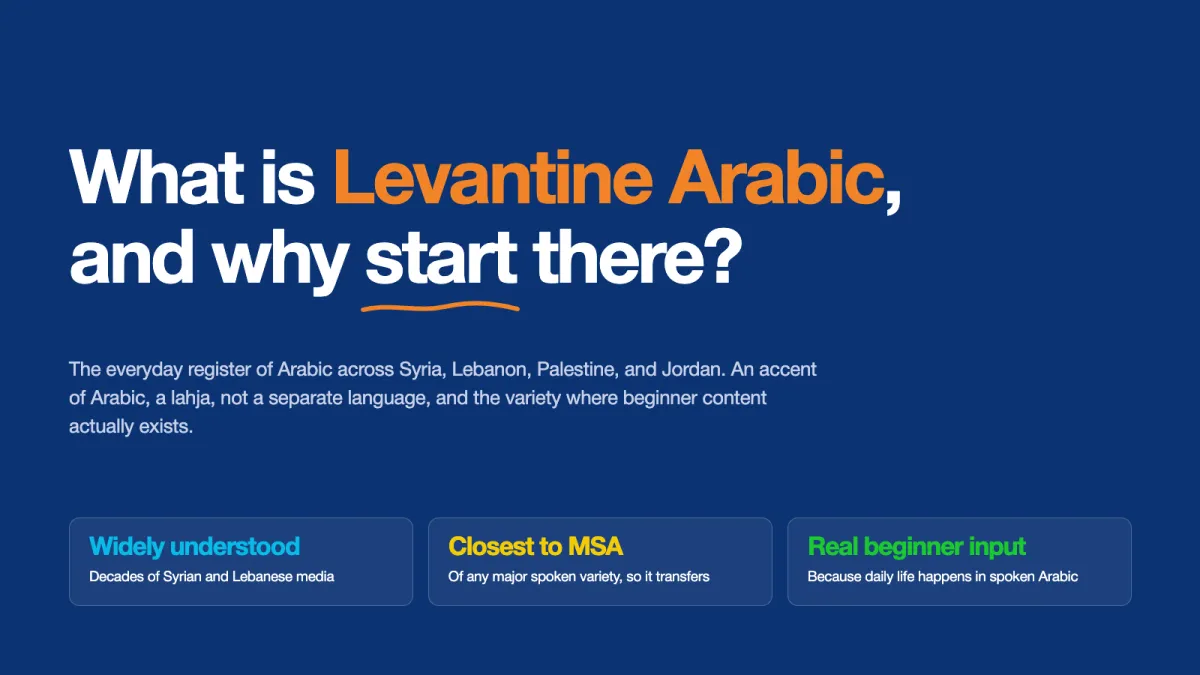
Levantine Arabic, known as Shami (شامي), is the spoken variety of Arabic used in everyday life across Syria, Lebanon, Palestine, and Jordan, by tens of millions of people in the Levant and large diaspora communities worldwide. Arabs consider it an accent of Arabic, a lahja, not a separate language: the everyday register of the same Arabic whose formal register is Modern Standard Arabic, a two-register structure the linguist Charles Ferguson described in his 1959 work on diglossia. For learners, Levantine matters for three practical reasons. It is one of the most widely understood varieties in the Arab world thanks to decades of Syrian and Lebanese media. It sits closer to MSA than any other major spoken variety, so everything you acquire transfers. And it is the variety where natural beginner content actually exists, because everyday life happens in spoken Arabic. This guide explains what Levantine is, where it fits in the language, and how to acquire it naturally.
I'm a native speaker. I grew up in Syria speaking Levantine at home, acquired MSA through cartoons, news, and history shows, and picked up other accents through movies and friendships. None of it ever felt like learning separate languages. It felt like the same language showing up in different rooms.
 What Levantine Arabic Is
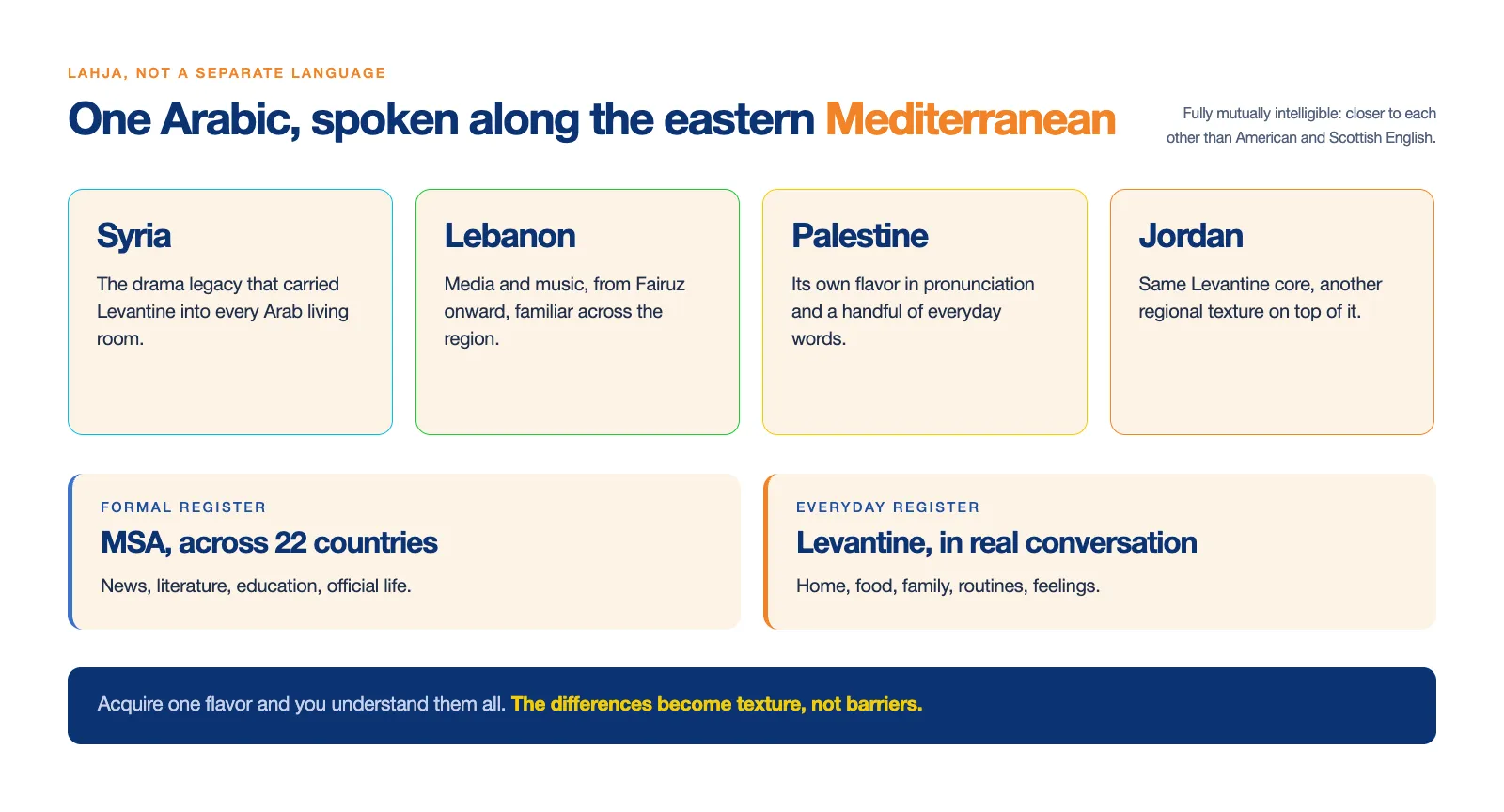
Arabic is one language with two kinds of registers: a formal one, Modern Standard Arabic, used in news, literature, education, and official life across 22 countries, and everyday spoken varieties used in real conversation. Levantine is the spoken variety of the Levant, the region along the eastern Mediterranean. What learners often call "dialects" are what Arabs call lahjat, accents: regional ways of speaking the same Arabic, the way American and British English are both English.
Within Levantine there are shades: Syrian, Lebanese, Palestinian, and Jordanian each have their own flavor in pronunciation and a handful of words. They are fully mutually intelligible, closer to each other than American and Scottish English. Acquire one and you understand them all; the differences become texture, not barriers.
 Why Levantine Is the Best Spoken Starting Point
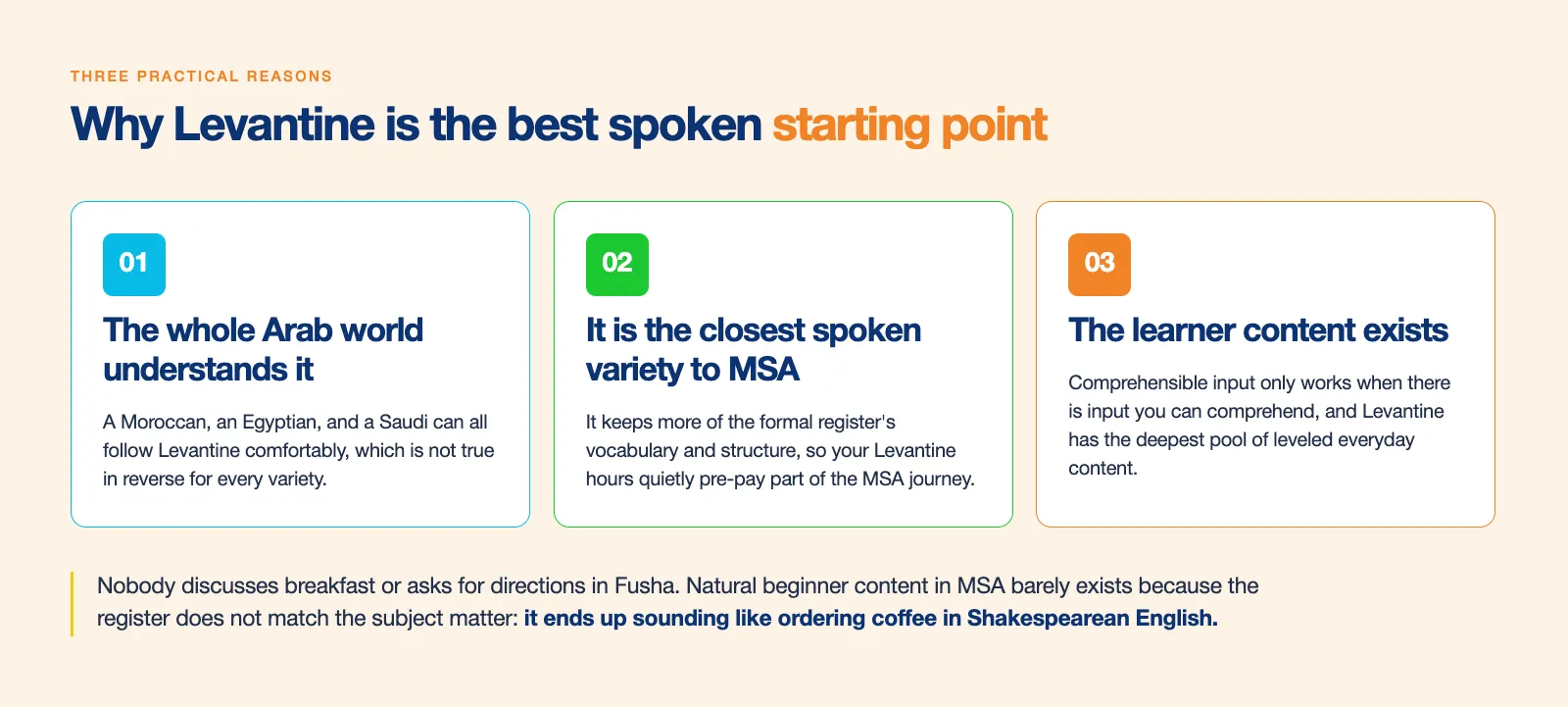
The whole Arab world understands it. Syrian dramas dominated Arab television for decades, and Lebanese media and music, from Fairuz onward, reached every Arab living room. That media legacy means a Moroccan, an Egyptian, and a Saudi can all follow Levantine comfortably, which is not true in reverse for every variety.
It is the closest spoken variety to MSA. Levantine preserves more of the formal register's vocabulary and structure than other major varieties, so the bridge into news, literature, and formal Arabic later is shorter. Your Levantine hours quietly pre-pay part of your MSA journey.
The learner content exists. Comprehensible input only works when there is input you can comprehend, and Levantine has the deepest pool of leveled, everyday content for learners, including the library we build daily at Arabic All The Time. If you want the full starting path, our Levantine Arabic page lays it out level by level.
Why We Built Levantine Alongside MSA, Not After It
The conventional advice says pick one Arabic and stick with it: MSA first, then a spoken variety, because mixing them will supposedly confuse you. That advice is wrong, and my own life is the counterexample. I acquired Levantine at home, MSA from television, and other accents from exposure, all overlapping, never sequential. That is how every Arab acquires multiple registers: through exposure, not through sequential study.
There is also a practical reason beginners start with Levantine: MSA is not used for daily life. Nobody discusses breakfast or asks for directions in Fusha. Beginner content, in any language, has to be about ordinary life, food, family, routines, feelings, and ordinary life in Arabic happens in spoken varieties. Natural beginner content in MSA barely exists because the register does not match the subject matter. It ends up sounding like ordering coffee in Shakespearean English: technically grammatical, totally unnatural.
MSA becomes essential at the intermediate and advanced level, where history, politics, science, documentaries, and serious media live, and where its content universe is vast. But that comes after the foundation is built, when your ear is ready for it. For a deeper look at what MSA is and why it matters, we've covered that separately, and the two registers reinforce each other precisely because they are one language.
 How to Acquire Levantine Naturally
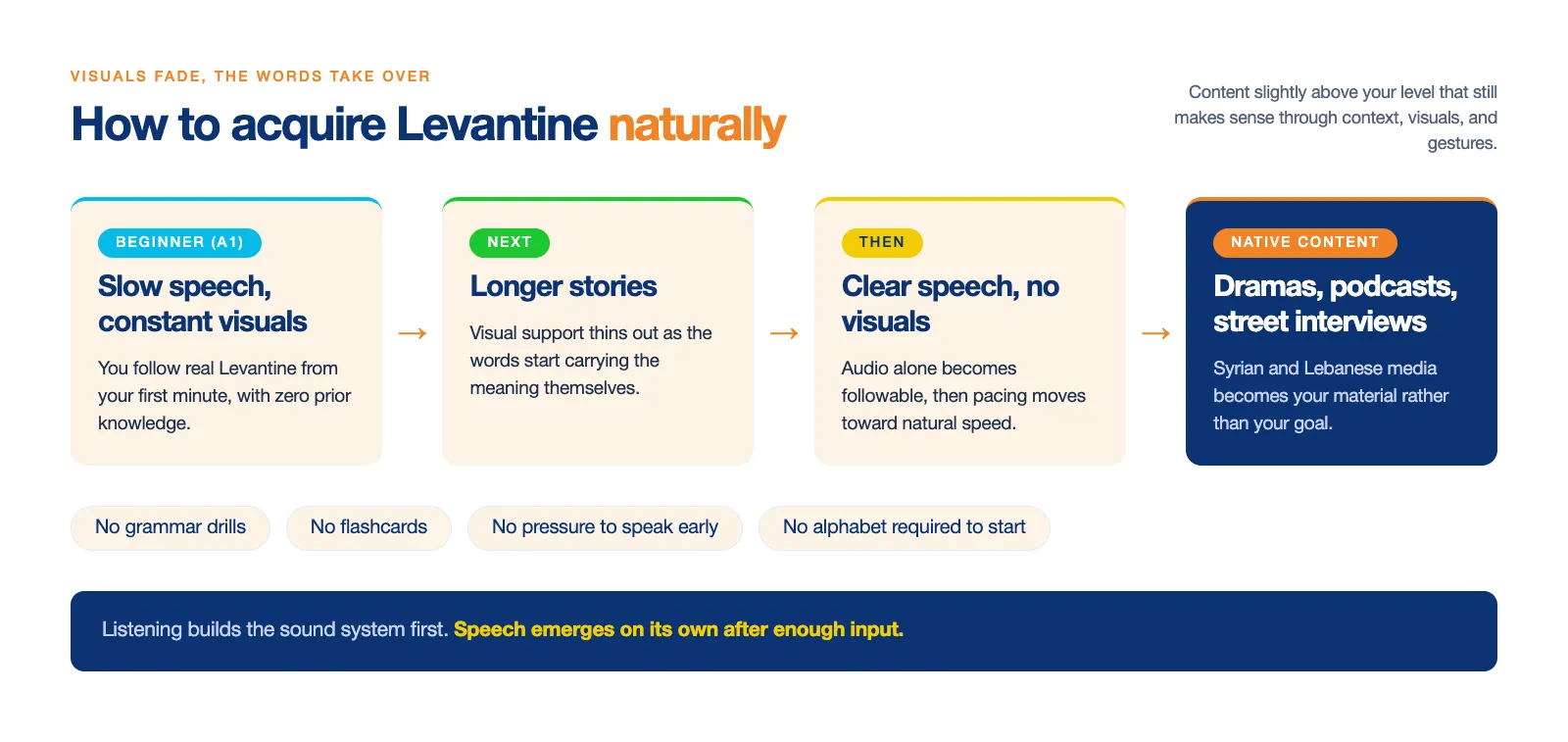
The same way you acquired your first language: comprehensible input. Content slightly above your level that still makes sense through context, visuals, and gestures. Decades of research associated with Stephen Krashen show that people acquire language by understanding messages, not by memorizing rules, and the evidence is summarized in our review of the research.
In practice the path looks like this. At Beginner (A1), slow speech and constant visuals carry the meaning, so you follow real Levantine from your very first minute with zero prior knowledge. As you level up, the visuals fade and the words take over, through longer stories, then clear speech without visual support, then near-natural pacing, until native content, Syrian and Lebanese dramas, podcasts, street interviews, becomes your material. No grammar drills, no flashcards, and no pressure to speak early: listening builds the sound system first. Speaking is a separate skill that comes later, and it takes its own practice once you understand enough to have something to say.
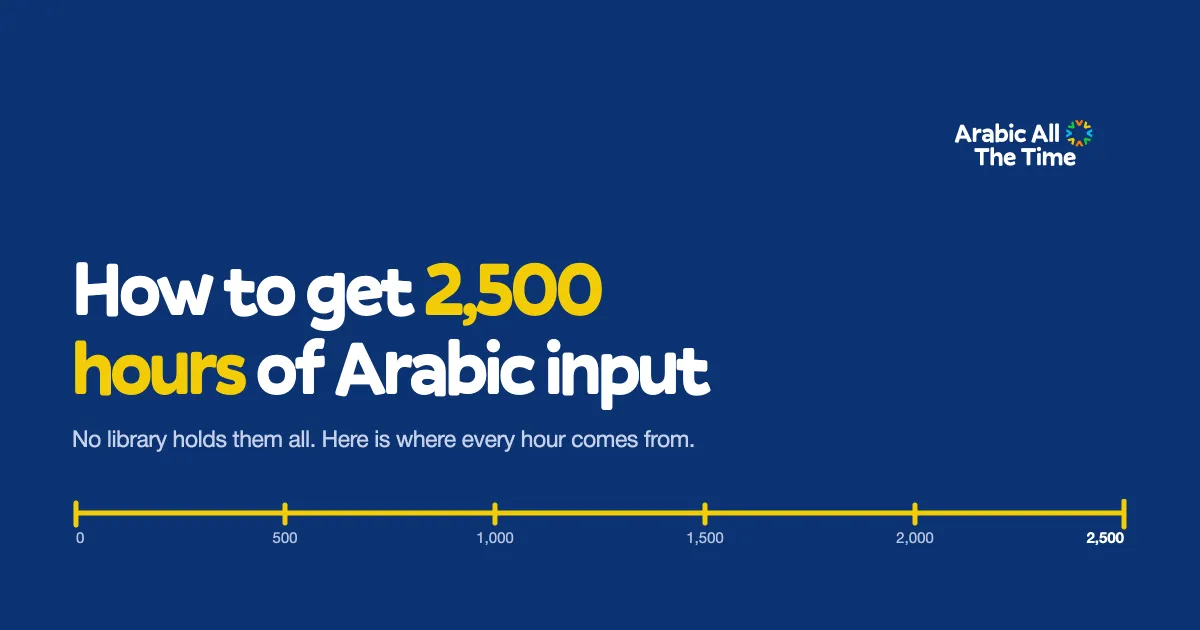
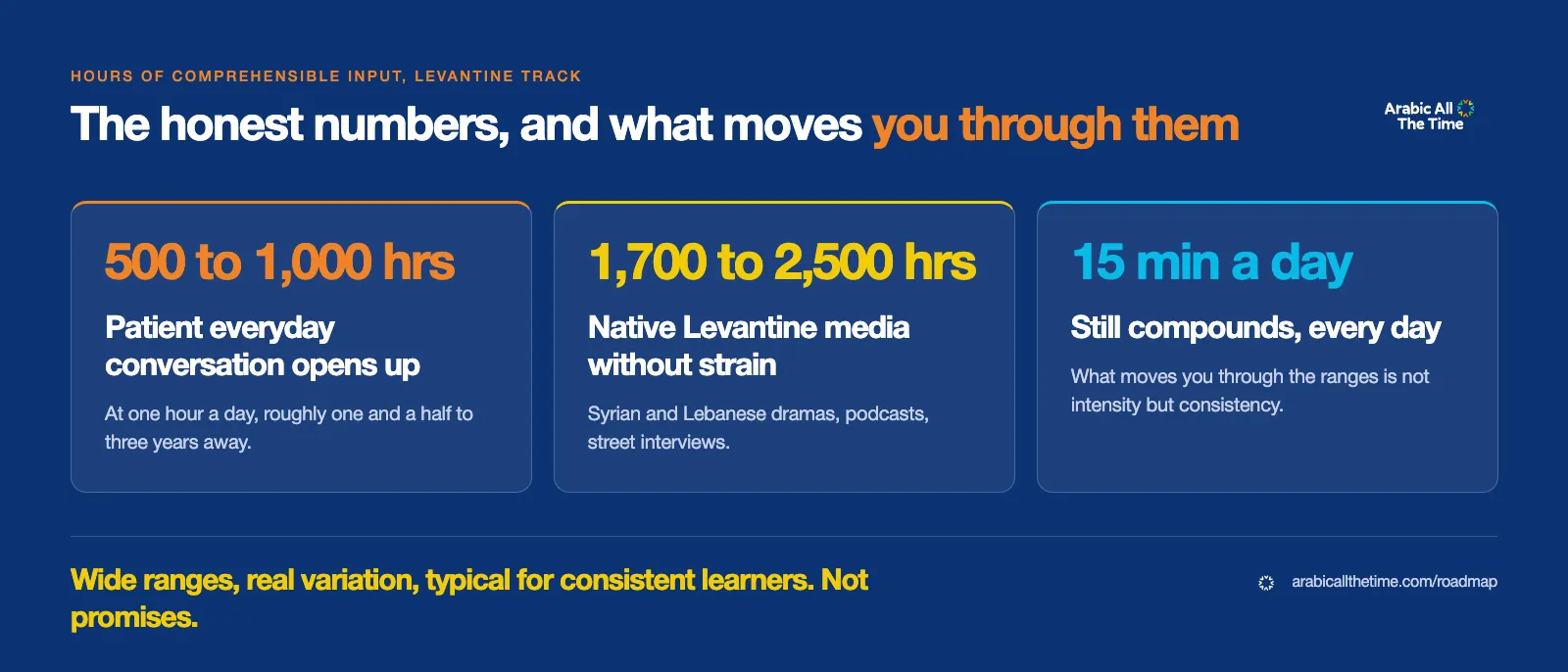
On timelines, the honest numbers: following patient everyday conversation typically opens between 500 and 1,000 hours of comprehensible input, and native Levantine media without strain typically arrives between 1,700 and 2,500 hours. Wide ranges, real variation, and the full math is public in the hours roadmap. What moves you through them is not intensity but consistency: even 15 minutes of understood Arabic every day compounds.
 Try a Free Crosstalk Session in Levantine Arabic
If you want to experience what Levantine comprehensible input feels like live, I offer free 30-minute crosstalk sessions. You speak English. I speak Levantine Arabic. We talk about pictures, your daily life, topics you care about, with zero pressure to produce Arabic, just input calibrated to your exact level. Most people are surprised by how much they understand in the first session. Book a free session here.
Frequently Asked Questions
What is Levantine Arabic?
Levantine Arabic, Shami (شامي), is the spoken variety of Arabic used in Syria, Lebanon, Palestine, and Jordan. Arabs consider it an accent of Arabic rather than a separate language. It sits close to Modern Standard Arabic in vocabulary and structure, and it's one of the most widely understood Arabic varieties across the Arab world thanks to the reach of Levantine media and large diaspora communities.
Where is Levantine Arabic spoken?
Across the Levant: Syria, Lebanon, Palestine, and Jordan, and in the large Levantine diaspora communities of Europe, North and South America, and the Gulf. Because Syrian and Lebanese media reached the entire Arab world for decades, Levantine is also widely understood far beyond the region itself.
Is Levantine Arabic a separate language?
No. Arabic is one language with regional spoken varieties, lahjat, and a shared formal register, MSA. Levantine is one of those varieties, the way American English is a variety of English. Syrian, Lebanese, Palestinian, and Jordanian speakers understand each other completely, and educated speakers move between Levantine and MSA automatically depending on the setting.
Should I learn Levantine or Egyptian Arabic?
Both are excellent choices with massive media behind them, Egyptian through its film legacy, Levantine through decades of television drama and music. Levantine has two practical edges for a new learner: it is the closest major spoken variety to MSA, so more of what you acquire transfers to formal Arabic later, and it currently has the deepest pool of leveled learner content. Whichever you pick, pick one, build real comprehension in it, and the next variety comes far faster.
Is Levantine Arabic close to MSA?
Closer than any other major spoken variety. They share a large core of vocabulary and structure; Levantine simplifies the formal grammar, drops the case endings, and shifts some sounds and function words. That closeness is one of the best reasons to start with it: your Levantine foundation shortens the bridge into news, literature, and formal Arabic.
Can other Arabs understand Levantine Arabic?
Yes, almost universally. Syrian dramas and Lebanese media made Levantine familiar in every Arab country, so speaking it works from Morocco to the Gulf. It is one of the safest varieties to be understood in across the whole Arab world.
How long does it take to learn Levantine Arabic?
Following patient everyday conversation typically opens between 500 and 1,000 hours of comprehensible input, and native Levantine media without strain typically arrives between 1,700 and 2,500 hours. At an hour a day, the first milestone is roughly one and a half to three years away. These are typical ranges, not promises, and the full methodology is published on our roadmap.
Do I need to learn the Arabic alphabet to start Levantine?
No. Levantine is acquired by ear first, which is also the natural order: the script maps Arabic sounds, and reading before you own those sounds bakes in substitutions from your native language. Listen for hundreds of hours first, and the script comes faster later, with pronunciation built on the real thing.
The Bottom Line
Levantine Arabic is the everyday register of one of the world's great languages: widely understood, rich in media, closest of the major varieties to formal Arabic, and, for a learner, the door that actually opens from day one, because daily life is where beginner comprehension lives. Start there, let MSA grow alongside as your interests widen, and let the hours do the work. When you're ready, see the full Levantine path, watch a free video at your level, or book a free crosstalk session and hear it live.
References
Ferguson, C. A. (1959). Diglossia. Word, 15(2), 325 to 340.
Krashen, S. D. (1982). Principles and Practice in Second Language Acquisition. Pergamon Press.
Ryding, K. C. (2005). A Reference Grammar of Modern Standard Arabic. Cambridge University Press.
U.S. Foreign Service Institute. Foreign Language Training. U.S. Department of State.
Versteegh, K. (2014). The Arabic Language (2nd ed.). Edinburgh University Press.