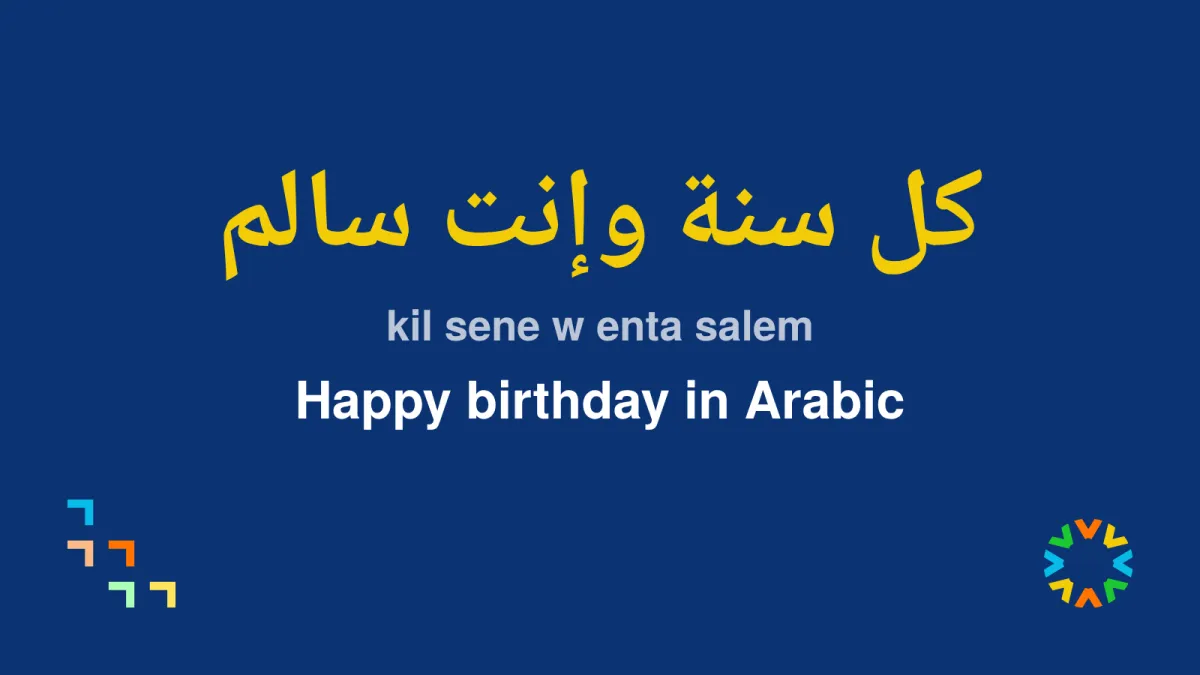
The textbook way to say happy birthday in Arabic is eid milad sa'id (عيد ميلاد سعيد). It's what you'll see written on a cake or a card. But if you're standing in a living room in Damascus or Beirut, what people actually say is kil sene w enta salem (كل سنة وإنت سالم), "may you be well every year."
Here are both, what they mean, which one to use with whom, and what to say back.
Eid milad sa'id, word by word
Eid (عيد) means a celebration or a feast day. Milad (ميلاد) means birth. Sa'id (سعيد) means happy. So it's "happy birth feast," which is about as literal a translation of "happy birthday" as you can get.
It's correct, it's understood everywhere, and you can say it out loud as easily as you can write it on a card. I say it myself. But it's only half the picture, because the wish Arabs reach for most often isn't a translation of "happy birthday" at all.
What people really say: kil sene w enta salem
In the Levant, the wish you'll hear most is kil sene w enta salem. Kil sene is "every year," and w enta salem is "and you're safe and well." The idea is "may every year find you well."
It changes with the person you're talking to:
- To a man: kil sene w enta salem (كل سنة وإنت سالم)
- To a woman: kil sene w enti salme (كل سنة وإنتِ سالمة)
- To a group, or politely to one person: kil sene w entu salmin (كل سنة وإنتو سالمين)
You'll also hear kil sene w enta b-khair (كل سنة وإنت بخير), "may every year find you well," which is just as common in the Levant. In Egypt the favorite is kol sana w enta tayyeb (كل سنة وإنت طيب). In Modern Standard Arabic the same wish is kull 'am wa antum bikhair (كل عام وأنتم بخير), and that's the version you'll see in formal messages and on social media.
The best thing about this phrase is that it isn't only for birthdays. The same words work for Eid, for the start of Ramadan, for Christmas and for New Year. Learn it once and you have the right thing to say at almost every celebration in the year.
'O'bal el-miyye: may you reach a hundred
After the wish, a lot of people add 'o'bal el-miyye (عقبال المية), "may you reach a hundred." 'O'bal is a lovely little word that means "may the same come to you," and you'll hear it at weddings and graduations too. At a birthday it turns into "here's to a hundred more."
The Arabic birthday song
When the cake comes out, most Arab families sing sana helwa ya gamil (سنة حلوة يا جميل), "a sweet year, beautiful one." It's an Egyptian song, which is why it's often sung with the Egyptian gamil, and in the Levant you'll hear plenty of families sing jamil instead. Plenty of families sing "Happy Birthday" in English right after it, and nobody finds that strange.
How to reply
- W enta salem (وإنت سالم), "and you too," is the natural answer to kil sene w enta salem. To a woman it's w enti salme.
- Allah ysallmak (الله يسلمك), "God keep you safe," is another warm reply. To a woman, ysallmik.
- Tislam (تسلم), "bless you," said to a man, or tislami to a woman, is a warm thank you that works for any wish.
- Shukran always works. More on that in thank you in Arabic.
A few birthday words worth knowing
If someone asks your age, they'll say addeish 'omrak? (قديش عمرك؟), "how old are you?" To say someone just turned an age, Levantine uses sar 'omro, "his age became," so sar 'omro tlatin is "he turned thirty." And if you want to add a little affection, put habibi or habibti at the end of the wish. "Kil sene w enti salme, habibti" is exactly what a mother says to her daughter.
Hear it in real conversations
At the start of a call with Maha, I ask how she's doing and she tells me, almost in passing, "mbareh kan eid miladi," "yesterday was my birthday" (1:50). I wish her "eid milad sa'id!" and she answers "merci, merci, tislam," before I ask her what she did for her birthday (2:06).
Every video on Arabic All The Time is made to be understood from the first minute, with free videos at every level. For the Arabic people actually speak in Syria, Lebanon, Jordan and Palestine, start with Levantine Arabic. And if you're starting from zero, here's how to learn Arabic step by step.
Frequently Asked Questions
How do you say happy birthday in Arabic?
Eid milad sa'id (عيد ميلاد سعيد) is the direct translation and is best for cards and messages. In conversation, most people say kil sene w enta salem (كل سنة وإنت سالم), "may you be well every year."
How do you say happy birthday in Arabic to a girl?
Say kil sene w enti salme (كل سنة وإنتِ سالمة). Eid milad sa'id stays the same for everyone.
What does kol sana wa enta bikhair mean?
It means "may every year find you well." It's used all over the Arab world, alongside kil sene w enta salem in the Levant and kol sana w enta tayyeb in Egypt.
How do you reply to kil sene w enta salem?
Say w enta salem, "and you too," or w enti salme to a woman. Allah ysallmak and shukran also work.
What is the Arabic birthday song?
Sana helwa ya gamil (سنة حلوة يا جميل), "a sweet year, beautiful one." It comes from Egypt and is sung at birthdays across the Arab world.
Do Arabs celebrate birthdays?
Many do, with a cake, candles and the song. Some religious families don't celebrate birthdays at all, and for them kil sene w enta salem is still the wish they use on Eid and other occasions.