A guest post by Toby Urff, founder of Reelang.
If you've been watching Arabic All The Time for a while, you know the idea behind it: you acquire Arabic by understanding messages, not by memorizing rules. That's why its library runs from complete beginner to advanced, in both Modern Standard Arabic and Levantine, with new videos added daily.
But those videos are designed input. They slow down, repeat, draw and use gestures, so that you understand almost everything. Native Arabic does you no such favors. Here is what it sounds like when nobody slows down. Om Sayf is about to make Japanese ice-cup coffee at home:
"Japanese restaurants serve your coffee inside a cup made of ice, and it costs fifty dollars. So I said: why would I pay fifty dollars? I'll make it at home."
So the question is not whether to watch native Arabic. It's when, and what to listen for once you do.
When native content starts to pay off
Native content doesn't open up all at once. As Arabic All The Time's guide on how to get your 2,500 hours of Arabic input explains, somewhere between 500 and 1,000 hours, highly visual and well-edited videos start to make sense: cooking videos, vlogs, travel shows, anything where the picture carries part of the meaning. Interviews and podcasts come after that.
By Level 5 on Arabic All The Time's seven-level roadmap, Bridging to Native (1,000 to 1,700 hours), everything made for learners is easy, and native content on familiar topics opens up with effort.
Before about 500 hours, native videos mostly teach you that you're lost. After it, the right ones are great input, and the clips I picked for this post are exactly that kind: people cooking and talking at home.
Why native video is in dialect
Arabic is diglossic. MSA is the language of writing, and when it's spoken it's mostly read from a script: news bulletins, speeches and sermons. Everything else, from family dinners to vlogs to arguments about potatoes, happens in dialect. So the native videos you'll want to watch, people cooking and talking at home, are almost all in dialect. If you're on the Levantine track, that means Shami.
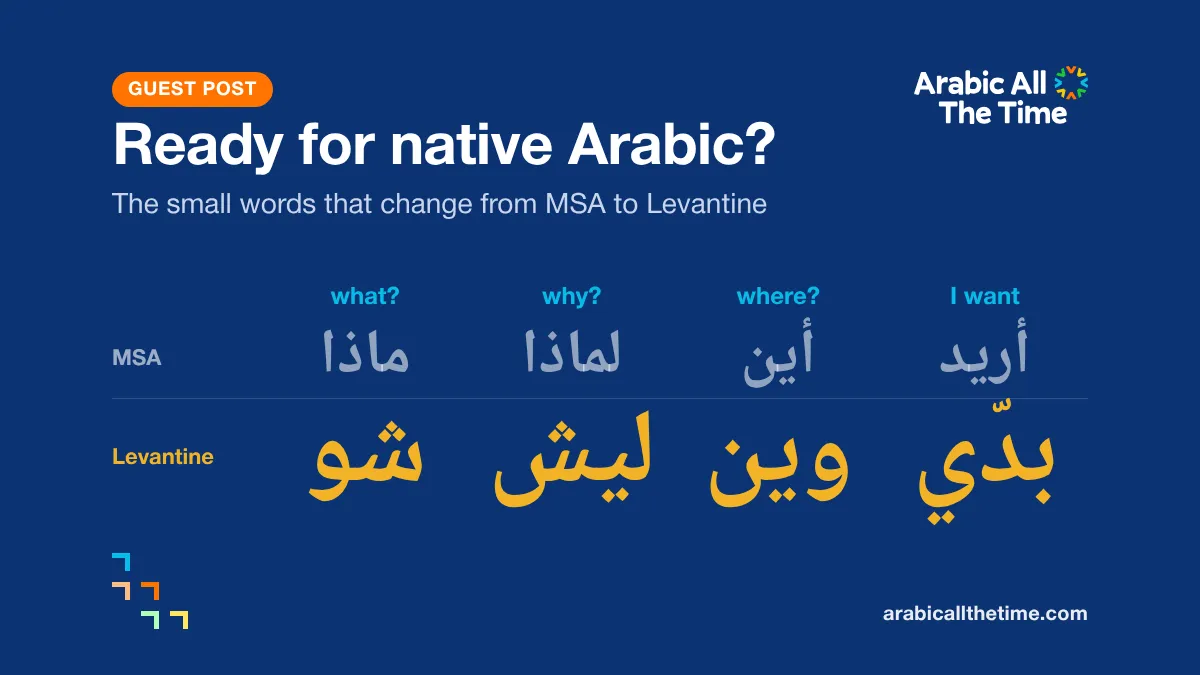
The grammar you already know carries over. What changes first are a handful of very small, very frequent words: question words, "want", and the little particles for "right now" and "going to".
The words that change between MSA and Levantine
These are the pairs to listen for. The Levantine forms are standard in any grammar of the dialect:
| Meaning | MSA | Levantine |
|---|---|---|
| what? | ماذا / ما | شو |
| why? | لماذا | ليش |
| where? | أين | وين |
| I want | أريد | بدّي (بدّك، بدّو…) |
| like this, so | هكذا | هيك |
| will, going to | سوف / سـ | رح |
| -ing, right now | (no particle) | عم |
| who, which, that | الذي / التي | اللي |
How often do you actually meet them? At Reelang, we counted them in our transcripts of short native Levantine videos, the vlogs, sketches and cooking clips we show learners, using only videos whose dialect a native speaker confirmed (1,355 of them):
- شو appears in 52% of those videos
- بدّي and its forms in 43%
- عم in 41%
- هيك in 31%
- ليش in 23%
- رح in at least 22%
- وين in 20%
So about every second native Levantine video has a شو in it. A 2026 study of TV-show speech came to the same list from a different direction: in its analysis of the SADA corpus, شو, بدّي, هيك, كتير and عم are among the ten words that most set Levantine apart from the other varieties, while الذي and التي are among the ten that most set MSA apart.
If you came up through MSA, each of these words is a small stumble until it becomes automatic. This is also why Arabic All The Time starts learners on a spoken dialect: no one asks "ماذا تفعل؟" in their kitchen.
شو عم تعملي؟ (What are you doing?)
One of the first sentences you'll catch has two of those words in it. Bilal walks into the kitchen and finds Aya peeling potatoes with a knife:
"Aya, what are you doing?" "Cutting potatoes." "With the knife? Then why did I buy this peeler?"
MSA has no particle for this; its present tense covers both "you do" and "you're doing". Levantine adds عم for the second: بتعملي is "you do", عم تعملي is "you're doing", right now. Once you notice it, you'll hear it in about four out of ten native videos.
شو راح نعمل؟ (What are we going to make?)
The future is just as small. Nada can't decide between tabbouleh and fattoush, so she makes both:
"I feel like tabbouleh, and I feel like fattoush, so what are we going to make? Fattouleh." And then: "Tell me, what are you having for lunch today?"
Where MSA says سوف or puts سـ on the verb, Levantine often says رح. Spellings vary, because the dialect has no official one: you'll see رح and راح for the same word. Notice also that she never says الآن. In Levantine, "now" is هلّق (also written هلّأ), which is how Om Sayf starts her sentence in the clip at the top.
شو بدّي احكيلكم؟ (What can I tell you?)
Some of these words also live inside fixed expressions. Mariam's husband is coming home from a trip, so she bakes his favorite lemon cake:
"After thirty-five minutes it's done, and the smell... what can I tell you? Just look at it. Come on, let's flip it."
Word for word, شو بدّي احكيلكم is "what do I want to tell you": she has no words for how good it smells. And يلا (come on, let's go) turns up in a third of native Levantine videos.
How to fit this into your week
Keep comprehensible input as your daily base. That's the job Arabic All The Time's videos were made for, and nothing in this post replaces it. Then, once you're past about 500 hours, add ten or fifteen minutes of short native clips on top, and more as you move toward Level 5:
- Pick by topic. Cooking and family videos are the easiest place to start, because the pictures carry the meaning.
- Listen for the small words first. When شو, عم, رح, بدّي and هيك stop costing you anything, whole sentences open up around them.
- Use Arabic subtitles if you want them, not English ones. At this level, reading along in Arabic helps you connect the sounds to words you already know from MSA.
- Use the same rule as on Arabic All The Time. Watch where you follow 80 to 90 percent of the meaning. When a clip is too hard, swipe to the next one. No guilt.
The clips in this post come from Reelang, which I built. It's a free feed of short native videos, a bit like TikTok, except every clip is graded for difficulty: not just the words, but how fast and how clearly people speak. You set your level and it shows you native videos you can almost understand. It separates the dialects, so you can stay in Levantine, stay in MSA, or mix both, the same two tracks you'll find on Arabic All The Time. Reelang's dialect tags started out as AI guesses; native speakers now check them, and every number in this post comes from clips a native reviewer confirmed. You'll also find Arabic All The Time's videos in the feed.
About the discount
Reelang is free to use, and the free feed is enough to start. If you later want the paid extras (longer videos, smarter subtitles), the links in this post carry Arabic All The Time's code AATT, which gives you 20% off Reelang+ for as long as you subscribe. It applies automatically when you arrive through any link here.
A note from Arabic All The Time: if you subscribe to Reelang+ through these links, Reelang shares a commission with us. It costs you nothing extra (you pay less, actually) and it helps us keep making new videos.