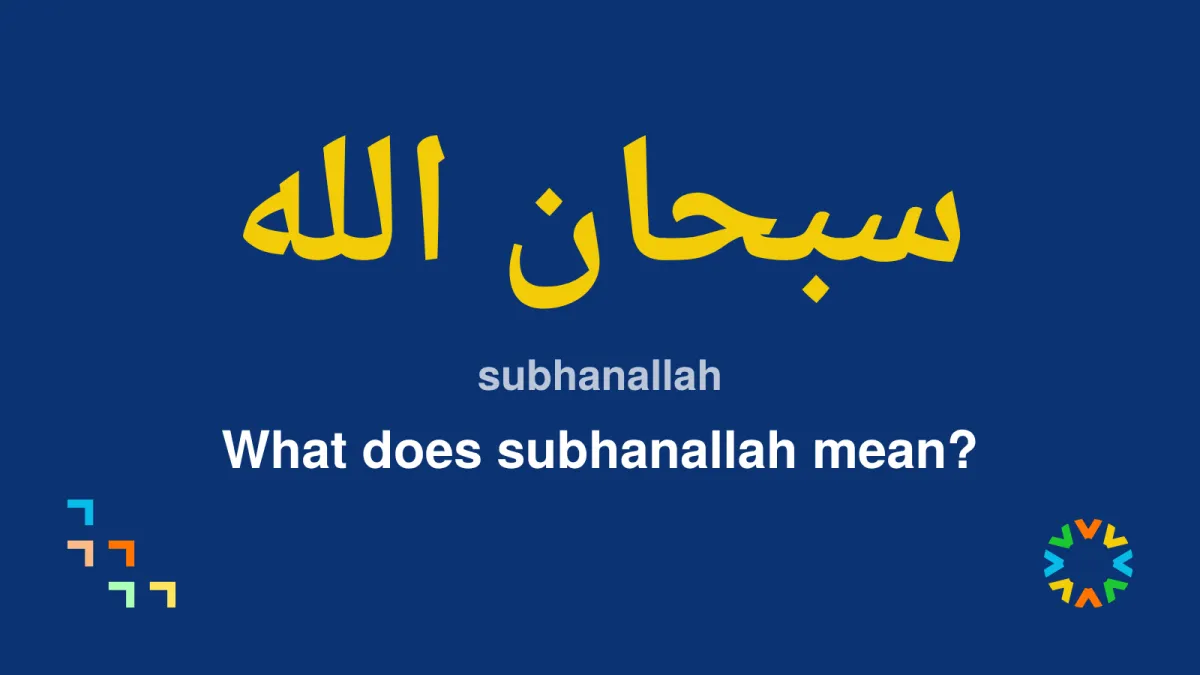
Subhanallah (سبحان الله) means "glory be to God." The idea behind it is that God is above any flaw, and Arabs say it whenever something leaves them in awe: a beautiful view, a newborn's tiny hands, a coincidence too strange to explain.
It's one of the phrases you'll hear most in any Arab home, and it does more than one job. The same two words can mean "wow," "how strange" or "that's life," and the tone tells you which.
What subhanallah means, word by word
It's two words. Subhan (سبحان) means glory, in the sense of declaring something far above any fault. Allah (الله) means God. Together, "glory be to God."
Subhan comes from the root s-b-ḥ (س ب ح). The same root gives tasbih (تسبيح), glorifying God, and misbaha (مسبحة), the string of prayer beads you'll see in so many hands in Damascus and Amman. In Syria people often call the beads a sebha.
In speech it runs together into one word, subhanallah. You'll see it written subhanallah, subhan Allah or SubhanAllah. They're all the same phrase.
When Arabs say subhanallah
- Beauty. The sea at sunset, snow on the mountains, a baby's face. Subhanallah here is wonder at how something so beautiful came to be.
- Coincidence. You were just thinking about your cousin and she calls. "Subhanallah, kint 'am fakker fiki!" (سبحان الله كنت عم فكر فيكي), "subhanallah, I was just thinking about you!"
- Something hard to believe. Strange news, a story that makes no sense. Said slowly, with a shake of the head, it's "how strange" or "can you believe it."
- Hard news. When someone passes away or life turns suddenly, subhanallah is a quiet way of saying "this is beyond us."
In Syria and Lebanon you'll also hear subhan el-khale' (سبحان الخالق), "glory to the Creator." It's what an aunt says when she sees how beautiful a bride looks, or how much a child has grown.
Subhanallah in prayer
Subhanallah is also a phrase of worship. Many Muslims say it 33 times after each prayer, together with alhamdulillah and Allahu akbar, counting on their fingers or on the misbaha. That counting is also called tasbih.
You'll often hear the longer form subhanallahi wa bihamdihi (سبحان الله وبحمده), "glory be to God, and praise be to Him." A well-known hadith in Sahih al-Bukhari names two phrases as light on the tongue and heavy on the scale: subhanallahi wa bihamdihi, and subhanallahil-'azim (سبحان الله العظيم), "glory be to God, the Almighty."
Subhanallah, mashallah or alhamdulillah?
Learners mix these three up all the time, because they all come up around good things. The difference is what you're reacting to.
Mashallah is for admiring something good about a person: your friend's new job, how well your son is doing. Alhamdulillah is for gratitude: you're fine, the exam went well, everyone got home safely. Subhanallah is for wonder and surprise: the view, the coincidence, the news you can't quite believe.
A newborn can get all three. Mashallah, she's beautiful. Subhanallah, look at her tiny fingers. Alhamdulillah, the mother is well. More on the other two in what does mashallah mean? and what does alhamdulillah mean?
Is subhanallah only for Muslims?
The phrase comes from Islam and from the Quran, and for many Muslims it's an act of worship every time they say it. In everyday life in the Levant, Arab Christians say subhanallah too, for the same moments of wonder and surprise. If you say it sincerely, it will always be heard as respectful.
How to reply to subhanallah
There's no set reply, because subhanallah is a reaction, not a greeting. Most of the time you simply agree. Repeat it, nod, or say wallah, "really." If someone says it about your child or your home, it's a compliment, and a shukran or Allah ykhallik, "God keep you," is a warm answer.
Hear it in real conversations
Subhanallah tends to slip out at moments nobody is filming, like a sunset from a car window or a phone call from someone you were just thinking about. What you'll hear in my videos is the awe right next to it. On a long hike to see the autumn leaves, someone lets out an "Allah, wow, wow" (11:58). That's exactly the kind of moment that makes people say subhanallah.
Every video on Arabic All The Time is made to be understood from the first minute, with free videos at every level. For the Arabic people actually speak in Syria, Lebanon, Jordan and Palestine, start with Levantine Arabic. And if you're starting from zero, here's how to learn Arabic step by step.
Frequently Asked Questions
What does subhanallah mean in English?
Subhanallah means "glory be to God." In everyday speech it works like "wow," "how amazing" or "how strange," depending on the moment.
When do you say subhanallah?
When something leaves you in awe or surprised: a beautiful view, a strange coincidence, news that's hard to believe. Many Muslims also say it 33 times after each prayer.
What is the difference between subhanallah and mashallah?
Mashallah is for admiring something good about a person or their life. Subhanallah is for wonder and surprise, at nature, at a coincidence or at something you can't explain.
How do you spell subhanallah?
In Arabic it's two words, سبحان الله. In English you'll see subhanallah, subhan Allah and SubhanAllah, and all of them are correct.
What does subhanallahi wa bihamdihi mean?
"Glory be to God, and praise be to Him." It's a longer form that many Muslims repeat as remembrance of God.
Can non-Muslims say subhanallah?
Yes. Arab Christians use it in daily life, and anyone who says it sincerely will be understood as showing respect and wonder.