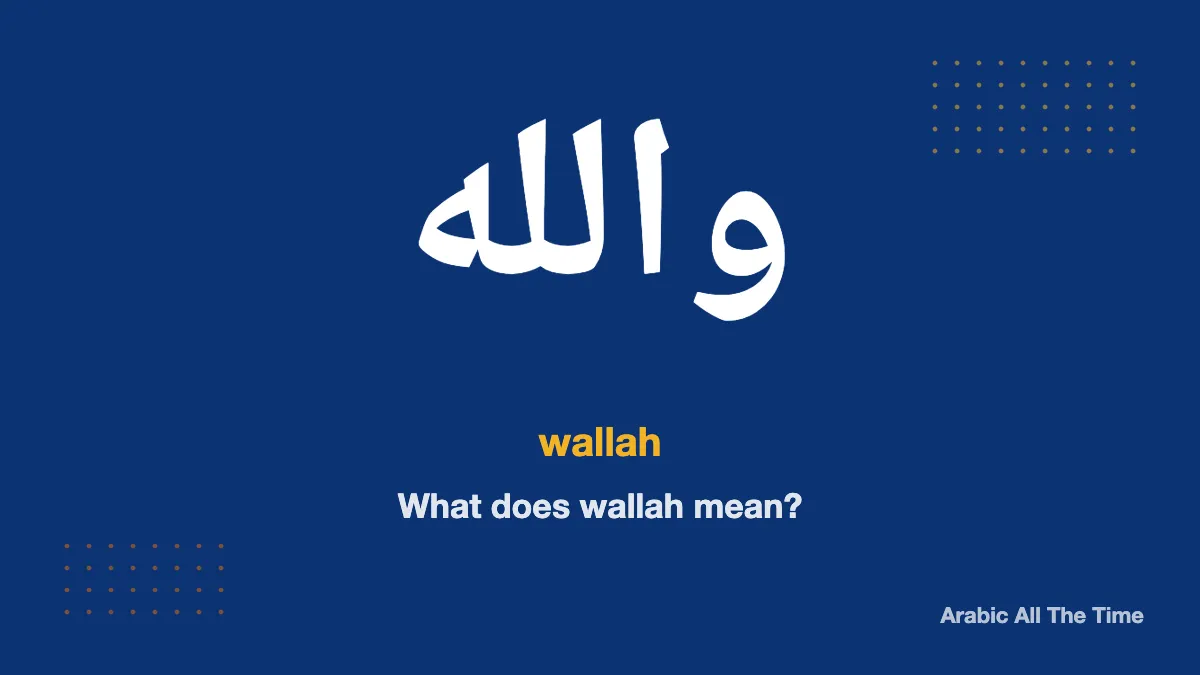
Wallah (والله) literally means "by God," an oath. In everyday Arabic it mostly works like "really," "honestly" or "I swear," and people use it to add weight to whatever they're saying.
You'll hear it constantly, sometimes several times in one sentence. Learners usually understand the literal meaning and miss the real one, which depends almost entirely on tone.
What wallah means, word by word
It's two parts. Wa (و) here is the Arabic "by" used in oaths, and Allah (الله) is God. So wallah is "by God," the same structure as "I swear to God" in English. In formal Arabic and in the Gulf you'll also hear wallahi (واللهِ, with a final vowel).
How people really use wallah
- To insist. "Wallah ma 'refet," "I swear I didn't know." Here it means "honestly, believe me."
- To ask "really?" Someone tells you surprising news and you answer "wallah?" with a rising voice. It works like "seriously?"
- "No, really." La wallah (لا والله) is a soft, honest no, as in "no, really, I hadn't heard."
- To refuse politely. When a host insists you eat more, "la wallah, shbe't" is "no, really, I'm full."
- For a big promise. Wallah el-'azim (والله العظيم), "by God the Almighty," is the heavy version. People save it for when they really need to be believed.
Wallah and 'an jad
The closest non-religious word is 'an jad (عن جد), "seriously." In the Levant you'll often hear them together, as in "wallah 'an jad," "I swear, seriously." If you'd rather not swear by God in casual speech, 'an jad does the same job.
Is it rude or religious to say wallah?
It's an oath, and some religious people avoid using it lightly, because swearing by God about small things, or swearing falsely, is taken seriously in Islam. In daily life, though, wallah is everywhere, said by Muslims and Arab Christians alike, and nobody hears it as rude. If you say it, say it about something true.
Wallah, yalla and khalas
Wallah belongs to a small group of words learners hear long before they understand them, along with yalla, "come on," and khalas, "enough" or "done." You don't learn these from a definition. You pick them up from hearing them in dozens of situations, until the tone tells you what each one means.
Hear it in real conversations
When Maha mentions in passing that her mother is Russian, I answer "la wallah, ma ba'ref," "no, really, I didn't know," and she asks "'an jad?", "seriously?" (17:32). In another conversation I ask her if she knows anything about the Tuareg, and she answers with a simple "la wallah," "no, honestly" (8:13). When she talks about English feeling like a second mother tongue, you'll hear wallah and 'an jad in the same sentence (5:19). And when I ask her whether she regrets leaving her lab job, she answers with the heavy version, "la wallah el-'azim" (21:52).
You’ll hear inshallah and alhamdulillah in the same conversations.
Every video on Arabic All The Time is made to be understood from the first minute, with free videos at every level. For the Arabic people actually speak in Syria, Lebanon, Jordan and Palestine, start with Levantine Arabic.
Frequently Asked Questions
What does wallah mean in English?
Literally "by God." In everyday speech it means "really," "honestly" or "I swear."
What does la wallah mean?
"No, really." It's an honest, soft no, often used to say you didn't know something or to politely refuse more food.
What is the difference between wallah and wallahi?
They mean the same thing. Wallahi keeps the final vowel of the classical form and is especially common in the Gulf. In the Levant you'll hear wallah most.
Is it disrespectful to say wallah?
Not in everyday use. It's an oath, so some religious people avoid it in casual speech, and you should never use it about something false.
Can non-Muslims say wallah?
Yes. Arab Christians use it all the time, and when anyone says it naturally, it doesn't sound out of place.
What does wallah 'an jad mean?
"I swear, seriously." It's two ways of saying "really" stacked together for extra emphasis.