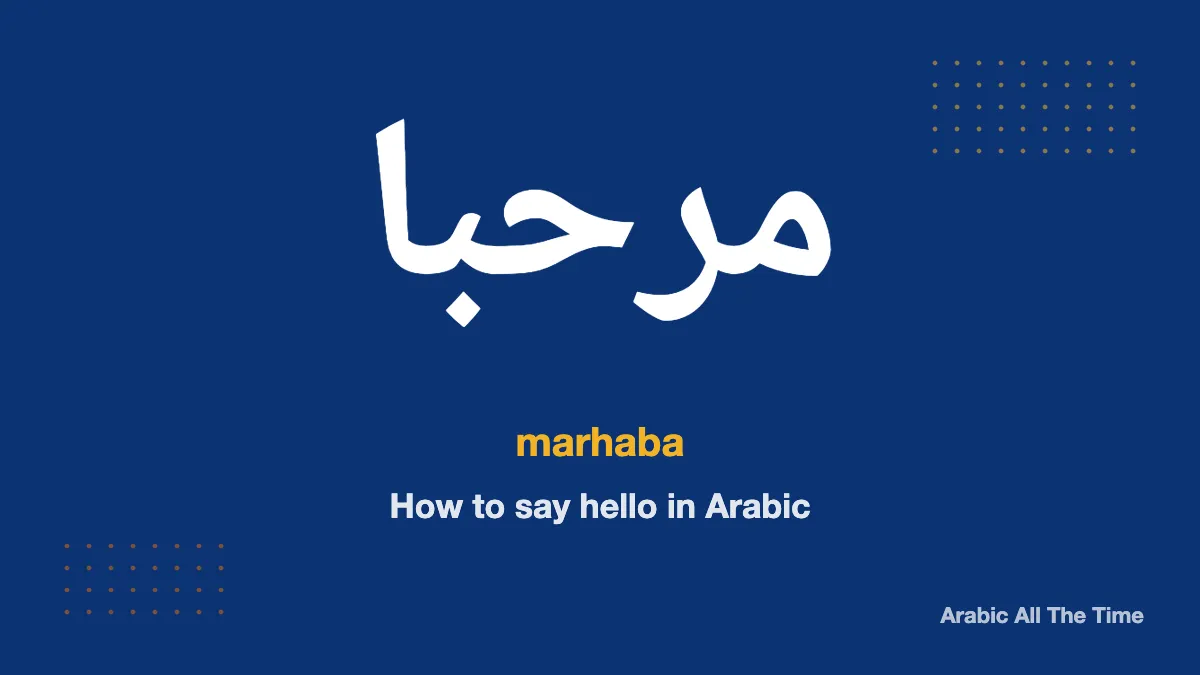
The everyday way to say hello in Arabic is marhaba (مرحبا). It's what you'll hear walking into a shop in Damascus or picking up the phone in Beirut. As-salamu alaykum (السلام عليكم) works in every Arab country, and ahlan (أهلا) is the friendly one.
Which one you choose says a little about the situation, and what people say back matters as much as the hello itself. Arabic greetings are usually a pair, and the reply is part of the greeting.
Marhaba, the everyday hello
Marhaba is the hello I grew up with in Syria, and it's the same in Lebanon, Jordan and Palestine. It's polite enough for a stranger and casual enough for a friend.
The word comes from the root r-ḥ-b (ر ح ب), which has to do with space and openness. The same root gives rahb (رحب), wide or spacious. Marhaba is an old way of telling a guest they've arrived somewhere roomy and welcoming. You don't think about any of that when you say it, but it's a nice thing to know.
To answer marhaba, you can say marhaba back. In the Levant people also love to double it.
- Marhabtein (مرحبتين), "two hellos," is a playful, warm reply.
- Ahlein (أهلين), "two welcomes," works the same way.
Ahlan and ahlan wa sahlan
Ahlan on its own is a friendly hi. Ahlan wa sahlan (أهلا وسهلا) means "welcome," and it's what you say when someone arrives at your home, your shop or your table. Literally it says the guest has come to family (ahl) and to easy, level ground (sahl).
The reply changes with who you're talking to. In Levantine Arabic you say ahlan fik (أهلا فيك) to a man, ahlan fiki (أهلا فيكي) to a woman and ahlan fikon (أهلا فيكن) to a group. In Modern Standard Arabic it's ahlan bika (أهلاً بكَ). In everyday Levantine speech you'll hear ahlan bik just as often as ahlan fik.
As-salamu alaykum, the greeting of peace
As-salamu alaykum means "peace be upon you," and the reply is wa alaykum as-salam (وعليكم السلام), "and upon you peace." It's an Islamic greeting used by Muslims all over the world, and in Arab countries it's also a common polite hello when you walk into an office, a shop or a room full of people.
In Syria and Lebanon, where Muslims and Christians live side by side, you'll hear marhaba more in daily life. If someone greets you with as-salamu alaykum, replying wa alaykum as-salam is always polite.
Hala, hi and the Lebanese mix
- Hala (هلا) is a casual hi, common in Jordan, Syria and the Gulf.
- Hi and hello are used as they are, especially by younger people.
- In Beirut, the famous three-language greeting is "Hi, kifak, ça va?" English, Arabic and French in one breath. People joke about it, but they really do say it.
Hello in Levantine and in formal Arabic
Most greetings are the same in spoken and formal Arabic. The difference shows up in the replies and the small words around them. A textbook might teach ahlan bika and kayfa haluk, "how are you." In a Damascus street you'll hear ahlan fik or ahlan bik, and kifak. Both are Arabic, and if you want to talk with people, you need the spoken ones. I wrote more about that in MSA or a dialect, which first?
After the hello, the next thing anyone says is "how are you," kifak (كيفك) to a man and kifik to a woman in Levantine Arabic. Arabic greetings take a little longer than English ones, and that's part of the warmth.
Hear it in real conversations
Most of my videos start with the same hello. In one with my twin sisters, I open with "marhaba, ana Hasan, ahlan wa sahlan bikon," "hello, I'm Hasan, welcome" (0:38). Then I welcome Yasmine and Lutas with "ahlan wa sahlan fikon," and they both answer "ahlan bik Hasan" (1:18). In a conversation with Maha, I welcome her, she answers "ahlan bik," I ask "kifik el-yom?", "how are you today?", and she asks me back, "kifak enta?" (0:33).
Every video on Arabic All The Time is made to be understood from the first minute, with free videos at every level. For the Arabic people actually speak in Syria, Lebanon, Jordan and Palestine, start with Levantine Arabic.
Frequently Asked Questions
How do you say hello in Arabic?
Marhaba (مرحبا) is the everyday hello. As-salamu alaykum works in every Arab country, and ahlan is a friendly hi.
What does marhaba mean?
Marhaba means hello. It comes from an old Arabic word for welcoming someone to a wide, open place, and today it's simply the everyday greeting in Syria, Lebanon, Jordan and Palestine.
How do you respond to marhaba?
Say marhaba back. In the Levant people also answer marhabtein, "two hellos," or ahlein, "two welcomes."
What does ahlan wa sahlan mean?
Ahlan wa sahlan means welcome. You say it when someone arrives. The reply in Levantine Arabic is ahlan fik to a man, ahlan fiki to a woman or ahlan fikon to a group.
Can non-Muslims say as-salamu alaykum?
Yes, anyone can say it. It's an Islamic greeting, and many Arabs of other faiths prefer marhaba. If someone says as-salamu alaykum to you, answering wa alaykum as-salam is always polite.
How do you say hello in Lebanese Arabic?
Marhaba, the same as in Syria, Jordan and Palestine. Lebanese people also mix in hi and the French ça va, as in the well-known "Hi, kifak, ça va?"